
Reviewed · BARCELONA WALKING TOURS
Barcelona: “The Secret of Cerdà” Treasure Hunt Walking Tour
Barcelona’s city center becomes an outdoor escape room in this self-guided treasure hunt. You follow an eccentric architect’s plans, visit five major sights, spot small details, and solve codes that open the locks on a treasure box. It is part sightseeing walk, part puzzle game, with a story tied to Barcelona’s past.
I like the freedom to stop for photos, food, or shopping rather than march behind a guide. I also like the private format, which lets your own group work at its own speed. The main catch is that the route can take longer than the advertised two hours, especially if you pause at each landmark or need extra time with the puzzles.
- A private city-center puzzle walk: Your group plays alone rather than joining strangers.
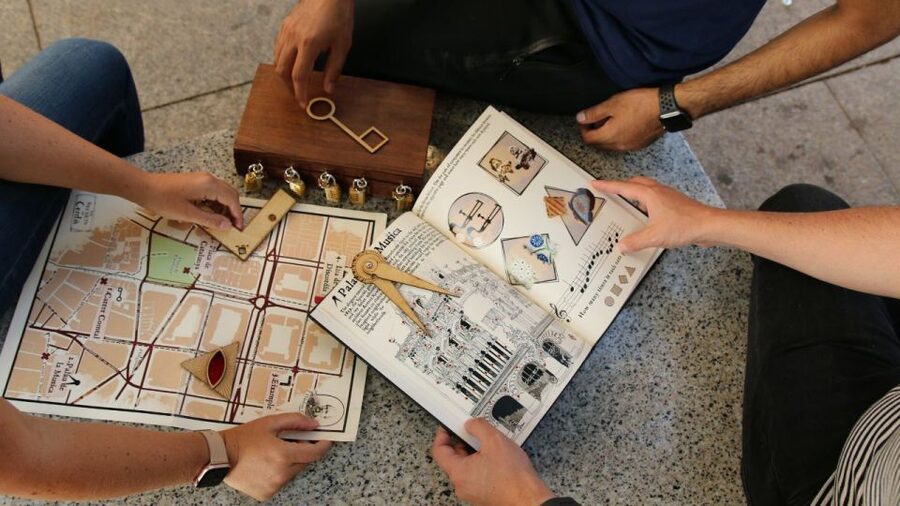
- A backpack full of tools: You receive a treasure map, challenge book, treasure box, and puzzle-solving equipment.
- Five major Barcelona stops: The route links the Illa de la Discòrdia, Gothic Quarter, Eixample, Plaça de Catalunya, and Palace of Catalan Music.
- A flexible 2.5-hour outing: The game takes about two hours, with extra time available for food, shopping, and photographs.
- Useful help when a clue is tough: QR codes can support you through the harder puzzles.
- Good for families with older children: Children age 7 and up can play with parents, though the activity is designed mainly for adults.
A Barcelona sightseeing walk with a locked treasure box
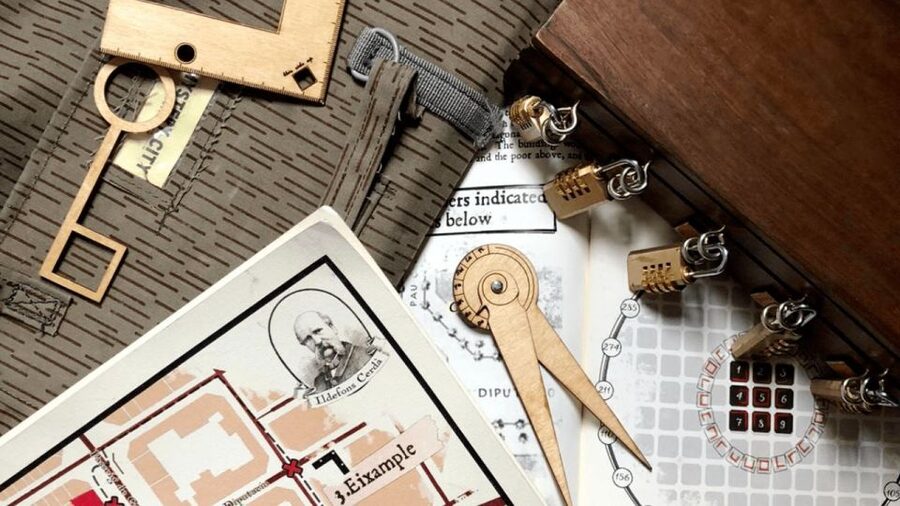
The experience begins at Carrer de Trafalgar, 17, near Plaça Urquinaona. You pick up a backpack containing the equipment for the game, then set off with your map and challenge book.
The story centers on an eccentric Barcelona architect who hid clues in his plans for the city. The name The Secret of Cerdà points toward Ildefons Cerdà, the planner linked with Barcelona’s Eixample district, though the supplied description keeps the story playful rather than academic. You are not simply walking from one address to another. Each stop gives you a piece of the mystery and a puzzle connected to the treasure box.
The private setup matters. You can debate a clue with your own family or friends without worrying about slowing down another group. It also makes this a good choice for people who find standard group tours too rigid.
You should not expect a live guide to explain every building. A host or greeter helps you begin, but the main experience is self-guided. Instructions and materials are available in English, Spanish, Catalan, and French.
Illa de la Discòrdia and Barcelona’s competing façades
The route takes you first to the Illa de la Discòrdia, one of the city’s best-known stretches of architecture. This block is famous for several striking buildings placed close together, making it a natural setting for a puzzle based on visual details.
You will have about 20 minutes here. That is enough time to examine the façades, take pictures, and work through the first challenge without turning the stop into a full architectural visit.
This is one of the clever ideas behind the activity. You are encouraged to look closely instead of merely walking past a famous sight. Decorative shapes, balconies, colors, and other small features can become useful when a puzzle asks you to notice what is in front of you.
The limitation is simple: 20 minutes is not enough for a detailed visit to every building. Treat this stop as an introduction and a clue station, then return later if one of the façades catches your eye.
More Barcelona Walking Tours:
- Barcelona Tapas and Wine Experience Small-Group Walking Tour
★ 5.0 · 5,804 reviews - Barcelona: Tapas Walking Tour with Food, Wine, and History
★ 4.8 · 4,261 reviews - Barcelona Tapas Walking Tour: Food, Wine & History
★ 4.5 · 1,928 reviews
The Gothic Quarter turns into a puzzle board
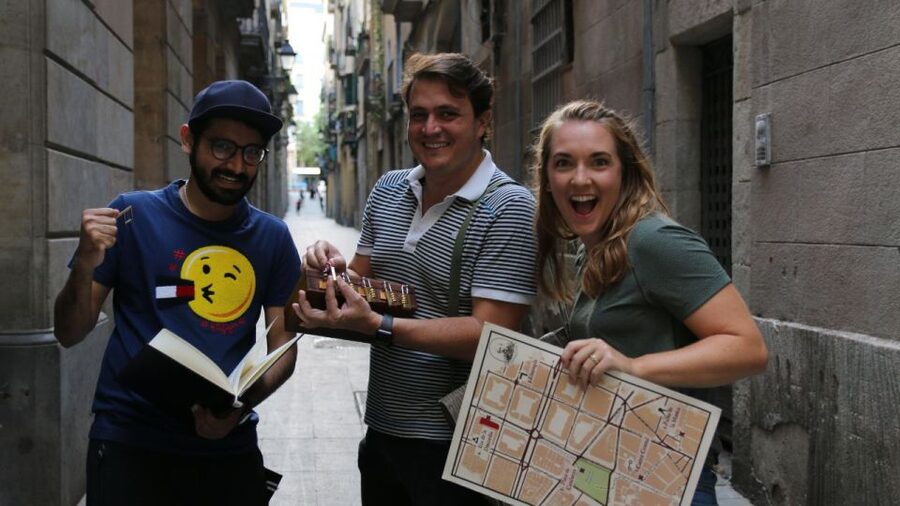
From the modernist façades of the Illa de la Discòrdia, the route moves toward the Gothic Quarter. The change in setting gives the walk variety. Here, narrow streets and older buildings provide a different kind of visual challenge than the broad Eixample avenues.
You are scheduled to spend about 20 minutes sightseeing here. The challenge may encourage you to notice a doorway, sign, architectural detail, or tucked-away corner that you might otherwise pass without a second look.
This part of the route is especially useful for first-time visitors who want a quick introduction to central Barcelona. You see a major historic district while also having a reason to pay attention to the details around you.
Keep your sense of direction switched on. The Gothic Quarter is a maze-like area, and puzzle solving can make you focus so closely on the book or map that you stop noticing where you are. Stay with your group and allow a little extra time if you enjoy stopping for photos.
Eixample and the city plan behind the story
The Eixample district gives the game its strongest connection to city planning. Its broad streets and regular blocks are a sharp contrast to the tighter lanes of the Gothic Quarter. That contrast helps you understand why Barcelona’s layout feels so different from one neighborhood to the next.
The route includes roughly 20 minutes here. Rather than treating the district as a long lecture, the activity uses the city plan as part of the mystery. The map and clues ask you to connect the place around you with the story in the challenge book.
I like this approach because it gives you a reason to think about Barcelona’s design while walking. You are not just checking off another district. You are using the streets as part of the game.
You should keep your expectations in check. This is not a specialist architecture tour, and the information is delivered through puzzles rather than a detailed guide talk. If you want a serious study of Cerdà’s urban planning, you will need a separate visit or tour.
Plaça de Catalunya brings the route into the open
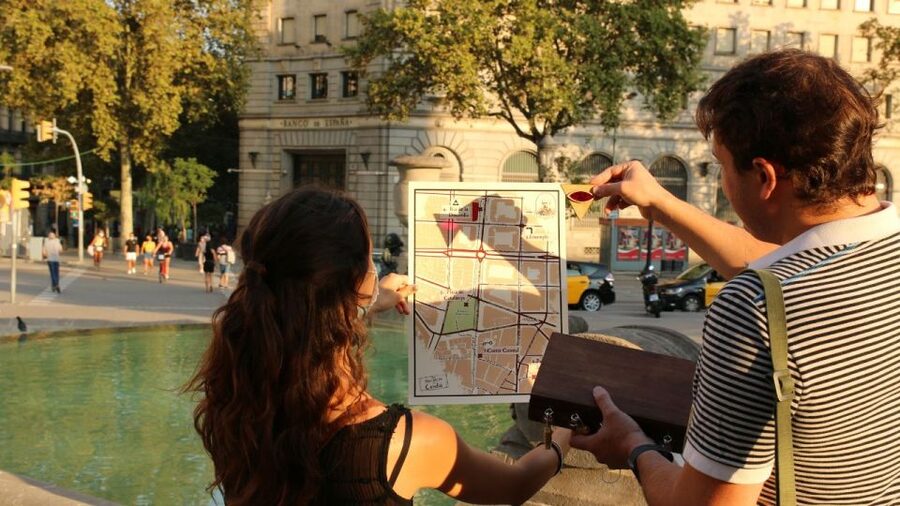
Plaça de Catalunya is one of the city center’s main meeting points, and it gives the route a more open setting after the enclosed feel of the Gothic Quarter. The square is also a practical place to pause, check the map, and regroup.
The planned sightseeing time is about 20 minutes. You may use that time to search for a clue, take photos, or simply get your bearings before the next challenge.
Large public squares can be harder for puzzle solving than quiet streets. There may be more visual information competing for your attention, and your group may need to agree on exactly what the clue is asking. That can be part of the fun, but it may also slow you down.
The square is a useful reminder that this activity is not only about finding obscure corners. It mixes famous public places with close observation, so you get a recognizable Barcelona route without losing the game element.
A different sort of day out in Barcelona:
- Barcelona: Park Güell Admission Ticket
★ 4.4 · 76,534 reviews - Barcelona: Casa Batlló Entry with Self-Audioguide Tour
★ 4.7 · 25,359 reviews - Barcelona: 24 or 48-Hour Hop-On Hop-Off Bus Tour
★ 4.4 · 20,872 reviews - Barcelona: Park Guell Guided Tour with Skip The Line Entry
★ 4.7 · 17,563 reviews
Palace of Catalan Music adds a dramatic finish
The Palace of Catalan Music is the final named stop in the route. Its decorative exterior makes it a natural place for a visual challenge, and the building gives the walk a strong architectural finish.
You are given about 20 minutes here. As with the other stops, the activity focuses on seeing and solving rather than entering for a full performance-hall visit. The supplied details do not include admission to the palace, so you should treat this as an exterior sightseeing stop unless your own plans include a separate visit.
This is one of the more memorable places on the route because it combines a major cultural landmark with the practical task of finishing a lock. You may find that the pressure to solve the final clue makes you inspect details more carefully than you would on a regular city walk.
After the locks are solved, you return to the starting point to claim the prize. The route also lists Barcelona as a final sightseeing location, but the specific details of that stop are not explained. Think of it as the wider city-center setting and the return leg rather than a separate attraction with a detailed program.
What is inside the backpack
The equipment gives the activity its character. You receive:
- A treasure map
- A treasure box
- A book of challenges
- Magical tools used during the puzzles
The box is not just a prop sitting in your bag. Each location supplies a challenge connected with one of its locks. You work through the clues, enter the codes, and gradually open the box.
The puzzles are intended to be challenging without requiring specialist knowledge. One useful feature is QR-code help for the harder parts. You can use that support if your group gets stuck instead of wasting half an hour on one clue.
That said, this format works best when at least two people enjoy puzzle solving. A solo player has to study the map, read the instructions, inspect the surroundings, and manage the box alone. The activity specifically does not recommend playing alone, and that is sensible advice.
How long does the route really take?
The listed duration is 2.5 hours, while the game itself takes about two hours. The extra half hour gives you room to walk between stops and pause along the way.
In practice, you should not treat two hours as a strict finish time. The route passes through places where you may want to stop for photos, browse shops, or eat. One participant needed more time even without stopping, so a relaxed group should plan for the full 2.5 hours and avoid scheduling an immediate appointment afterward.
The walk is designed as a city-center route, but exact distances between stops are not provided. Comfortable shoes are a sensible choice, especially if you plan to explore beyond the puzzle instructions.
The flexible timing is one of the activity’s better features. You can keep moving if your group is competitive, or slow down if you want the sightseeing part to matter just as much as the game.
Is $26 per person good value?
At $26 per person, this costs more than a free city walk but less than many private guided activities. The value depends on what you want from Barcelona.
If you would otherwise pay for a standard walking tour and a separate family activity, the price can make sense. You get a private experience, prepared materials, a story, and a route through several well-known central areas. The equipment also gives the walk a clear purpose, which can be useful when children or teenagers lose interest during ordinary sightseeing.
The price is less compelling if you mainly want detailed explanations from a local guide. There is no promise of a live commentary throughout the route, and the activity is built around independent problem solving. You are paying for the game design and private use of the materials, not for a long architectural lecture.
For a couple, the cost is reasonable if both people enjoy escape-room puzzles. For a family or small group, the price can be easier to justify because everyone shares the same box and challenge book.
Who will enjoy this most?
I would choose this for adults, teenagers, families with children age 7 and up, and friends who like escape rooms. It is also a good fit if you have already seen some of Barcelona’s headline sights and want a more active way to revisit the center.
The strongest match is a group that likes to cooperate. One person may read the clue, another may study the building, and someone else may handle the lock. That division of tasks keeps the activity moving.
Children under 6 are not suitable for the experience. Younger children may still enjoy the sights, but the supplied age guidance begins at 7, and children should play with their parents.
You should choose something else if you want a quiet, guide-led walk with long explanations. You should also think twice if nobody in your group enjoys codes, maps, or stopping to inspect details. The game is the main event, not a small extra.
Practical details before you reserve
The starting point is Carrer de Trafalgar, 17, near Plaça Urquinaona. You pick up the backpack at the shop and begin from there.
The activity is offered in English, Spanish, Catalan, and French. All bookings are private, so your group does not share the game with other people, even if several groups are playing in the same general area.
It is wheelchair accessible. Still, the route moves through central Barcelona streets, and the supplied information does not describe the surface or exact route conditions at every stop. If detailed accessibility needs are important for your group, confirm the route conditions before booking.
You can cancel up to 24 hours in advance for a full refund, and reserve now while paying later. Starting times depend on availability.
Should you book The Secret of Cerdà?
Book it if you want to see central Barcelona while doing something active with your own group. The mix of the Gothic Quarter, Eixample, Plaça de Catalunya, the Illa de la Discòrdia, and the Palace of Catalan Music gives you a useful city-center route, while the treasure box keeps everyone involved.
I especially recommend it for families with older children and for adults who enjoy outdoor escape rooms. Allow the full 2.5 hours, bring patience for the harder clues, and use the QR help when needed.
Skip it if your priority is expert commentary, interior visits, or a tightly timed itinerary. At $26 per person, it is a fair price for a private puzzle walk, but the value comes from solving the mystery together rather than collecting detailed facts from a guide.
FAQ
Where does the treasure hunt start?
It starts at Carrer de Trafalgar, 17, near Plaça Urquinaona in Barcelona.
How long does the activity take?
The stated duration is 2.5 hours. The game itself takes about two hours, and you are encouraged to allow extra time for photos, food, shopping, and sightseeing.
Which places does the route visit?
The route includes the Illa de la Discòrdia, the Gothic Quarter, the Eixample district, Plaça de Catalunya, and the Palace of Catalan Music. It also includes sightseeing in Barcelona and a return to the starting point.
Is the activity guided?
It is mainly self-guided. A host or greeter helps you begin, and the backpack contains the map, challenge book, treasure box, and puzzle tools.
What languages are available?
The activity is available in English, Spanish, Catalan, and French.
Can children join the treasure hunt?
Children under 6 are not suitable for the activity. Children age 7 and up can take part when playing with their parents, though the game is designed mainly for adults.
Recently added around Barcelona
- Montserrat very early : Hiking, Abbey, very small group★ 5.0 · 127 reviews
- Guided Private Yacht Tour in Barcelona Spain★ 5.0 · 6 reviews
- Private Tour from Barcelona to Montserrat (with guide)★ 4.5 · 6 reviews
- Private Tour from Barcelona to Costa Brava (with guide)★ 5.0 · 5 reviews
- Street Art, Sculptures & Crime Stories Walking Tour – Barcelona★ 5.0 · 11 reviews
- Andorra Tour★ 4.0 · 7 reviews
- Barcelona Gaudi Tour: Sagrada Familia, Casa Batllo & Casa Mila★ 5.0 · 4 reviews
- Wine Tasting in Barcelona (Catalan Varieties) Small Groups★ 5.0 · 10 reviews
Barcelona Walking Tours, compared.

Barcelona Tapas and Wine Experience Small-Group Walking Tour
Read our review →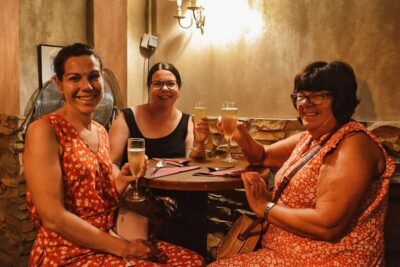
Tapas Walking Tour with Food, Wine, and History
Read our review →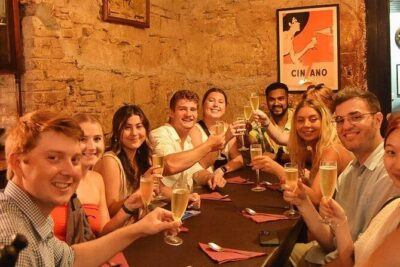
Barcelona Tapas Walking Tour: Food, Wine & History
Read our review →

Gothic Quarter Ghosts and Legends Walking Tour
Read our review →
Barcelona Helicopter, Sailboat & Old Town Private Walking Tour
Read our review →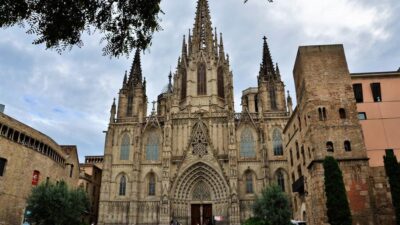

Helicopter Flight, Boat Ride, and Walking Tour
Read our review →Browse the lists this tour appears in