
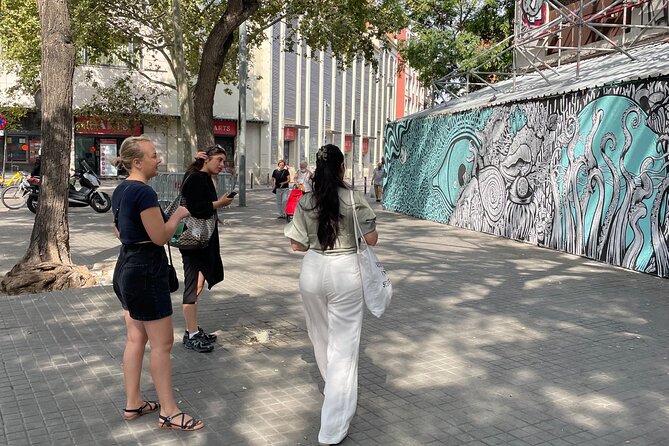
Reviewed · BARCELONA STREET ART TOURS
Street Art, Sculptures & Crime Stories Walking Tour – Barcelona
Barcelona’s street art is not just decoration. It records protest, local legends, social change, and the city’s rougher chapters. This 2.5-hour walk connects those stories across El Raval, La Rambla, the Gothic Quarter, and El Born, where old stone and fresh paint share the same streets.
I like the strong local focus and the way the route moves beyond the standard sights. I also like the practical touch of a guide such as Liliia or Leila offering food, coffee, bar, and restaurant suggestions. The main drawback is the price: at $108.37 per person, it makes the most sense if you care deeply about urban art and want a small, flexible experience.
Key points at a glance
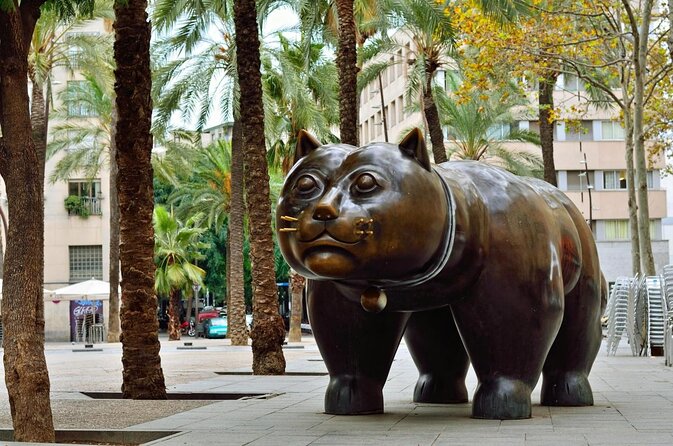
- Political art in El Raval: See murals and small works tied to social struggles, local legends, and the neighborhood’s difficult past.
- A mosaic underfoot: Find Joan Miró’s colorful pavement work on La Rambla, an artwork many people walk across without noticing.
- Ancient streets, modern art: The Gothic Quarter adds Roman remains, medieval lanes, Picasso connections, and contemporary installations.
- Optical tricks in El Born: Look for illusion-based art and the eerie facade known as the staring building.
- A small-group format: The maximum is 15 people, with the option to customize the walk for your group.
- A route with useful local advice: Liliia is praised for art knowledge, history, friendliness, and recommendations for lunch and drinks.
Why this Barcelona walk feels different
Many city tours use street art as a quick photo stop. This one treats it as a way to read Barcelona. You get the paint, mosaics, sculptures, and installations, but you also get the stories around them: social conflict in Raval, medieval punishment in El Born, and the steady change from dangerous district to cultural center.
The route also has a pleasing shape. It starts at Carrer Nou de la Rambla in Ciutat Vella and ends on Carrer Antic de Sant Joan in Born, not far from Ciutadella. You move through four central districts rather than staying in one compact art zone, so the walk gives you a broader sense of how Barcelona’s neighborhoods differ.
The experience is offered in English and allows a maximum of 15 people. That is small enough for questions and conversation, though it is not the same as a one-on-one guide. The tour can be adjusted for your group, and the actual group size may be smaller. One booking became a private walk because no one else had signed up, but you should not assume that will happen.
The tour receives a 5 out of 5 rating from 11 ratings, with particular praise for Liliia and Leila. The strongest pattern is clear: the guides explain both the artwork and the city around it, rather than simply pointing at painted walls.
More Barcelona Street Art Tours:
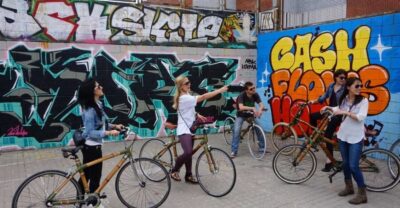
- Barcelona Street Art and Graffitti Bicycle Tour
★ 5.0 · 361 reviews - Barcelona Street Art Tour with Exclusive Artist Studios Visit
★ 5.0 · 152 reviews - Raval Street Art and Graffiti Guided Tour in Barcelona
★ 5.0 · 81 reviews
El Raval: Barcelona’s art with an edge
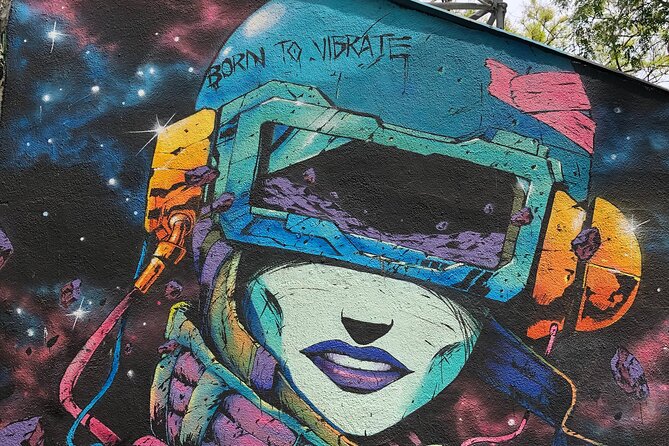
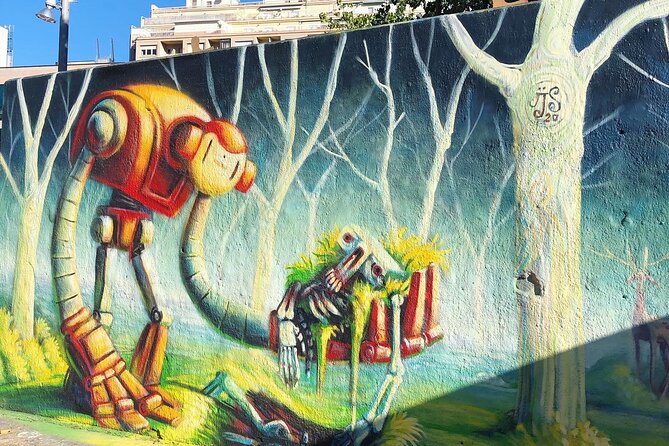
The first hour takes place in El Raval, the most important stop for understanding the tone of the walk. This district has a multicultural, rebellious character, and its street art often deals with politics, social struggles, and the hard parts of city life.
You will look at large murals as well as tiny works tucked into alleys and doorways. That mix matters. The big pieces are easy to spot, but the smaller ones make you slow down and scan the street. I like that this part of the walk asks you to treat the neighborhood itself as a changing gallery.
The guide also connects art to a dramatic historical killing that influenced work in the area. The experience does not present Raval as a neat, polished quarter. Instead, it explains how a district once known as Barcelona’s gritty underbelly has become a center for culture and creative work.
You will also see mosaics that represent Raval’s rebellious spirit. These add another texture to the painted murals. Street art here is not limited to spray paint. It includes small installations, symbolic images, and works that respond to local memory.
This is likely the strongest section for anyone interested in political street art or social history. It is also the section where the subject matter may feel heaviest. If you want only cheerful art and easy photo stops, the crime stories and social themes may not suit you. If you like seeing how art responds to real places, this is where the tour earns its keep.
The scheduled time is one hour, the longest stop on the route. That gives the guide room to explain details and answer questions instead of rushing from one wall to the next.
La Rambla: notice what is under your feet
La Rambla takes about 20 minutes. Its flower stalls, performers, theaters, and constant foot traffic make it a very different setting from Raval’s side streets. Here, the art is woven into one of Barcelona’s most famous public spaces.
The key work is Joan Miró’s mosaic set into the pavement. It is colorful, large, and easy to miss because people are busy moving along the boulevard. Your guide helps you stop and look at it as a work by a major Catalan artist, not simply part of the pavement.
That detail captures the value of a street art walk. You are not only visiting places designed for sightseeing. You are learning how to notice art placed in ordinary public space. The mosaic is also a useful reminder that Barcelona’s public art includes established artists as well as anonymous or contemporary creators.
The guide also points out philosophical street art by local artists. These works address identity, freedom, and city life. The description is broad, and the exact pieces may change over time, as street art is rarely permanent. That is both a strength and a limitation. You get a living art scene, but you should not expect every image to remain exactly as shown in photographs or descriptions.
The Gothic Quarter: Roman stone and modern marks
The Gothic Quarter adds a sharp visual contrast. This is Barcelona’s old core, a district shaped by Roman remains, medieval walls, Gothic arches, and narrow lanes. Contemporary art appears in and around those older structures, creating the kind of contrast that makes this tour more than a standard old-town walk.
You will look for modern murals tucked into ancient alleys and courtyards. The guide explains how installations reinterpret medieval legends and how bold color changes the feel of old stone. I find this part especially useful for visitors who plan to see the cathedral area anyway. You gain another way to read the same streets.
The route also includes artworks connected with Picasso’s early Barcelona years. That broadens the art story beyond graffiti. You are looking at the city as a place where formal art, public art, and informal urban work overlap.
This stop lasts about 20 minutes, so do not expect a full Gothic Quarter history lesson. The emphasis remains on the art and the tension between old buildings and modern expression. The lanes can also be busy and visually crowded, so keep your attention on the guide while looking around.
For photographers, the contrast is excellent: old masonry, arches, shadowed passages, and bright contemporary work. For history fans, the art gives the quarter a present-day voice instead of leaving it frozen in the medieval past.
More Barcelona Walking Tours:
- Barcelona Tapas and Wine Experience Small-Group Walking Tour
★ 5.0 · 5,804 reviews - Barcelona: Tapas Walking Tour with Food, Wine, and History
★ 4.8 · 4,261 reviews - Barcelona Tapas Walking Tour: Food, Wine & History
★ 4.5 · 1,928 reviews - Barcelona: Tapas Food Crawl Walking Tour with Tastings
★ 4.9 · 1,798 reviews
El Born and La Ribera: optical tricks and dark stories
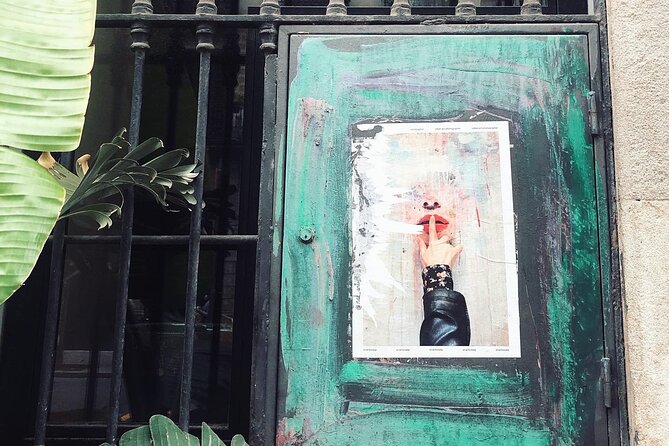
The final 40 minutes take place in El Born and La Ribera. This is the route’s art-heavy finish, with historic markets, modern galleries, murals, and stories connected to medieval executions.
The most playful feature is optical illusion art by internationally known local artists. These works trick the eye and bend what you think you are seeing. They are good examples of how street art can work as an encounter rather than a flat image on a wall.
You will also see the facade known as the staring building. Its windows and details appear to watch people passing by, giving the structure an eerie quality. It is an unusual stop because the building itself becomes part of the art experience. Instead of focusing only on a mural, you look at how architecture can create a mood.
Near Santa Caterina Market, colorful murals sit beside the market’s wavy, Gaudí-inspired roof. This is one of the route’s most photogenic areas, but the guide’s context is more useful than a quick picture. You see how public art, food markets, old streets, and modern neighborhood life meet in one compact district.
El Born is also where the tour’s crime-story thread comes full circle. The district’s past includes public executions, while its present has a more fashionable gallery-and-cafe feel. That contrast gives the final section a little bite. Barcelona’s polished image has not erased its darker stories.
The tour finishes on Carrer Antic de Sant Joan, close to Ciutadella. That is convenient if you want to continue exploring Born, visit the park, or stop for food. The route does not return to the starting point, so plan your day around ending in this district.
What the guide adds to the artwork
The guide is the main reason to book this rather than simply download a street-art map. Liliia is praised for explaining the art, the history of each district, and the context behind individual works. She is also described as friendly and willing to take time with questions.
Leila receives similar praise for professionalism and art knowledge. Since the tour is offered with a maximum of 15 people and may be customized, the guide can respond to the group instead of delivering a fixed speech at every stop.
I also value the local recommendations. Liliia has suggested coffee, bars, restaurants, and lunch spots. That can be especially useful after a walking tour, when you are already in El Born and want to eat nearby rather than cross the city.
The guide’s role is not limited to naming artists. You can expect explanations of why a work is in a certain place, how it relates to the district, and what the neighborhood’s past contributes to its meaning. That is the difference between seeing street art and understanding why it is there.
Price, timing, and practical value
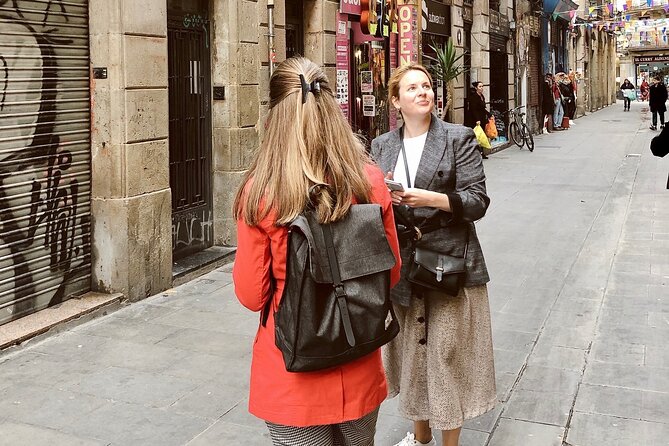
The price is $108.37 per person. That is a serious cost for a 2.5-hour walking tour, especially since there are no snacks included. The value depends on how much personal attention and art context you want.
For a large general sightseeing group, I would find the price hard to justify. For someone focused on urban art, photography, city history, or less familiar parts of Barcelona, it becomes easier to defend. The guide’s recommendations and the option to customize also add value, particularly for a first visit when you want to shape the walk around your interests.
The group discount may help if you are traveling with several people. The maximum group size is 15, so ask about the final arrangement if a quiet, personal tour matters to you. The walk is conducted in English and includes admission to the stops where an admission charge applies, with no separate attraction ticket described.
Wear comfortable walking shoes. The experience covers four neighborhoods and involves city streets, alleys, and public spaces. The tour operates daily during the stated period, from November 15, 2024 through March 16, 2027, with listed opening hours from 7:00 a.m. to 8:00 p.m. Your booking confirmation will provide the exact start time.
Most people can participate, and service animals are allowed. The meeting point is at Carrer Nou de la Rambla, 105. Since the finish is in Born, not near the starting point, allow extra time afterward if you have a reservation elsewhere.
Free cancellation is available up to 24 hours before the start time. Cancellations or changes made less than 24 hours in advance are not accepted for a refund.
Who should book this walk
I would choose this tour if you want art with a social and historical frame. It suits repeat visitors who have already seen the major monuments, as well as first-time visitors who want a different introduction to central Barcelona.
It is a good match for:
- People who enjoy graffiti, murals, mosaics, and public sculpture
- Visitors curious about Barcelona’s political and social stories
- Small groups who want room for questions
- Photographers looking for unusual street scenes
- Anyone who wants local suggestions for food and drinks
- Readers who prefer a guide-led walk to searching for art alone
I would hesitate if your main aim is to cover famous architecture quickly. You will pass through historic districts, but this is not a full cathedral, Gaudí, or museum tour. The crime stories and social themes may also feel more serious than a light sightseeing walk.
Should you book the Street Art, Sculptures and Crime Stories Walking Tour?
Book it if you want to see Barcelona through its walls, pavement, alleys, and neighborhood memories. The route has variety: Raval supplies the social edge, La Rambla adds Miró, the Gothic Quarter brings old stone and Picasso, and El Born finishes with optical art, strange architecture, and market murals.
The price is high, but the experience offers something a standard city walk usually does not: a guide who links art to place and gives useful advice for the rest of your stay. I would especially consider it for a small group that can benefit from customization. If you simply want famous landmarks or the lowest-cost introduction to Barcelona, choose another tour.
FAQ
How long does the tour last?
The tour lasts approximately 2 hours and 30 minutes.
Where does the tour start?
It starts at Carrer Nou de la Rambla, 105, Ciutat Vella, 08001 Barcelona, Spain.
Where does the tour finish?
It finishes at Carrer Antic de Sant Joan, 7, Ciutat Vella, 08003 Barcelona, in El Born near Ciutadella.
What neighborhoods does the tour visit?
The route covers El Raval, La Rambla, the Gothic Quarter, and El Born or La Ribera.
What language is the tour offered in?
The tour is offered in English.
How many people can join?
The maximum group size is 15 people.
Can the tour be customized?
Yes. The experience may be customized for you and your group.
Are snacks included?
No. Snacks are not included.
Can I cancel for a full refund?
Yes, if you cancel at least 24 hours before the experience start time. Cancellations made less than 24 hours in advance are not refunded.
Recently added around Barcelona
- Montserrat very early : Hiking, Abbey, very small group★ 5.0 · 127 reviews
- Guided Private Yacht Tour in Barcelona Spain★ 5.0 · 6 reviews
- Private Tour from Barcelona to Montserrat (with guide)★ 4.5 · 6 reviews
- Private Tour from Barcelona to Costa Brava (with guide)★ 5.0 · 5 reviews
- Andorra Tour★ 4.0 · 7 reviews
- Barcelona Gaudi Tour: Sagrada Familia, Casa Batllo & Casa Mila★ 5.0 · 4 reviews
- Barcelona: 2/4/8 hours or 1 day bike rental★ 5.0 · 6 reviews
- Wine Tasting in Barcelona (Catalan Varieties) Small Groups★ 5.0 · 10 reviews
Barcelona Street Art Tours, compared.
Barcelona Street Art and Graffitti Bicycle Tour
Read our review →
Barcelona Street Art Tour with Exclusive Artist Studios Visit
Read our review →
Raval Street Art and Graffiti Guided Tour in Barcelona
Read our review →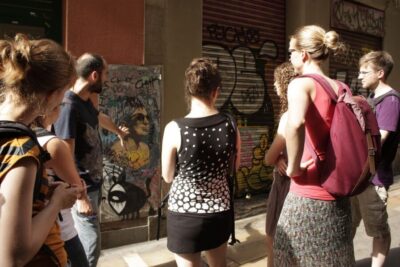
Private Barcelona Street Art Workshop with a Street Artist
Read our review →
Barcelona Art & Wine: Galleries, Studios & Street Art
Read our review →
Insider Street Art Tour with Private Studio Visit
Read our review →Browse the lists this tour appears in