
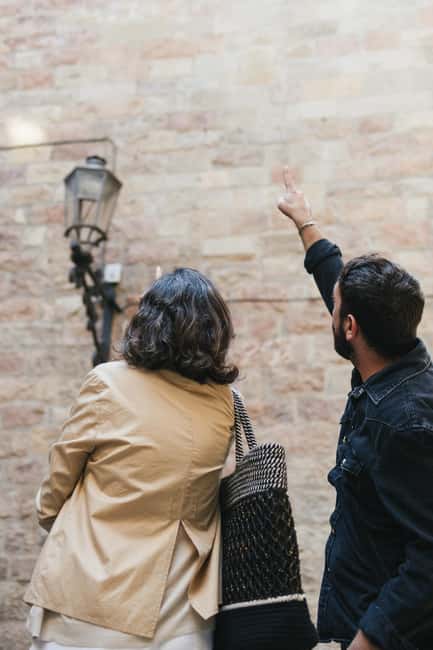
Reviewed · BARCELONA WALKING TOURS
Barcelona: Jewish Quarter 2-Hour Walking Tour
Barcelona’s Jewish Quarter is easy to miss. Its narrow lanes sit in the middle of the Gothic Quarter, yet much of its Jewish past survives only in fragments, old walls, and carefully explained clues. This tour brings those pieces together, including Sinagoga Mayor Barcelona, presented as the oldest synagogue in Europe, and the ruins of the Old Synagogue.
I like the small group of no more than six, which gives you room to ask questions and keeps the walk personal. I also like the way the tour moves beyond one famous building to cover four synagogue locations, a medieval mikve, Roman walls, and the home of a Jewish alchemist. The main consideration is that the Synagogue Museum entrance costs extra, and the Old Synagogue may occasionally be closed.
Key points
- See Sinagoga Mayor Barcelona: Visit the synagogue described as Spain’s oldest, with its museum entrance paid separately.
- Trace four synagogue sites: Walk through the Gothic Quarter to places connected with Jewish worship and daily life.
- Find the medieval mikve: See the site of a historic ritual bath, a rare and unusual stop in central Barcelona.
- Understand the 1391 attack: Learn how a violent assault brought Barcelona’s medieval Jewish community to an abrupt end.
- Walk in a group of six or fewer: The limited size suits questions, family-history interests, and a slower pace.
- Meet in Plaça Sant Jaume: The tour begins beside the Alcampo store and returns to the same place after two hours.
Why Barcelona’s Jewish Quarter takes careful looking
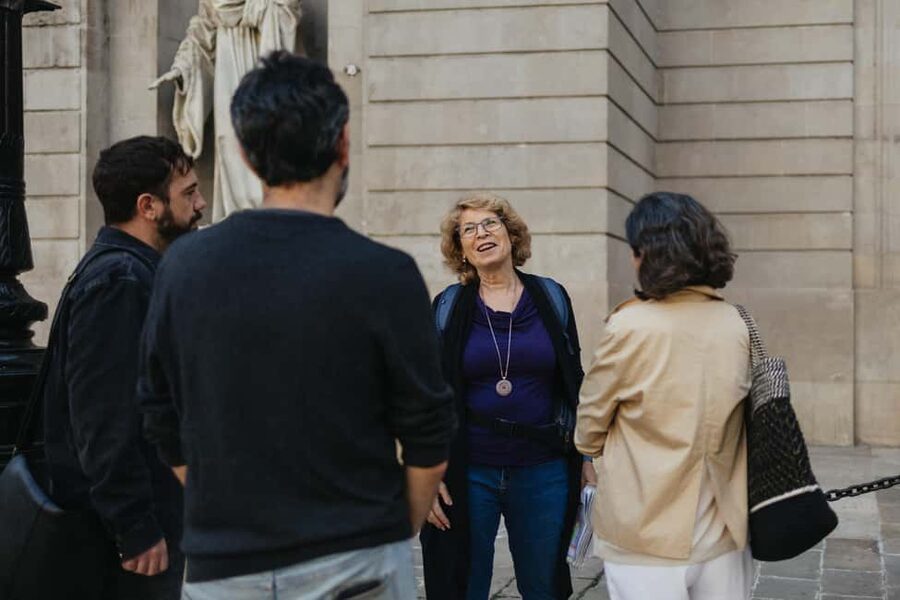
The Jewish Quarter is not a single grand attraction with a clear entrance. It is a small area woven into Barcelona’s Gothic Quarter, where medieval lanes, Roman walls, courtyards, and later buildings cover much of the evidence.
That is why a guide matters here. Without one, you could walk past a synagogue site or a barely visible remnant without knowing what you are seeing. The guide connects the physical remains to the story of a Jewish population that grew in Barcelona over many centuries.
The tour presents Jewish settlement in Spain as reaching back to the period after the destruction of the Second Temple in Jerusalem in 70 CE. The community in Barcelona grew in size and influence, with an important role in the city’s political, commercial, and spiritual life.
The story is not presented as a simple tale of peaceful coexistence. The Jewish population lived through changing conditions, and the tour leads toward the violent attack of 1391. That assault marked a decisive break, ending the established Jewish presence in Barcelona and bringing a tragic close to the medieval community.
I find this historical framing useful because it gives the buildings meaning. You are not simply looking at an old wall or a narrow alley. You are trying to understand how a community lived, worked, worshipped, and then disappeared from the city.
More Barcelona Walking Tours:
- Barcelona Tapas and Wine Experience Small-Group Walking Tour
★ 5.0 · 5,804 reviews - Barcelona: Tapas Walking Tour with Food, Wine, and History
★ 4.8 · 4,261 reviews - Barcelona Tapas Walking Tour: Food, Wine & History
★ 4.5 · 1,928 reviews
Starting at Plaça Sant Jaume
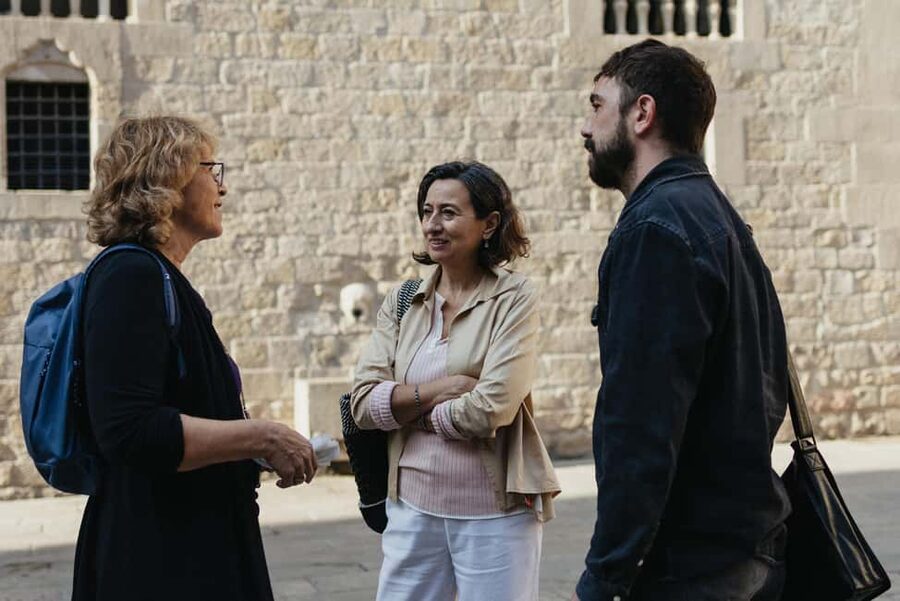
You meet your guide in Plaça Sant Jaume, beside the Alcampo store. This central square is a practical starting point for a walk through the Gothic Quarter, and the tour ends back at the same location.
A clear meeting point matters in this part of Barcelona. The Gothic Quarter has a dense network of small streets, and a simple square reference is easier to find than a doorway hidden down an alley. I would still allow a little extra time to reach the plaza, especially if you are coming from another part of the city.
The tour lasts two hours. That is enough time to cover several sites and hear the broad story without turning the walk into an all-day history lesson. It also means the guide has to choose details carefully. Expect a focused introduction to Jewish Barcelona rather than a complete account of every period in Spanish Jewish history.
The group limit is six people. That is one of the strongest practical features of the experience. In a group this size, you can usually hear the guide clearly in the narrow streets and ask about family history, architecture, religious customs, or the changing shape of the neighborhood.
The walk is offered in English with a live guide. Past guides have included Edu, Ella, Lilach, Alan, and Kate. The strongest guide qualities are clear explanations, a friendly manner, and flexibility with the pace. Edu, in particular, is described as adjusting his pace, answering questions fully, and using maps, photos, and reconstructions to explain what the medieval area once looked like.
Sinagoga Mayor and the oldest synagogue claim
The principal indoor stop is Sinagoga Mayor Barcelona. It is described as the oldest synagogue in Spain and the oldest synagogue in Europe, making it the central draw for anyone interested in Jewish history or historic religious buildings.
The attraction is not only the age of the site. The synagogue helps you picture Jewish religious life within the medieval city. The surrounding Gothic lanes make the setting especially effective, since the scale and layout of the quarter are part of the lesson.
The Synagogue Museum entrance is not included in the tour price. This is important when comparing the $76 cost with other walking tours. You are paying for a small, guided experience, but you should also allow for the separate museum admission if you want to go inside.
The site can occasionally be closed. That is a real limitation, especially because many people book the walk primarily for the synagogue. If it is closed, the tour still covers the surrounding Jewish Quarter and other historic locations, but the experience loses its most tangible interior stop.
Ask your guide questions here. The small group makes this easier, and the synagogue is the kind of place where a short explanation can change how you see the entire neighborhood.
Four synagogue locations in the Gothic Quarter
One of the tour’s better choices is to cover four synagogue sites instead of stopping at only one building. Some locations are visible as historic structures, while others are identified through remnants, street patterns, and the guide’s explanation.
This gives you a more realistic picture of medieval Jewish Barcelona. A community is not just one house of worship. It needs homes, schools, businesses, ritual spaces, and connections to the wider city. The walk helps you locate that broader community within the Gothic Quarter.
You will move through narrow medieval lanes that still retain the feel of an old urban quarter. The streets are part of the experience, but they can also make the walk slower and less straightforward than a normal city sidewalk route.
Look closely at what your guide points out. Jewish Barcelona is often present through traces rather than large, polished monuments. A barely visible architectural detail or an old wall may carry more importance than its appearance suggests.
This part of the tour is especially useful if you have already seen the main Gothic Quarter sights and want a more focused reason to explore its smaller streets. It also works well at the start of a Barcelona visit because it gives you a historical map of the center.
More 2-Hour Experiences in Barcelona:
- Barcelona: Two-Hour Midday or Sunset Sailing Cruise
★ 4.8 · 1,732 reviews - Barcelona: 2-Hour City Sights Guided Segway Tour
★ 4.9 · 453 reviews - Barcelona: 2-Hour Sailboat Tour with Snacks and Drinks
★ 4.8 · 357 reviews - 2-Hour Sailing Tour in Barcelona with Open Bar & Snacks
★ 5.0 · 318 reviews
The medieval mikve and a Jewish alchemist’s home
The medieval mikve is one of the most unusual stops. A mikve is a ritual bath, and seeing its historic location adds a personal dimension to the tour. It shows how religious practice shaped ordinary community life, not just synagogue worship.
The stop may interest you most if you enjoy places that are modest in size but strong in historical meaning. You are not going to a grand monument. You are seeing a piece of ritual infrastructure that helps explain how the community maintained its traditions.
The tour also includes the remains of a house owned by a Jewish alchemist. Here, architecture and social history meet. The ruins offer a glimpse into the work and status of an individual within the medieval city, while the guide supplies the context that the stones alone cannot provide.
These stops help prevent the walk from becoming a list of synagogues. You see religious life, domestic space, work, and the physical boundaries of the quarter. That range gives the two hours a good rhythm.
I would pay attention to the guide’s visual material at this point. One guide, Alan, used old maps, photos, and reconstructions to show how the area may once have looked. That kind of material is helpful because modern Barcelona can hide the shape of the medieval quarter.
The Old Synagogue and the end of medieval Jewish Barcelona
The ruins of the Old Synagogue, associated with Shlomo Ben Adret, are another key stop. The site is linked to one of Barcelona’s historic synagogues and helps anchor the final part of the story in a specific place.
The tour also explores the small Jewish Quarter around the Roman walls. This is where the city’s long timeline becomes clear. Roman Barcelona, medieval Jewish Barcelona, and the later Gothic city overlap in a compact area.
The most difficult part of this history is the attack of 1391. The tour explains how the violence brought a dramatic end to the Jewish community’s presence in Spain. You should expect a serious account rather than a light sightseeing stop.
The Old Synagogue may be closed at times. If access is unavailable, your guide can still explain the site and its place in the quarter, but you should not assume every advertised interior will be open on your date.
That uncertainty is worth keeping in mind when you book. The walk’s real value comes from the guide’s ability to read the streets and explain the surviving evidence. Still, if entering the old synagogue is your main goal, check current conditions before committing.
What the guides add to the walk
The guide is the heart of this experience. The streets and historic sites matter, but many of them are quiet or partly hidden. A strong guide turns scattered remains into a connected story.
The guides praised most warmly are described as clear, patient, personable, and deeply prepared. Ella is noted for explaining both Catalan and Barcelona history alongside the Jewish past. Edu is described as conversational, attentive to pace, and especially good with questions. Lilach is remembered for an engaging style and an easy command of the subject.
You can expect the walk to adjust to the group. Several guide descriptions point to a comfortable pace, rest stops when needed, and care for older participants or people with walking difficulties. The activity is also listed as wheelchair accessible, though the medieval lanes themselves may still require you to discuss specific needs when booking.
This is not a recorded audio tour. You get a live English-speaking guide who can respond to your interests. If your family has Jewish ancestry, bring names or places you want to ask about, but do not expect the guide to conduct formal genealogical research in two hours.
The small group also helps families. Teenagers can ask questions without feeling lost in a large crowd, and adults can pause over points that interest them. One guide was especially effective at weaving facts into conversation, which can make a serious subject easier to follow.
Is $76 good value for two hours?
At $76 per person, this is not a budget city walk. The price makes more sense if you value a small group and want a specialist subject rather than a general introduction to Barcelona.
You are paying for a two-hour private-feeling format with a maximum of six people, a live English guide, and access to a number of locations that are easy to miss on your own. The guide’s maps, images, and explanations also add value that you would not get from simply walking through the quarter.
The price is less attractive if you want a long museum visit or a broad Gothic Quarter tour. Museum admission is extra, and the synagogue or Old Synagogue may not always be open. You are buying interpretation and access to a carefully chosen route, not guaranteed entry to every site.
For people with Jewish family connections, the cost may feel justified because the tour can help place names, traditions, and historical events in a real city setting. It is also a good choice for visitors who have already seen Barcelona’s major churches and plazas and want a more specialized subject.
Hotel pickup costs €30 more. Since the meeting point is central and the tour ends there, I would skip pickup unless you have a clear reason to need it.
Practical advice before you book
Wear comfortable shoes. The route uses narrow historic streets, and the Gothic Quarter is best handled at a steady walking pace rather than rushed.
Plan the tour around your interest in Jewish Barcelona, not as a substitute for all of Barcelona’s major sights. Two hours gives you a focused historical walk, not a full city tour.
If the synagogue interior matters to you, ask about current opening conditions and the separate museum admission. The experience remains worthwhile if access changes, but your expectations should match the actual conditions.
The tour is listed as wheelchair accessible. If you use a wheelchair or have walking limitations, contact the provider in advance so the guide can account for your needs. The guide can adjust pace, and past tours have included rest periods for older participants.
You can cancel up to 24 hours in advance for a full refund, and the reserve-now, pay-later option keeps your plans flexible. Starting times vary, so check availability when choosing your date.
Who should take this tour?
I would recommend it to anyone with a serious interest in Jewish history, medieval Barcelona, religious heritage, or urban archaeology. It is particularly well suited to people who prefer a small, conversational group over a large sightseeing procession.
It also suits families with older children and teenagers. The subject is difficult in places, but the short format and live questions can keep it approachable.
You may want to skip it if your main aim is a grand architectural tour, a food walk, or a long indoor museum experience. The Jewish Quarter is subtle, and much of the story depends on explanation rather than spectacular remains.
Should you book the Barcelona Jewish Quarter walk?
Book this tour if you want help finding the Jewish traces hidden inside Barcelona’s Gothic Quarter. The combination of Sinagoga Mayor, four synagogue locations, the medieval mikve, the alchemist’s house, and the Old Synagogue gives you far more than a single historic building.
The best reason to choose it is the guide-led format. Edu, Ella, Lilach, Alan, and the other guides have been described as clear, kind, flexible, and able to make difficult history understandable. The small group makes that personal attention possible.
I would book with two cautions: budget separately for the Synagogue Museum, and accept that the Old Synagogue or another interior may be closed. If you are comfortable with those limits, this is a thoughtful, focused way to see a part of Barcelona that is easy to overlook.
FAQ
How long is the Barcelona Jewish Quarter tour?
The walking tour lasts two hours.
Where does the tour begin?
It begins in Plaça Sant Jaume, next to the Alcampo store.
Where does the tour end?
The activity ends back at the meeting point in Plaça Sant Jaume.
What language is the tour offered in?
The live tour is offered in English.
How many people can join the group?
The group is limited to six participants.
Is the tour wheelchair accessible?
Yes, the activity is listed as wheelchair accessible.
Is entrance to the Synagogue Museum included?
No. The entrance fee to the Synagogue Museum is not included in the tour price.
Is hotel pickup available?
Yes. Hotel pickup is available for an additional €30.
Can I cancel the tour for a refund?
Yes. You can cancel up to 24 hours in advance for a full refund.
Recently added around Barcelona
- Montserrat very early : Hiking, Abbey, very small group★ 5.0 · 127 reviews
- Guided Private Yacht Tour in Barcelona Spain★ 5.0 · 6 reviews
- Private Tour from Barcelona to Montserrat (with guide)★ 4.5 · 6 reviews
- Private Tour from Barcelona to Costa Brava (with guide)★ 5.0 · 5 reviews
- Andorra Tour★ 4.0 · 7 reviews
- Barcelona Gaudi Tour: Sagrada Familia, Casa Batllo & Casa Mila★ 5.0 · 4 reviews
- Street Art, Sculptures & Crime Stories Walking Tour – Barcelona★ 5.0 · 11 reviews
- Wine Tasting in Barcelona (Catalan Varieties) Small Groups★ 5.0 · 10 reviews
Barcelona Walking Tours, compared.

Barcelona Tapas and Wine Experience Small-Group Walking Tour
Read our review →
Tapas Walking Tour with Food, Wine, and History
Read our review →
Barcelona Tapas Walking Tour: Food, Wine & History
Read our review →

Gothic Quarter Ghosts and Legends Walking Tour
Read our review →
Barcelona Helicopter, Sailboat & Old Town Private Walking Tour
Read our review →

Helicopter Flight, Boat Ride, and Walking Tour
Read our review →Browse the lists this tour appears in