

Reviewed · BARCELONA HOP-ON HOP-OFF BUS TOURS
Barcelona: City Sightseeing Hop-On Hop-Off Bus Tour
Barcelona’s two sightseeing bus routes give you a quick way to understand a city that sprawls from the Gothic Quarter and port to Park Güell, Tibidabo, the beaches, and FC Barcelona. The Red and Blue routes share central stops but then head in different directions, so you can see far more than you could comfortably cover on foot.
I like the freedom to hop off for the Sagrada Familia, Picasso Museum, Gothic Quarter, or Park Güell, then catch another bus later. I also like the clear audio commentary in 16 languages, which adds context while you sit back and watch the city roll by. The main drawback is time: you cannot explore every stop in one day, and buses stop running at 7pm, even if you are still far from your hotel.
Key points at a glance

- Two routes, 38 stops: The Red Route covers Montjuïc, the waterfront, beaches, Poblenou, Sagrada Familia, and Arc de Triomf. The Blue Route reaches Park Güell, Tibidabo, Pedralbes, and FC Barcelona.
- A useful first-day tour: Ride both routes to get your bearings, then return to the neighborhoods and sights that catch your interest.
- 24 or 48 hours: A 24-hour ticket can work well for a focused day. The 48-hour ticket is better if you want time to get off and explore.
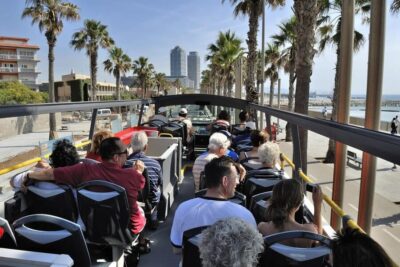
- Open-top views: The upper deck offers fine city views, but it can be hot in summer and chilly in winter. A roof can close if rain begins.
- Audio in 16 languages: Commentary is available in Spanish, Catalan, English, French, German, Italian, Portuguese, Chinese, Japanese, Russian, Dutch, Hebrew, Swedish, Arabic, Turkish, and Norwegian.
- Good for reducing walking: The bus reaches far-flung sights and can help families, older visitors, and anyone with limited energy.
Why Barcelona works well from the top deck

Barcelona is spread out, and its most famous sights are not all in one compact old town. The Gothic Quarter, Gaudí’s major works, Montjuïc, the Olympic area, the beaches, and Camp Nou sit in different parts of the city. A sightseeing bus connects them without requiring you to learn the metro on your first morning.
I would use this tour first, not last. Ride a full section of one route to get a feel for the city, listen to the commentary, and note the places you want to revisit. Then use the bus as transport, rather than trying to treat every stop as a full sightseeing visit.
The buses are branded Barcelona Bus Turistic, with open upper decks and covered lower seating. They run roughly every 20 minutes under the standard schedule, though high-season service information also describes extra buses at busy times. Allow for delays in traffic, especially when you have a timed entry to a major attraction.
More Barcelona Hop-On Hop-Off Bus Tours:
- Barcelona: 24 or 48-Hour Hop-On Hop-Off Bus Tour
★ 4.4 · 20,872 reviews - City Sightseeing Barcelona Hop-On Hop-Off Bus Tour: 24 or 48-Hour
★ 4.0 · 5,250 reviews - Barcelona City Tour Hop-On Hop-Off with Optional Boat
★ 4.0 · 3,012 reviews
The Red Route: Montjuïc, port, beaches, and Sagrada Familia
The Red Route is the broader sightseeing circuit and usually the better choice if you want Barcelona’s major landmarks in one ride. A full loop takes about 120 minutes without getting off, but that is a long stretch if you are sitting in direct sun or trying to keep to a tight schedule.
The route begins at Plaça de Catalunya, a handy central starting point. From there, it passes Casa Batlló and the Fundació Antoni Tàpies before crossing the Eixample, the orderly district laid out in blocks beyond the old city.
The next section heads toward Sants and Plaça d’Espanya. This is your gateway to Montjuïc, where several stops serve museums, gardens, Olympic sites, and cultural attractions.
At CaixaForum and the Mies van der Rohe Pavilion, you can see two very different sides of Barcelona’s architecture. Poble Espanyol offers a purpose-built collection of Spanish architectural styles, while the Museu Nacional d’Art de Catalunya sits near the Olympic area and is one of the city’s most important art stops.
The Montjuïc section also includes the Joan Miró Foundation, the Telefèric de Montjuïc, and Miramar with its Costa i Llobera gardens. You may find this part of the route especially useful if you want the hilltop views without walking all the way up. The cable car and museums require separate tickets, so plan your budget before getting off.
From Montjuïc, the bus drops toward the World Trade Center and the Columbus monument at the end of La Rambla. The Colom stop is well placed for the port, La Rambla, and the Museu d’Història de Catalunya. You can walk toward the Gothic Quarter from here, though the old streets are best explored on foot rather than viewed from a bus.
The Red Route continues around Port Olímpic and along the beaches. Platja del Bogatell and Platja de la Nova Mar Bella show you a less medieval, more open side of Barcelona. These stops are useful if you want a break by the water or are staying near the coast.
The route then moves through the Forum, Diagonal Mar, and Poblenou. This eastern part of the city feels more modern and spread out than the center. Torre Glòries gives you a view of Barcelona’s newer skyline, while the Sagrada Familia stop brings you back to Gaudí’s most famous work.
The bus stop near Sagrada Familia is useful for photos and access, but expect crowds and some confusion about exactly where to wait. If you have timed admission, arrive early and confirm the return stop before entering the basilica.
The final central stops include Arc de Triomf and the shared area around Plaça de Catalunya. Arc de Triomf has a stop nearby, though the bus does not necessarily place you directly in front of every landmark. Keep the map handy and look for the stop signs when you get off.
The Blue Route: Gaudí, Tibidabo, Pedralbes, and football
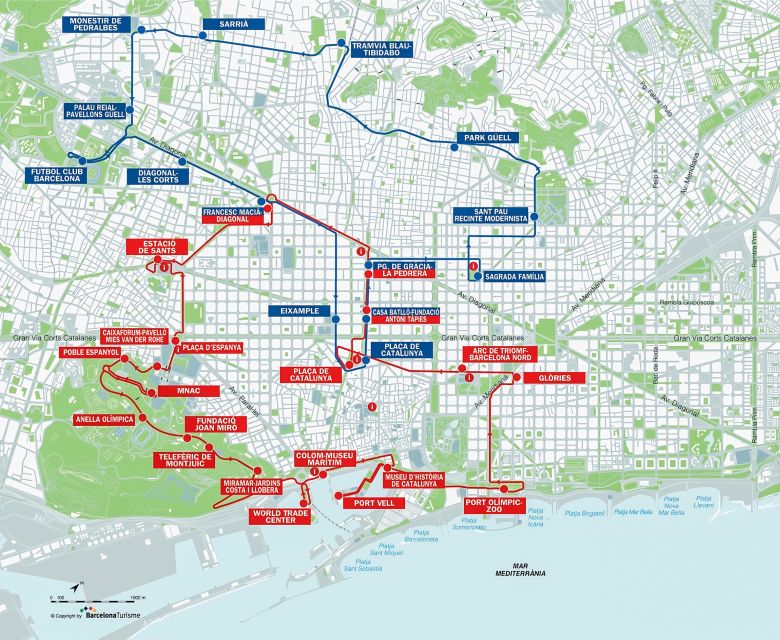
The Blue Route takes you toward the city’s northern and western districts. It is the route to choose for Park Güell, the Sant Pau Modernist Site, Tibidabo, Pedralbes, and FC Barcelona.
It begins at Plaça de Catalunya and passes Casa Batlló before heading along Passeig de Gràcia to La Pedrera, also called Casa Milà. These Gaudí buildings are among Barcelona’s most famous façades, and the bus gives you an easy first look before you decide if you want to return for an interior visit.
The Sant Pau Recinte Modernista is one of the route’s best cultural stops. Its former hospital buildings offer a different view of Catalan modernism, with more space and less street pressure than the central Gaudí sites.
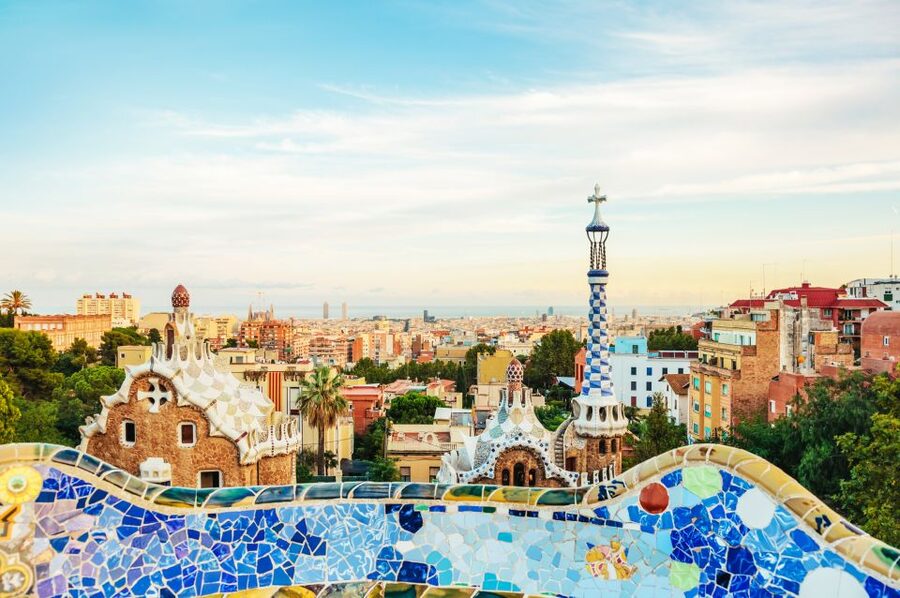
Park Güell is the big reason many people choose the Blue Route. The bus stop is not right at the park entrance, and the walk can be long and steep. This matters if you have limited mobility, young children, or a timed park entry. Check the walking route before you get off, and leave extra time.
The route continues to Tramvia Blau and Tibidabo, then through Sarrià. These stops take you away from the central tourist core and toward hillier, quieter districts. The full route is useful for seeing how Barcelona changes as it climbs away from the sea, but it takes time, so do not plan too many museum visits on the same day.
At the Monestir de Pedralbes, you can get off for one of the city’s important religious and architectural sites. Palau Reial and the Güell Pavilions add another stop for architecture lovers.
Football fans will want the FC Barcelona stop. The Blue Route is the practical choice for reaching the club’s famous stadium area, but if football is your only goal, public transport may be faster. The Blue Route also includes Diagonal, Les Corts, Francesc Macià, Eixample, and Sant Antoni, giving you a wide tour of the western and central city.
How to plan a 24-hour ticket
The 24-hour ticket is valid for 24 hours, not simply until the end of the calendar day. That gives you a useful option for starting one afternoon and continuing the following morning.
For a short visit, I would consider this pattern:
- Start with the Blue Route in the morning and choose Park Güell, Sagrada Familia, or Sant Pau.
- Use the Red Route in the afternoon for Montjuïc, the port, beaches, and central Barcelona.
- Get off at only two or three major stops. Trying to visit every attraction will leave you rushing.
- Use the bus the next morning if your 24-hour period still covers that time.
A full loop on both routes can help you understand the city, but it is not the same as exploring it. The best use of one day is to combine longer rides with a few carefully chosen stops.
More City Tours in Barcelona:
- Barcelona: Private City Tour by Eco Tuk Tuk
★ 4.9 · 1,339 reviews - Flamenco Show Ticket at Theatre Barcelona City Hall
★ 4.5 · 1,264 reviews - Barcelona: City Walking Tour with Local Guide
★ 4.9 · 980 reviews - Barcelona: Sagrada Familia or Coastal City Sights by eBike
★ 4.8 · 812 reviews
Why the 48-hour ticket can be worth the extra cost
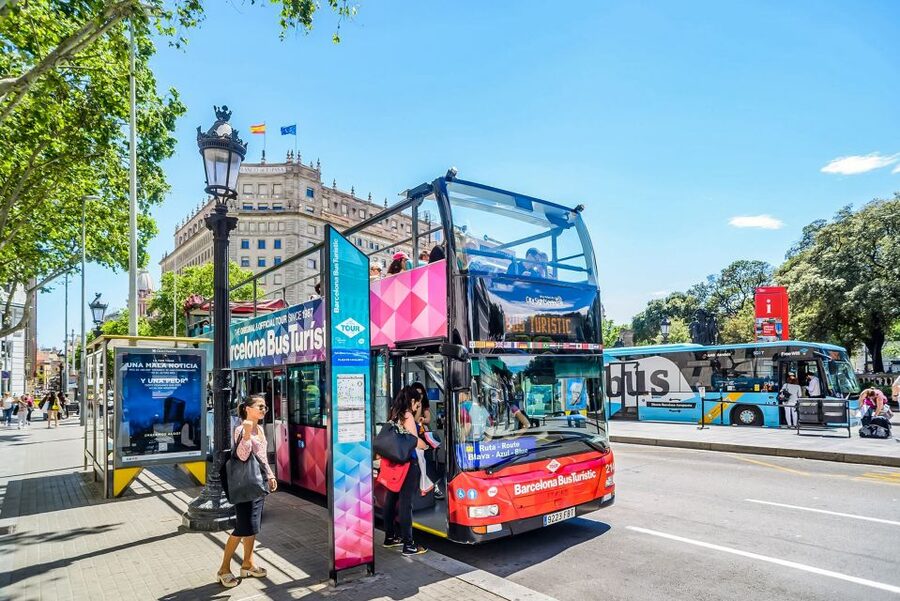
At $39 per person, the tour is not the cheapest way to move around Barcelona. The metro can be cheaper for direct trips between attractions, and walking costs nothing. The value here comes from combining transport, city orientation, and commentary in one ticket.
The 48-hour option makes more sense if you want to visit several sights without rushing. You can ride one route on the first day, use the second route on the next, and return to a favorite district. The two days must be consecutive, so do not buy it expecting to spread the rides across separate parts of your trip.
A 48-hour ticket is also helpful for families. You can use the bus to reduce long walks, get off when children need a break, and avoid rebuilding your route from scratch each time. It is less useful if you plan to spend most of your time inside museums or have already mastered Barcelona’s public transport.
The discount booklet may reduce the cost of selected attractions, restaurants, and shops, but check each offer before counting it as part of your savings. Attraction admission, food, and drinks are not included.
Audio commentary, Wi-Fi, and practical comfort
The audio guide is available in 16 languages and comes with headphones. You receive headphones on site, but you can bring your own if you prefer. The commentary gives enough background to make the buildings and districts more meaningful without turning every stop into a lecture.
Wi-Fi is included, though it may not work equally well on every bus. I would not depend on it for essential navigation, attraction reservations, or directions. Download important tickets and maps before setting out.
The upper deck is the best place for photos and a clear view, but it is exposed. Summer sun can be strong, and winter rides can feel cold. Bring water, sunscreen, and an extra layer. If rain begins, the roof can close automatically on some buses, which keeps the ride practical but changes the open-air experience.
The buses are clean, and staff are generally helpful with boarding and route questions. At busy stops, especially near Sagrada Familia, you may not get onto the first bus. Keep your schedule loose if you are traveling at a peak time.
Timing mistakes to avoid
The first buses leave Stop 1 at 9am, and the last buses leave Stop 1 at 7pm. That does not mean you can board at any stop until 7pm and still ride back to the center. The service ends according to the operating schedule, so check the final departure times before getting off far from your accommodation.
This is the most important practical warning. If you are at a distant stop late in the day, you may need a taxi or public transport to return. Do not assume the bus will complete the route after the last departure from the starting point.
The tour runs all year except January 1 and December 25. A service suspension has also been listed for Thursday, February 12, so check the date-specific operating notice when booking. Mobile and printed vouchers are accepted, and the meeting point can vary according to the option you select.
Free cancellation is available up to 24 hours before the scheduled activity, and reserve-now-pay-later booking may be offered. The ticket can also have flexible access for up to three months from the selected travel date, but confirm the exact terms at checkout.
Who should book this Barcelona bus tour?
I would recommend it to first-time visitors, families, anyone who wants less walking, and people visiting Barcelona for only a day or two. It is also useful if you want to compare districts before deciding where to spend your limited sightseeing time.
The tour is less suitable if you need precise point-to-point transport, want to travel late at night, or prefer a quiet visit at each attraction. The bus is a sightseeing service, not a fast metro substitute. Traffic, boarding time, and the long route can make it slower than public transport.
The strongest features are the coverage, the two-route ticket, the open-top views, and the helpful orientation on your first day. The main compromises are the price, the early evening finish, the occasional wait, and the uphill walk from the Park Güell stop.
Should you book it?

Book this tour if you want to see Barcelona’s shape before choosing where to spend your time. The 48-hour ticket is the better buy for a relaxed visit, while the 24-hour option works if you select only a few stops and use the bus as both a tour and a ride between districts.
If you already know Barcelona well, plan to use the metro, and have specific timed reservations, buy the tour only if the open-top views and commentary matter to you. For most first visits, though, the bus is a practical way to cover a big city without wearing out your feet.
FAQ
How long are the tickets valid?
You can choose a 24-hour or 48-hour hop-on hop-off ticket. The 48-hour ticket must be used on consecutive days.
Can I use the ticket on both the Red and Blue routes?
Yes. The ticket gives access to both routes, which together cover 38 stops across Barcelona.
How often do the buses run?
The standard service frequency is about every 20 minutes. High-season information also states that additional branded buses may run every five minutes during busy periods.
What time does the bus service operate?
The first buses leave Stop 1 at 9am, and the last buses leave Stop 1 at 7pm on both routes. Check the schedule carefully before getting off at a distant stop.
Is the audio guide included?
Yes. Audio commentary and headphones are included. The guide is available in 16 languages, including English, Spanish, Catalan, French, German, Italian, Portuguese, Chinese, Japanese, Russian, Dutch, Hebrew, Swedish, Arabic, Turkish, and Norwegian.
Are attraction admission tickets included?
No. The bus ticket does not include entry to attractions, food, or drinks.
Does the tour operate all year?
The service operates throughout the year except January 1 and December 25. A separate service suspension may apply on specific dates, so check availability for your chosen day.
Recently added around Barcelona
- Montserrat very early : Hiking, Abbey, very small group★ 5.0 · 127 reviews
- Guided Private Yacht Tour in Barcelona Spain★ 5.0 · 6 reviews
- Private Tour from Barcelona to Montserrat (with guide)★ 4.5 · 6 reviews
- Private Tour from Barcelona to Costa Brava (with guide)★ 5.0 · 5 reviews
- Andorra Tour★ 4.0 · 7 reviews
- Barcelona Gaudi Tour: Sagrada Familia, Casa Batllo & Casa Mila★ 5.0 · 4 reviews
- Street Art, Sculptures & Crime Stories Walking Tour – Barcelona★ 5.0 · 11 reviews
- Wine Tasting in Barcelona (Catalan Varieties) Small Groups★ 5.0 · 10 reviews
Barcelona Hop-On Hop-Off Bus Tours, compared.

City Sightseeing Barcelona Hop-On Hop-Off Bus Tour: 24 or 48-Hour
Read our review →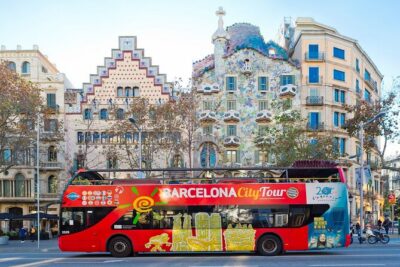
Barcelona City Tour Hop-On Hop-Off with Optional Boat
Read our review →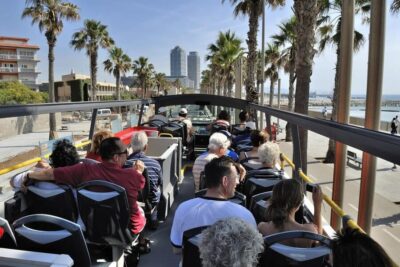

Barcelona Hop-On Hop-Off Bus and FC Barcelona Immersive Tour
Read our review →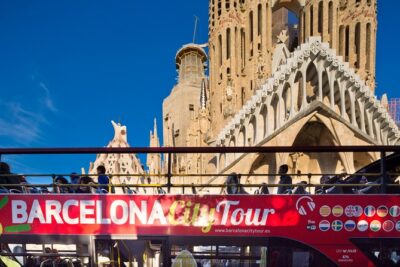
Shore Excursion: Barcelona City Tour Hop-On Hop-Off
Read our review →
Browse the lists this tour appears in