
Reviewed · BARCELONA HOP-ON HOP-OFF BUS TOURS
Shore Excursion: Barcelona City Tour Hop-On Hop-Off
Barcelona’s two sightseeing routes give you a quick look at a very spread-out city, from the waterfront and Gothic Quarter to Sagrada Família, Park Güell, and Montjuïc. You can stay aboard for the big picture or hop off when a neighborhood catches your eye.
I like the single ticket for both routes and the regular service between major stops. I also like the sliding roof on the double-deck buses, a useful feature in Barcelona’s changeable weather. The catch is that traffic, full buses, and long waits can eat into a short cruise day, so you need a firm return plan.
Key points to know
- Two routes cover a wide area: The East Route focuses on the waterfront, central Barcelona, and Gaudí landmarks, while the West Route reaches Montjuïc, Plaça d’Espanya, and Camp Nou.
- The best value comes from selective hopping: Use the bus to connect distant areas, then spend real time at one or two chosen sights.
- Park Güell is not right beside the bus stop: Expect an uphill walk with stairs before reaching the park entrance.
- Traffic is a real part of the tour: The advertised ride takes about 2 hours and 20 minutes, but stops and city traffic can make a full circuit longer.
- Cruise passengers need extra care: The port meeting area can be confusing, and the bus may stop running before you are ready to return.
- The audio system is practical but uneven: It offers multilingual narration and an assisted listening system, though some buses have had faulty headphone connections.
Why this bus works well for a first look at Barcelona
Barcelona is not a compact port city where every important sight sits within a few blocks. The beach, Gothic center, Sagrada Família, Park Güell, Montjuïc, and Camp Nou are spread across different parts of town. A sightseeing bus helps you connect them without working out several local bus and metro journeys.
The best use of this tour is as a city orientation ride. Stay on for a full circuit at the start, note the areas you want to revisit, then hop off at one or two stops. Trying to see every attraction in one day is not realistic, especially when your ship schedule limits your time.
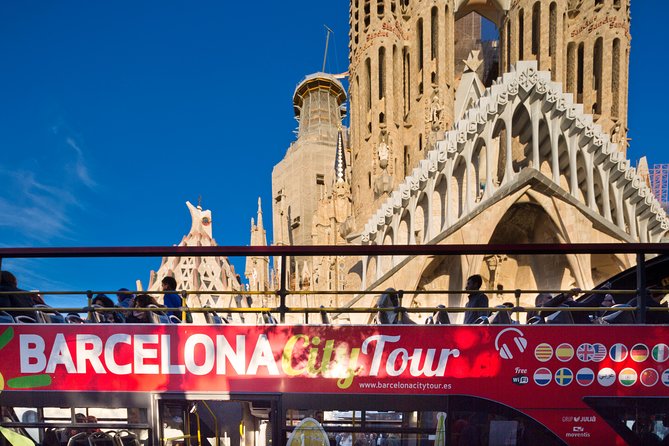
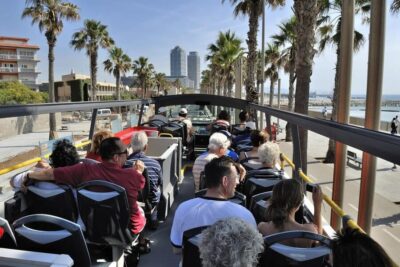
The open top gives you a clear view of Barcelona’s grand avenues, modernist buildings, hills, and waterfront. If the weather turns wet, the buses have a sliding roof. That does not make the ride weatherproof in every seat, but it is better than a completely open vehicle.
The ticket costs $39.65 per person. That is fair if you use both routes or make several hops, but less attractive if you only ride one short section. You are paying for convenience and a broad view, not admission to the attractions themselves. Food, drinks, and entrance fees are extra.
More Barcelona Hop-On Hop-Off Bus Tours:
- Barcelona: 24 or 48-Hour Hop-On Hop-Off Bus Tour
★ 4.4 · 20,872 reviews - Barcelona: City Sightseeing Hop-On Hop-Off Bus Tour
★ 4.4 · 10,061 reviews - City Sightseeing Barcelona Hop-On Hop-Off Bus Tour: 24 or 48-Hour
★ 4.0 · 5,250 reviews
East Route: beaches, Gaudí, and central Barcelona
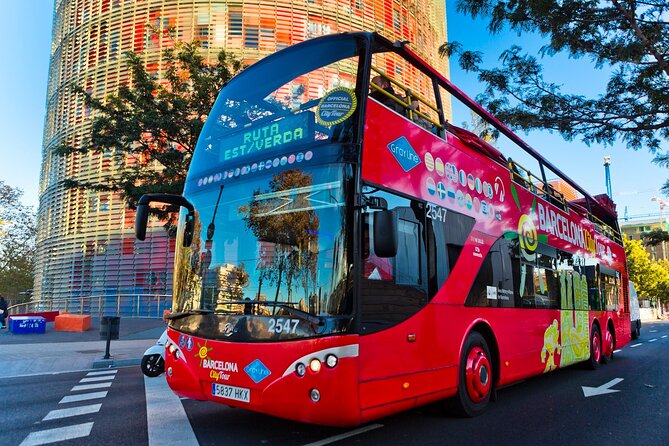
The East Route is the stronger choice if your main goal is Barcelona’s classic sightseeing. It links the waterfront with the city center and several of Antoni Gaudí’s famous buildings.
Pla de Palau and Barceloneta Beach
Pla de Palau is a useful starting point near the old port and the southeastern edge of the historic center. From here, the bus heads toward Barceloneta, the former fishing district known for its beach, narrow streets, and seafood restaurants.
Barceloneta Beach gives you a quick view of Barcelona’s Mediterranean side. You can hop off for a walk along the promenade, but keep an eye on the clock. A short beach stop can easily become a longer pause, and the next bus may already be filling.
Port Olímpic, Bogatell, and Nova Mar Bella
The route continues past Port Olímpic, built for the 1992 Olympic Games, and along the beaches of Platja Bogatell and Platja de la Nova Mar Bella. These stops show a more modern Barcelona, with broad public spaces and a long waterfront rather than the old lanes of the Gothic Quarter.
Forum Sport follows farther northeast. This section is useful if you want to see how much the city extends beyond the historic core. It is less important for a first visit than Sagrada Família or the Gothic Quarter, so I would usually remain aboard unless you have a particular reason to stop.
More Barcelona Cruise Port Transfers:
- Best of Barcelona Shore Excursion & Sagrada Familia Skip the Line
★ 4.5 · 148 reviews - Full-Day Private Guided All Inclusive Barcelona Shore Excursion
★ 5.0 · 18 reviews - Private, guided shore excursion w/ chauffeured vehicle
★ 5.0 · 7 reviews - Shore Excursion of Barcelona
★ 4.9 · 4 reviews
Glòries and Sant Pau
Glòries is a major city junction near modern shopping and transport facilities. Nearby, the Recinte Modernista de Sant Pau is one of Barcelona’s finest modernist complexes. Its colorful tilework, gardens, and ornate buildings are often overshadowed by Gaudí, but it deserves attention.
If you want to visit Sant Pau, check how much time you have before leaving the bus. The stop gives you access to the complex, but an actual visit takes longer than a quick photograph from the street.
Park Güell
Park Güell is one of the most popular stops, and it needs careful planning. The bus does not reach the park entrance. From the stop, you must walk uphill, with stairs along the way, before arriving at the site.
That distance matters. A map can make the stop look closer than it feels, especially in warm weather or when you are moving quickly to meet a timed admission. The bus is useful for getting you into the Park Güell area, but it is not a door-to-door transfer.
If you already have a Park Güell ticket, allow time for the walk and for finding the correct entrance. If your cruise day is tight, you may prefer to view the area from the bus and spend your limited time elsewhere.
La Pedrera and Casa Batlló
The bus then enters the Eixample, Barcelona’s orderly central district, with its broad avenues and famous modernist façades. La Pedrera, also called Casa Milà, is recognizable for its rippling stone exterior and elaborate roofline.
Casa Batlló is nearby on Passeig de Gràcia. Its colorful façade and bone-like forms make it one of the city’s most memorable buildings. These stops are excellent for a quick architectural look, though the interiors require separate tickets and more time.
The route may return to this area again on the West Route, which can be helpful if one direction is crowded or delayed.
Arc de Triomf and Ciutadella Park
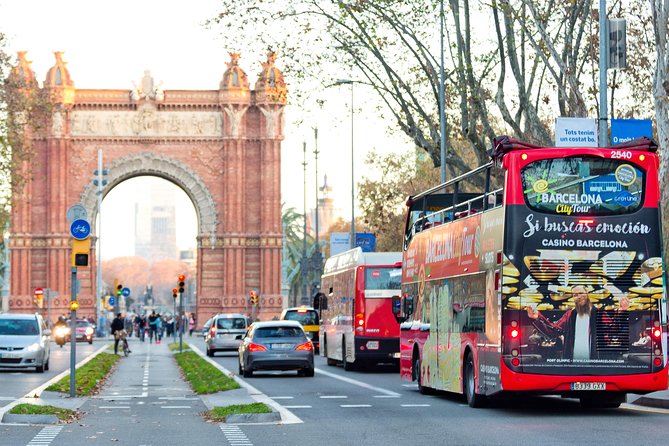
Arc de Triomf leads toward Ciutadella Park, a pleasant area for a walk away from the heaviest traffic. The arch was built for the 1888 Barcelona Universal Exposition, and the park includes broad paths, greenery, and cultural buildings.
This is one of the better places to hop off if you want a break from sightseeing buses. It also connects naturally with the old city, although you should plan your return to a marked stop rather than assume a passing bus will pick you up anywhere.
West Route: Montjuïc, museums, and Camp Nou
The West Route covers the port, Montjuïc, Plaça d’Espanya, and western Barcelona. It is the better route for city views, Olympic sites, museums, and FC Barcelona history.
World Trade Center and the port
The route begins at the World Trade Center area near the cruise port. This is convenient in theory, but the port area can be confusing. The stop is a parking area rather than a grand, obvious sightseeing terminal, and the surroundings may feel chaotic when several ships are in port.
Give yourself time to locate the correct red Barcelona City Tour marker. Do not rely on a generic colorful bus or assume every sightseeing bus accepts the same ticket. The cruise port is also where you must think hardest about your return.
Miramar Gardens and Montjuïc
The bus climbs Montjuïc, passing stops on Avinguda Miramar and near the Olympic Ring. Montjuïc offers broad views over the port and city, and the ride itself is one of the more scenic sections.
The Olympic Ring includes venues connected with the 1992 Olympic Games. The area is spread out, so hopping off here makes sense mainly if you want to walk around the hill or visit a specific site. Otherwise, stay seated and enjoy the views without losing time between buses.
Museu Nacional d’Art de Catalunya and Poble Espanyol
The Museu Nacional d’Art de Catalunya sits above the grand steps near Montjuïc. Even from the bus, the setting is impressive, with long views toward Plaça d’Espanya and the city.
Poble Espanyol is a purpose-built Spanish village with architectural examples, shops, and craft-related attractions. It is a separate paid attraction, so treat the stop as an option rather than part of the bus ticket.
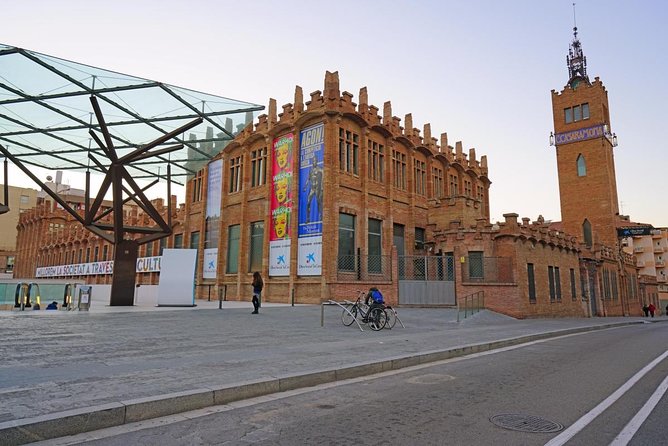
CaixaForum Barcelona is another cultural stop nearby. This former industrial building has a distinctive modernist exterior and changing exhibitions. Plaça d’Espanya is one of the route’s most useful transfer points, with its broad circular design and views toward Montjuïc.
Sants and Camp Nou
The bus continues toward Estació de Sants, Barcelona’s main railway station, then to Spotify Camp Nou, home of FC Barcelona. The stadium is a major draw for football fans, but the bus ticket does not include a stadium tour or museum entry.
If Camp Nou is a priority, confirm its current visiting arrangements before you board. Construction or event schedules can affect what you can see, and a stadium visit can take much longer than a quick photo stop.
The route then follows Avinguda Diagonal, one of Barcelona’s main arteries. Stops near numbers 635 and 571 show the city’s modern commercial side. Plaça de Francesc Macià may be moved because of works, so do not depend on that exact stop location.
Sagrada Família and the return toward the port
The West Route eventually reaches La Pedrera, Sagrada Família, Barcelona Nord Bus Station, Carrer de la Marina, Port Olímpic, and Pla de Palau. This makes it possible to combine the West Route with the East Route, although timing can become tight.
Sagrada Família is the key stop for many people. The basilica’s towers and unusual forms are easy to spot, but entering requires a separate ticket and a scheduled visit. The bus gives you access to the area, not admission.
The stop near Barcelona Nord can help if you are connecting with other public transport, while Carrer de la Marina and Port Olímpic return you toward the waterfront. Roch Xarcuters i Formatgers i Formagers is listed near the final part of the route, giving you another central-city reference point.
Do not assume that reaching the final stop will be quick. Barcelona traffic can slow the bus at lights and crowded junctions. The buses may also finish service around the early evening, so check the day’s operating times before hopping off far from the port.
How to plan a cruise-day visit
A ship excursion needs a different strategy from a normal city break. You cannot simply keep riding until you feel finished. You must allow time for the last bus, port transfer, security procedures, and possible traffic.
I would choose one of these plans:
- Overview plan: Ride one complete route without getting off, then walk near the port or central stop.
- Gaudí plan: Use the East Route for Sagrada Família and one of the Passeig de Gràcia buildings. Skip Park Güell unless you have plenty of time and a timed entry.
- Montjuïc plan: Take the West Route, get off near the museums or Olympic Ring, then return directly toward the port.
- Two-route plan: Ride both routes with only one brief stop. This gives you the widest view but little time inside attractions.
The most serious risk is not the sightseeing itself. It is losing time while waiting for a full bus or changing routes. One report describes a 90-minute wait followed by another 45-minute wait after a route change. That will not happen every day, but it shows why a cruise passenger should keep a taxi plan in reserve.
Barcelona can also be exceptionally busy when many ships arrive together. On one such day, the service was effectively unusable for a passenger who had already paid. The tour is not covered by the worry-free policy, so a cruise passenger should understand that a missed experience may not be protected in the same way as a cruise-line excursion.
Audio, seats, weather, and practical comfort
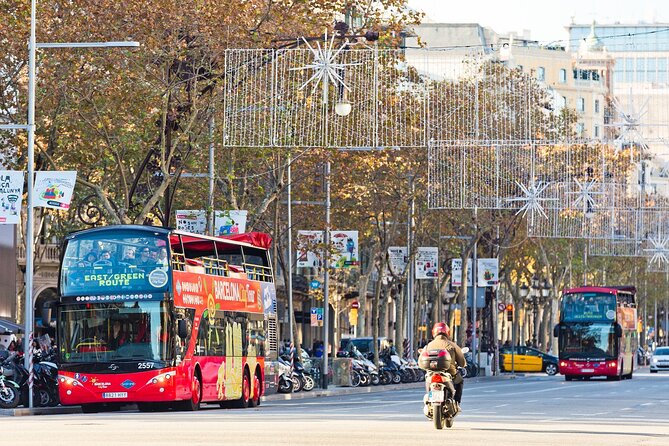
The buses have air conditioning, open upper decks, a sliding roof, and a multilingual audio system. English is available, and the audio system includes a wireless looping setup for passengers with auditory disabilities. Seats using that system are marked, with priority for people who need them.
The audio is recorded rather than delivered by a live guide. That keeps the narration consistent, but it can feel less engaging than a person pointing out details in real time. Headphone sockets have also been unreliable on some buses, producing crackling or weak sound.
Upper-deck seats are wonderful on a clear day, but they can be much colder than the street. Bring a light layer even in spring. In rain, water has entered some buses around windows, doors, and stairs, so the roof helps but does not guarantee a dry ride.
The discount booklet can reduce prices at selected attractions, shops, and restaurants. Its value depends on what you plan to visit, so treat it as a bonus rather than a reason to buy the ticket.
Mobile tickets are accepted, and confirmation arrives at booking. Keep your active ticket or printed ticket available during the ride. A booking voucher may be intended only for redemption, and losing the issued riding ticket can create a problem when staff check passengers.
Service animals are allowed. Pets are permitted only when carried in a suitable basket. Most people can participate, but the uphill walk to Park Güell and the bus stairs are worth considering if mobility is limited.
Who should book this Barcelona bus tour?
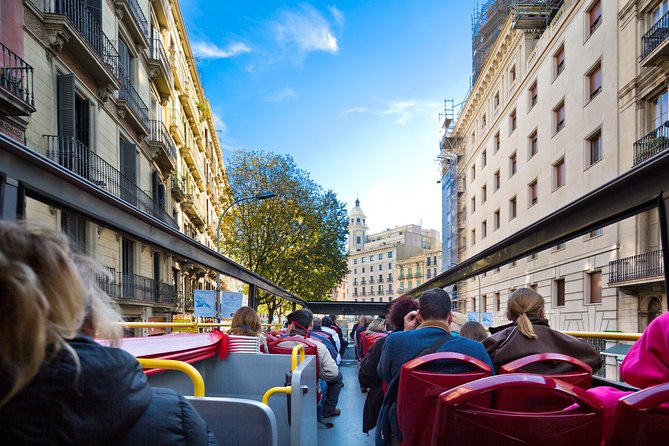
I would choose this tour if you want a broad first look, dislike navigating unfamiliar public transport, or want to connect beaches, Gaudí buildings, Montjuïc, and Camp Nou in one ticket. Families may also like the freedom to hop off when energy levels change.
I would be more cautious if you have only a few hours between ship arrival and all-aboard time. In that case, a prearranged private transfer or a focused walking plan near the port may give you more control.
The 3.9 rating reflects that mixed reality. The route coverage and flexibility earn strong praise, while long waits, confusing stops, traffic, poor audio connections, and port logistics cause trouble. At $39.65, it is good value when you ride widely and use the booklet, but not if you spend most of the day waiting or only take one short ride.
Should you book it?
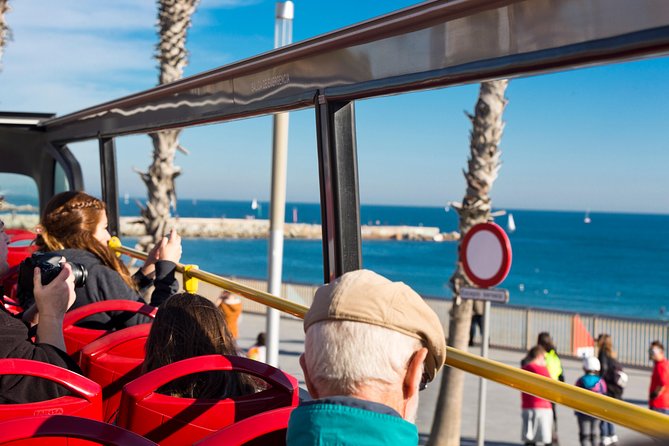
Book it for an easy city overview, especially if you have a full day in Barcelona and want to cover both sides of the city. Use the bus as transportation between selected areas, not as a promise that every attraction can fit into 2 hours and 20 minutes.
For a cruise stop, book only after checking your arrival time, the day’s bus hours, and the return route to the port. Pick one main route, leave a generous buffer, and avoid making Park Güell or a long museum visit your final activity. Used with that discipline, this is a practical introduction to Barcelona. Used without it, the city’s traffic and crowds can turn a simple sightseeing ride into a race against the ship’s departure.
FAQ
How long does the Barcelona City Tour take?
The stated duration is approximately 2 hours and 20 minutes. Hopping off, waiting for another bus, changing routes, and city traffic can make your total outing much longer.
Does one ticket cover both routes?
Yes. One ticket covers all listed stops on both the East Route and West Route.
Is Park Güell right beside the bus stop?
No. The stop requires an uphill walk with stairs before you reach the park. Allow extra time if you have an admission ticket.
Is the tour suitable for cruise passengers?
It can be, but the port meeting area may be confusing and traffic or full buses can cause delays. You need to leave enough time to return to your ship.
Is the audio guide available in English?
Yes. The buses use a multilingual audio guide system, including English. The system also has an audio setup adapted for people with auditory disabilities.
Can I cancel for a full refund?
You can cancel at least 24 hours before the experience starts for a full refund. Cancellations or changes made within 24 hours are not refunded or accepted.
Recently added around Barcelona
- Montserrat very early : Hiking, Abbey, very small group★ 5.0 · 127 reviews
- Guided Private Yacht Tour in Barcelona Spain★ 5.0 · 6 reviews
- Private Tour from Barcelona to Montserrat (with guide)★ 4.5 · 6 reviews
- Private Tour from Barcelona to Costa Brava (with guide)★ 5.0 · 5 reviews
- Street Art, Sculptures & Crime Stories Walking Tour – Barcelona★ 5.0 · 11 reviews
- Andorra Tour★ 4.0 · 7 reviews
- Barcelona Gaudi Tour: Sagrada Familia, Casa Batllo & Casa Mila★ 5.0 · 4 reviews
- Wine Tasting in Barcelona (Catalan Varieties) Small Groups★ 5.0 · 10 reviews
Barcelona Hop-On Hop-Off Bus Tours, compared.


City Sightseeing Barcelona Hop-On Hop-Off Bus Tour: 24 or 48-Hour
Read our review →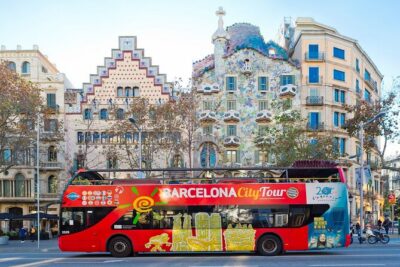
Barcelona City Tour Hop-On Hop-Off with Optional Boat
Read our review →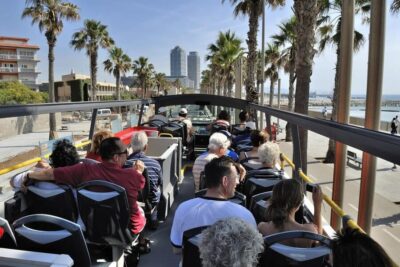

Barcelona Hop-On Hop-Off Bus and FC Barcelona Immersive Tour
Read our review →
Browse the lists this tour appears in