
Reviewed · BARCELONA GOTHIC QUARTER TOURS
Barcelona: Cemetery Tour – Gothic Graves & Local History
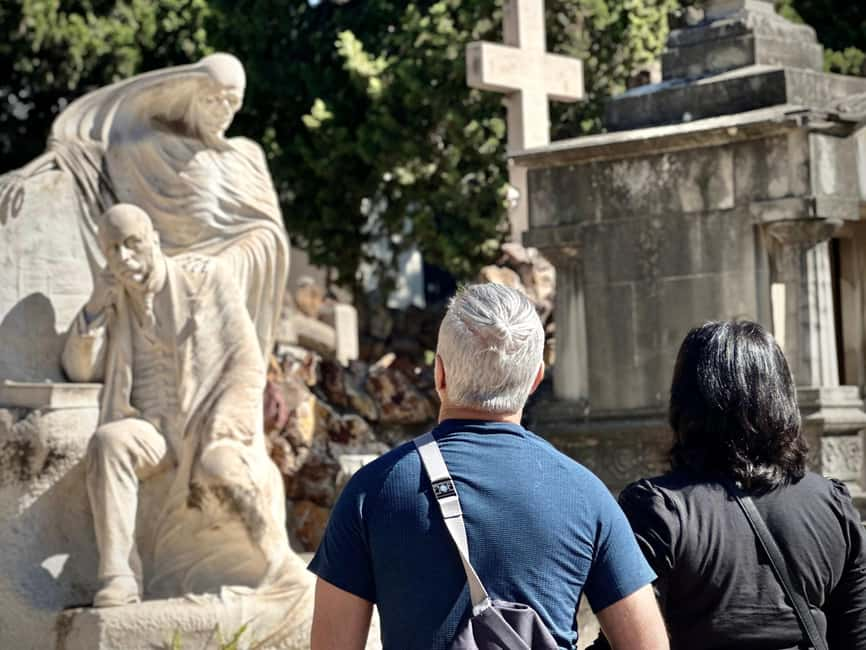
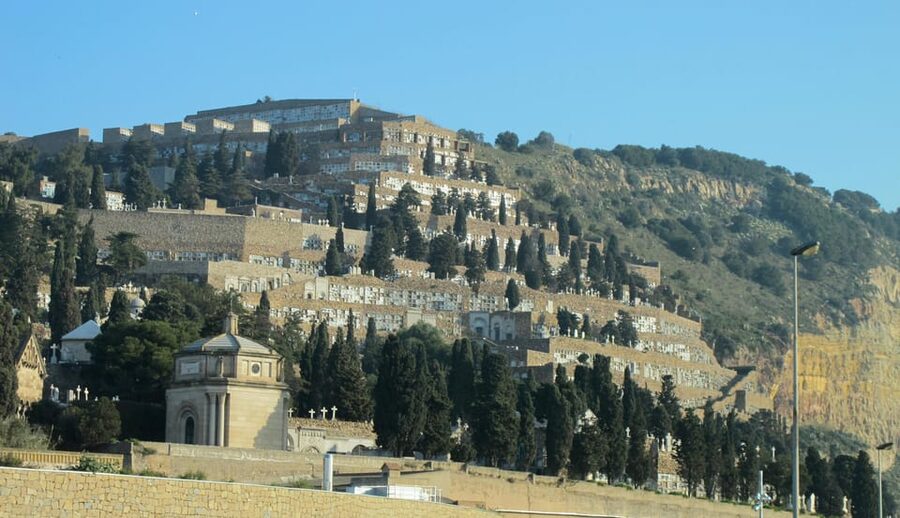
Montjuïc Cemetery is Barcelona’s city of the dead, a huge hillside burial ground filled with churchlike mausoleums, angels, skeletons, obelisks, and sea views. Guide Onno leads you through the parts most people miss, explaining the lives of writers, politicians, artists, and political figures buried here.
I like the tour’s quiet, non-touristy feel and the way it connects Barcelona’s past to real people rather than famous buildings alone. I also like that transport is included, since the cemetery is large and hilly. The main drawback is the walking: stairs and uneven uphill and downhill paths make this a poor choice if you have mobility, knee, or recent-surgery concerns.
Key points to know before you book
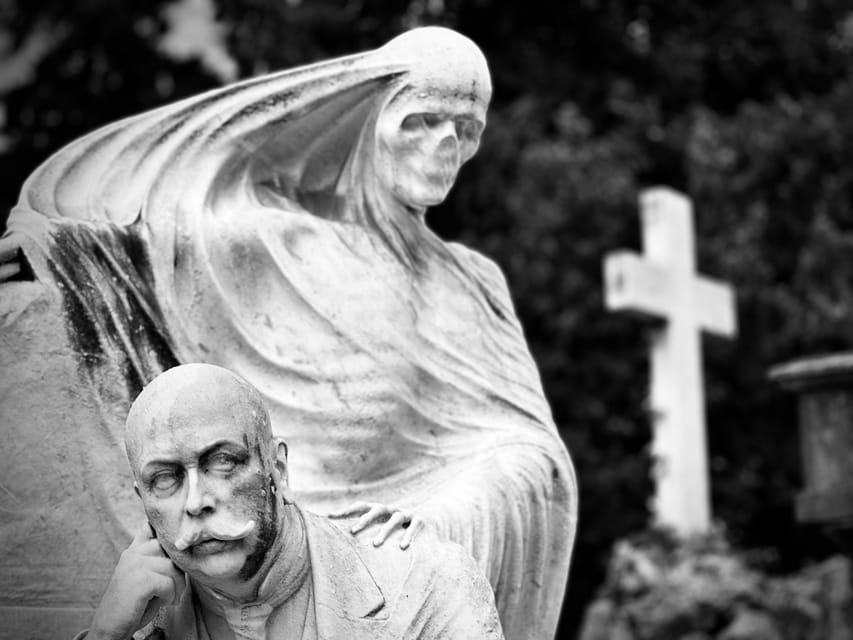
- A 19th-century cemetery turned outdoor museum: Expect ornate Gothic tombs, huge family mausoleums, sculptures, a pyramid, and obelisks.
- A guide is genuinely useful: Montjuïc Cemetery is large enough that you could easily miss its most important and unusual graves alone.
- Barcelona history through its citizens: Stories include artists, city planners, writers, politicians, Civil War figures, and anarchists.
- A rare break from the city crowds: You might see very few other people, especially outside peak season.
- Transport is included: Meet at Portal de Santa Madrona, ride to the cemetery, then return to the same point.
- Plan for stairs and comfortable shoes: The route is not continuously tiring, but the cemetery’s slopes can be hard on knees and feet.
Why Montjuïc Cemetery feels unlike Barcelona’s usual sights
Barcelona is famous for Gaudí, grand boulevards, markets, and packed Gothic streets. Montjuïc Cemetery offers a very different look at the city. Instead of studying Barcelona through churches and civic buildings, you read its story through the people who helped shape it and the monuments built to remember them.
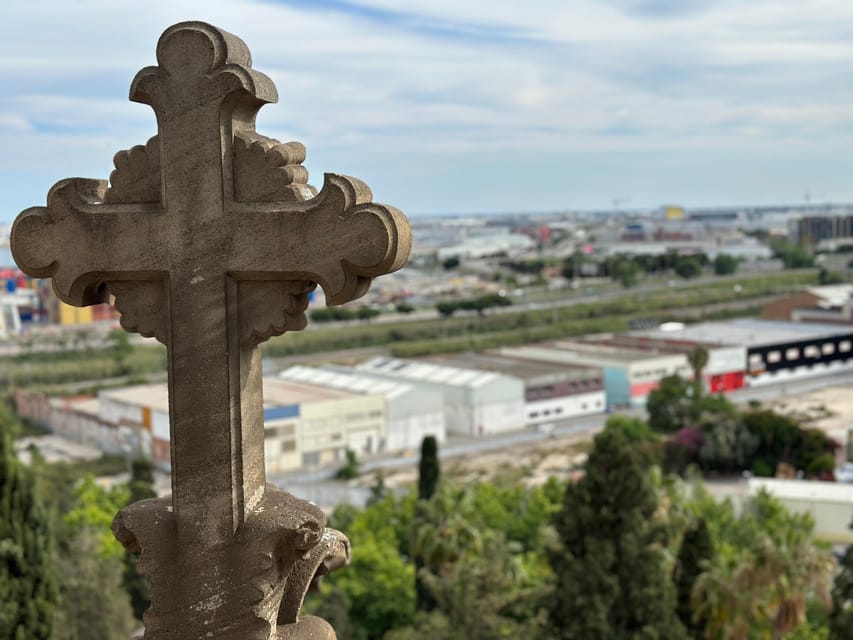
The cemetery sits on the hillside of Montjuïc, overlooking the sea. Its setting gives the walk a calm, slightly eerie quality. You are not moving through a staged attraction. You are walking through a working cemetery and an open-air collection of funerary art.
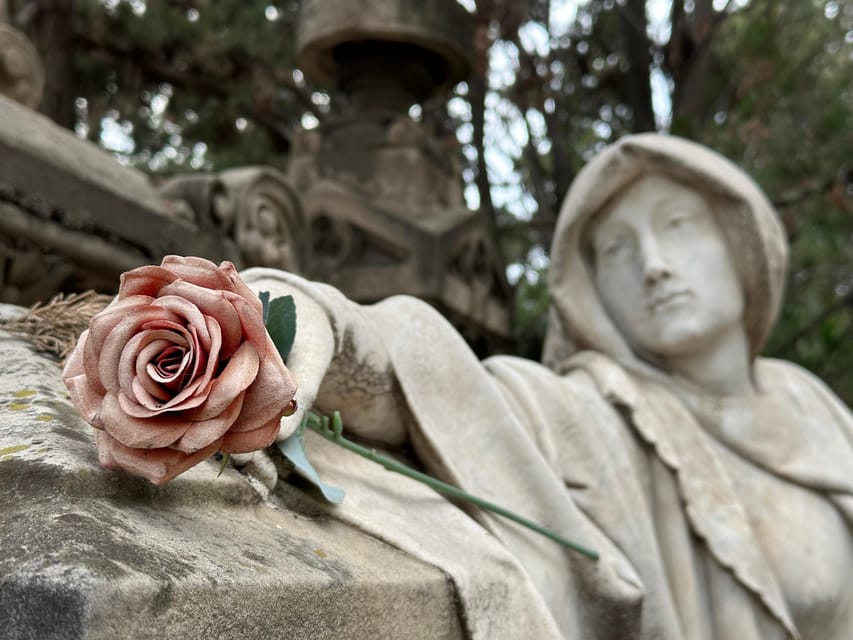
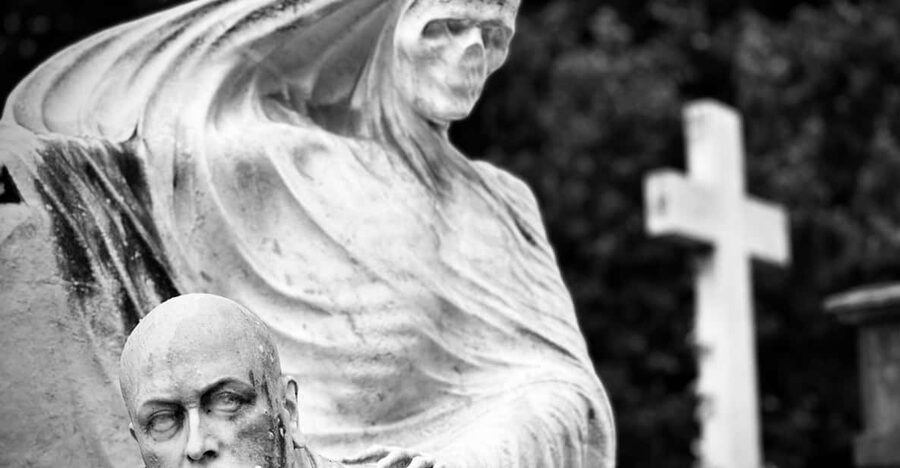
The graves range from grand family tombs that resemble small churches to simpler markers with their own stories. Sculptures of angels and skeletons appear among the mausoleums. A pyramid and several obelisks add to the strange variety. The result is beautiful, solemn, and occasionally theatrical without feeling like a theme park.
I especially like the way this setting slows the pace of a Barcelona visit. After the noise of the center, the cemetery gives you room to look closely. You can study stonework, read names, and listen to stories without the usual line of people waiting behind you.
More Barcelona Gothic Quarter Tours:
- Barcelona all included: Sagrada, Park Güell, Montjuic & Gothic
★ 5.0 · 2,169 reviews - Barcelona Gothic Quarter Tapas & Taverns Food & Wine Tour
★ 5.0 · 1,470 reviews - Barcelona: Gothic Quarter Ghosts and Legends Walking Tour
★ 4.7 · 1,443 reviews
Meeting at Portal de Santa Madrona
The tour begins at Portal de Santa Madrona, where the guide waits with a white umbrella in front of the wooden doors or gate of the old city wall. That detail matters because it gives you a clear visual marker in an area where a group can otherwise be hard to spot.
From there, you travel by city transport to Montjuïc Cemetery. The ride takes about 10 minutes. Roundtrip transport is included, so you do not need to work out the route to this large hillside cemetery on your own.
The return trip also ends at Portal de Santa Madrona. That makes the experience easy to fit into a day of sightseeing, though I would avoid scheduling another timed attraction immediately afterward. Cemetery tours can run at a relaxed pace, and the walking route includes several stops for stories and photographs.
The tour is in English and lasts about two and a half hours. Check the available starting times when booking, since the schedule can vary.
Walking through the Gothic mausoleums
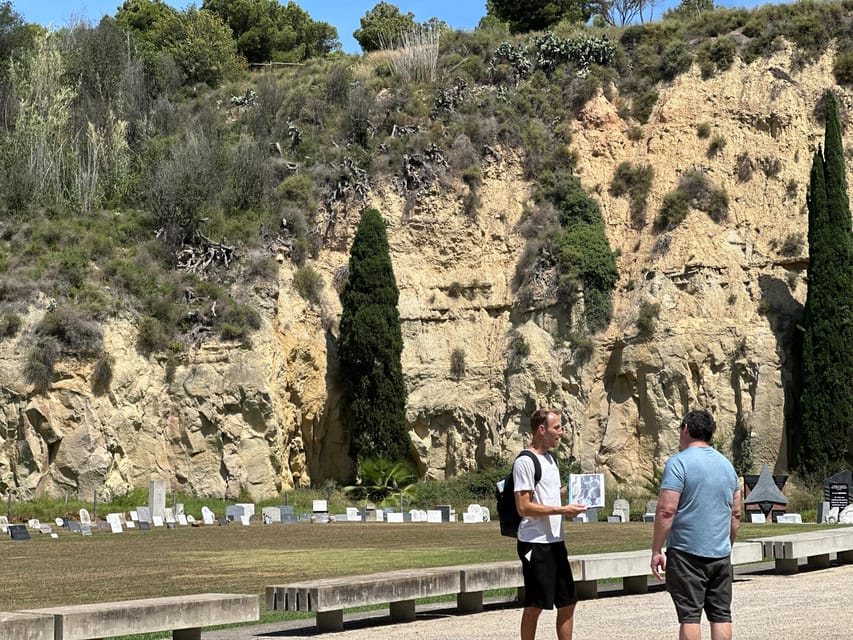
The main part of the experience takes place inside Cementiri de Montjuïc. This is the section that makes a guide especially helpful. The cemetery is large, and its most interesting monuments are spread across a sloping site rather than gathered in one neat row.
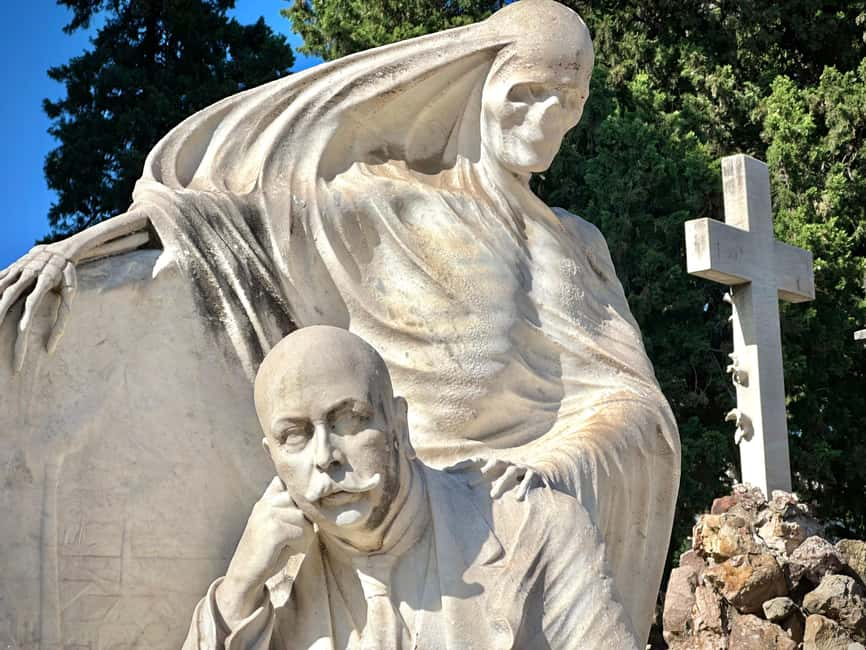
You will see ornate mausoleums that look like miniature churches, along with carved angels, skeletons, obelisks, and other elaborate memorials. Some graves are grand and highly decorative. Others are more modest, but their owners and stories give them equal weight.
The route moves up and down the cemetery rather than following one flat path. You stop often to look at tombs and hear about the people connected to them, so this is not a nonstop hike. Still, the stairs and slopes add up. Good shoes are essential, and people with knee trouble or limited mobility may find the route difficult.
Photography is a major part of the appeal. The stonework, sculptures, and open views create striking pictures, especially when the cemetery is quiet. The guide can also help you notice details that are easy to miss when you are focused only on taking photos.
One unusual advantage of a small tour is the atmosphere. On a rainy low-season visit, it is possible to be the only person on the tour. Even with a full booking, the cemetery itself can feel nearly empty. That quiet is not a minor detail. It changes the whole mood of the place.
The people buried here give Barcelona a human story
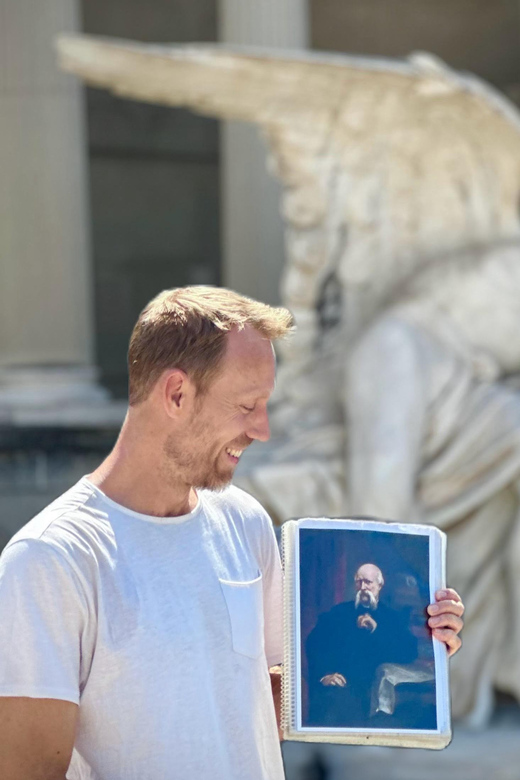
The tour is not just a walk among decorative graves. Onno uses the cemetery’s residents to explain Barcelona’s past. You hear about local writers, politicians, artists, and other important figures, with stories that connect private memorials to wider events in the city.
One particularly interesting figure is Ildefons Cerdà, the city planner associated with Barcelona’s Eixample. His grave gives the tour a direct link to the broad, ordered city beyond the cemetery walls. You begin to see the modern streets not simply as a design, but as part of the work of a person whose life and final resting place can be discussed in the same afternoon.
The route also includes political and Civil War history, including anarchist connections. For anyone interested in the conflicts and movements that shaped Barcelona, this section adds useful depth. The cemetery becomes a place where art, politics, family wealth, public life, and personal memory meet.
The stories also keep the tour from becoming a catalogue of stone objects. Without context, a large mausoleum is simply a large mausoleum. With a name, a profession, and a story, it becomes a clue to how Barcelona once lived and what its citizens wanted remembered.
More Barcelona History Walks:
- Barcelona: Tapas Walking Tour with Food, Wine, and History
★ 4.8 · 4,261 reviews - Barcelona Tapas Walking Tour: Food, Wine & History
★ 4.5 · 1,928 reviews - Barcelona: 2.5-Hour Bike or E-Bike Historical Tour
★ 4.5 · 1,262 reviews - Barcelona Erotic Museum – Explore Art, History & Fun
★ 4.4 · 450 reviews
The final stops: Fossar de la Pedrera, Durruti, and Miró
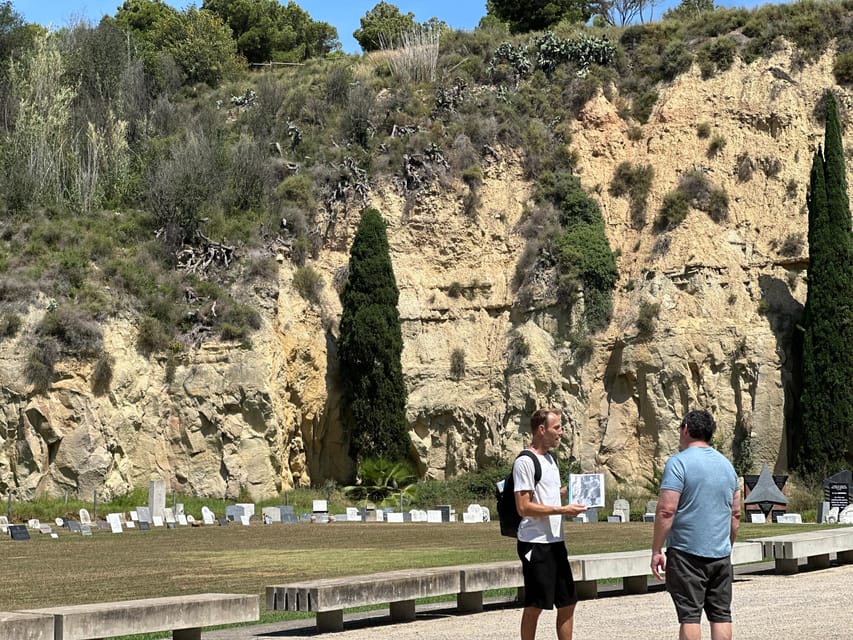
After the main cemetery walk, the tour continues to several specific locations. Fossar de la Pedrera is a photo and sightseeing stop with its own historical importance. It adds a more serious political and memorial dimension after the ornate family tombs and decorative sculpture seen earlier.
You then visit the tomb of Buenaventura Durruti. His inclusion brings the Civil War and anarchist history into sharper focus. This is one of the tour’s most useful features for people who want more than architecture. The cemetery is not only a display of wealthy families and elaborate stonework. It also holds reminders of conflict and political change.
The final named stop is the tomb of Joan Miró. His grave gives the route a connection to one of Barcelona’s best-known modern artists. Seeing his burial place alongside older mausoleums helps show the cemetery’s range across different periods and kinds of public life.
Each of these stops is brief, with about 15 minutes at Fossar de la Pedrera and roughly five minutes at each tomb. The short visits work well because the main portion already gives you time to explore the cemetery at a slower pace.
How much value do you get for $28?
At $28 per person, this is a reasonably priced guided experience if you value context, transport, and access to a place that is hard to tackle efficiently alone. You are paying for a 2.5-hour walk, an English-speaking guide, and transport in both directions from central Barcelona.
The value is less obvious if you only want to wander among graves for a few minutes. The cemetery is not a quick photo stop. Its size and slopes mean that a solo visit could become a long search, with no clear way to know which monuments or people matter most.
A guide also changes the experience from visual sightseeing to local history. You hear about Cerdà, Durruti, Miró, and other citizens rather than simply photographing tombs. If you like architecture, cemeteries, social history, or unusual city walks, the price makes sense.
The tour may be especially good value for a solo visitor. You receive transport, company, and a clear route without needing to organize a separate trip to Montjuïc. If you are already comfortable navigating the area and prefer complete independence, you could decide that the guided element is less important.
Who will enjoy this unusual Barcelona walk?
I would recommend this for adults who enjoy history told through personal stories, funerary art, photography, and quieter places. It suits someone who has already seen Barcelona’s headline sights and wants a different side of the city, but it can also work early in a first visit for anyone drawn to unusual cultural experiences.
It is not designed for young children. Children under 12 are not suitable for the tour, and the walking conditions also rule out wheelchair users and people with mobility impairments. Pregnant people, anyone recovering from recent surgery, and people over 70 are listed as unsuitable for this activity.
Those restrictions are worth taking seriously. The route is not described as continuously exhausting, but it does include stairs and repeated uphill and downhill sections. If you are unsure about your knees or balance, this is a place to ask before booking rather than hoping the route will be flat.
The experience also fits people who prefer small groups and a calm pace. You get time to stop, listen, and take photos. It is less suitable if you want a fast overview or feel uncomfortable spending several hours in a cemetery.
Practical tips for a better visit
Wear comfortable shoes with good grip. The site is hilly, and attractive clothing that works for city cafés may not be the best choice for uneven paths and stairs.
Bring a camera, but do not let photography take over. Some of the most memorable details may be small carvings or inscriptions that do not look dramatic at first glance.
Allow the full two and a half hours. The transport is short, but the cemetery itself is large, and the value comes from moving through several sections rather than rushing to a single famous tomb.
If you are visiting in a quiet season, expect a particularly peaceful experience. A rainy day can make the cemetery feel even more solitary, though you should dress for changing weather and protect your camera.
The tour offers free cancellation up to 24 hours before the start, and you can reserve while paying later. Those options are useful if your Barcelona schedule is still shifting.
Should you book the Montjuïc Cemetery tour?
Book it if you want a quiet, unusual side of Barcelona and like the idea of learning about the city through its dead. The combination of Gothic tombs, sea views, Civil War history, famous names, and a well-planned route gives the experience more substance than a simple cemetery stroll.
The strongest reason to book is the guide. Onno’s approach, as described by the experience, adds stories, small facts, and an easygoing human touch. A guide is also practical here because the cemetery is too large for a short, casual visit.
Skip it if stairs are a serious problem, if you are traveling with children under 12, or if cemeteries are not your kind of sightseeing. For everyone else, $28 buys an uncommon and thoughtful way to understand Barcelona, with transport included and far fewer crowds than you will find at the city’s best-known sights.
FAQ
How long does the Montjuïc Cemetery tour last?
The tour lasts about 2.5 hours, including the guided cemetery visit, transport, and the additional stops.
Where does the tour begin?
It begins at Portal de Santa Madrona. The guide waits with a white umbrella in front of the wooden doors or gate of the old city wall.
Where does the tour end?
The activity ends back at Portal de Santa Madrona.
Is transport included?
Yes. Transport from the city to Montjuïc Cemetery and back is included by city bus. The listed transfer takes about 10 minutes each way.
What language is the tour in?
The live guided tour is in English.
What can I see at Montjuïc Cemetery?
You can see Gothic-style graves, large mausoleums, angels, skeletons, a pyramid, obelisks, sculptures, and scenic views toward the sea.
Which notable graves are included?
The route includes the tombs of Buenaventura Durruti and Joan Miró. It also discusses other important citizens, including Ildefons Cerdà.
Is the tour suitable for people with mobility problems?
No. The route includes stairs and repeated uphill and downhill walking. It is not suitable for wheelchair users or people with mobility impairments, and people with knee problems may struggle.
Can I cancel the booking?
Yes. You can cancel up to 24 hours in advance for a full refund. You can also reserve now and pay later.
Recently added around Barcelona
- Montserrat very early : Hiking, Abbey, very small group★ 5.0 · 127 reviews
- Guided Private Yacht Tour in Barcelona Spain★ 5.0 · 6 reviews
- Private Tour from Barcelona to Montserrat (with guide)★ 4.5 · 6 reviews
- Private Tour from Barcelona to Costa Brava (with guide)★ 5.0 · 5 reviews
- Andorra Tour★ 4.0 · 7 reviews
- Barcelona Gaudi Tour: Sagrada Familia, Casa Batllo & Casa Mila★ 5.0 · 4 reviews
- Street Art, Sculptures & Crime Stories Walking Tour – Barcelona★ 5.0 · 11 reviews
- Wine Tasting in Barcelona (Catalan Varieties) Small Groups★ 5.0 · 10 reviews
Barcelona Gothic Quarter Tours, compared.
Barcelona all included: Sagrada, Park Güell, Montjuic & Gothic
Read our review →
Barcelona Gothic Quarter Tapas & Taverns Food & Wine Tour
Read our review →
Gothic Quarter Ghosts and Legends Walking Tour
Read our review →
Barcelona Old Town & Gothic Quarter Small Group Tour
Read our review →
Ramblas, Old Town, Gothic and Gaudi Architecture Walking Tour
Read our review →
El Born and Gothic Quarter Wine & Tapas Bar Tour
Read our review →
Kids and Family Gothic Quarter Walking Tour in Barcelona
Read our review →Browse the lists this tour appears in