
Reviewed · BARCELONA GOTHIC QUARTER TOURS
Barcelona & Gothic to Modern. Regular Tour
Barcelona’s old center is more than a handsome collection of churches and narrow lanes. It is a record of power, religion, war, dictatorship, urban renewal, and daily life. This three-hour architecture walk helps you read that record, moving from Roman Barcelona to the post-Franco city, Olympic Barcelona, and the controversial forat de la vergonya, or hole of shame.
I like the route’s two-part focus: the Gothic and La Ribera quarters provide plenty of historic texture, while Enric Miralles gives the tour a modern architectural lens. I also like that the guide may turn a market visit into fieldwork, asking you to look at how a building was shaped rather than simply admire its appearance. The main caution is that this is not a light sightseeing stroll. Some visitors may find the information dense, especially if they want a simple introduction to Barcelona.
Key points to know before you book
- Architecture with political context: The walk links buildings to religion, government, urban change, and the post-Franco period.
- A Miralles-focused approach: You learn to examine Barcelona through the methods and ideas of architect Enric Miralles.
- Four major stops: Santa Caterina Market, Santa Maria del Mar, Barcelona Cathedral, and the Temple of Augustus anchor the route.
- A strong guide can make the difference: Pia is an architect and university-level architecture lecturer who can explain complex ideas in clear English.
- Small-group setting: The maximum group size is 20 people, though some departures may be much smaller.
- Good fit for curious architecture fans: You do not need to be an architect, but you should enjoy asking why a city looks and works as it does.
Why this Barcelona walk feels different
Many old-city walks point out a church, name a date, and move along. This one tries to show you the forces behind the streets and buildings. You look at how Barcelona developed, who shaped it, and what each period wanted the city to become.
The central figure is Enric Miralles, the Catalan architect whose work often responds to movement, fragments, memory, and the awkward edges of urban life. The tour uses his way of thinking as a tool. Instead of treating architecture as decoration, you are encouraged to notice how buildings meet streets, how public spaces are made, and how old structures survive inside a changing city.
That approach gives the walk an unusual range. Roman Barcelona appears at the beginning. The Carolingian era follows. Later sections address the years after Franco, the Olympic transformation, and the urban conflict associated with the forat de la vergonya. You get architecture, but also civic decisions and social tension.
This is why I would not book it only because you want pretty photographs. Book it because you want to understand what you are seeing. The reward comes when a familiar facade, market, or square begins to reveal its layers.
More Barcelona Gothic Quarter Tours:
- Barcelona all included: Sagrada, Park Güell, Montjuic & Gothic
★ 5.0 · 2,169 reviews - Barcelona Gothic Quarter Tapas & Taverns Food & Wine Tour
★ 5.0 · 1,470 reviews - Barcelona: Gothic Quarter Ghosts and Legends Walking Tour
★ 4.7 · 1,443 reviews
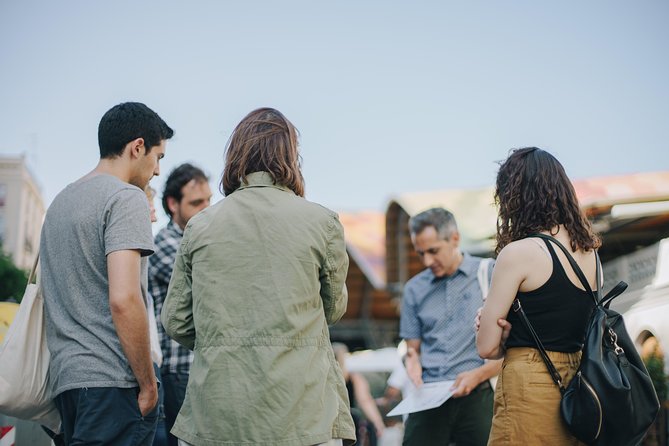
Starting at Plaça Nova and finding the group
The tour begins at the Barcino Sculpture on Plaça Nova, at Plaça Nova 40 in the Ciutat Vella. The start time is 10:30 am, and the walk ends back at the meeting point.
Plaça Nova is a practical place to begin because it sits beside the old Roman center and near Barcelona Cathedral. Still, take a moment to identify your guide before the start. One person had trouble finding the right group because several tours were gathering at the same location. The simple fix is to arrive early, look for the Barcelona Architecture Walks guide, and confirm the tour name.
The mobile ticket makes entry and check-in straightforward. The walk is offered in English, and the group can include up to 20 people. That is small enough for a real conversation, though a full group will feel less personal than a private outing.
Pia is the guide most often associated with this experience. She brings architectural training, teaching experience, and a strong command of Barcelona’s past. Her best quality is her ability to connect design with politics and religion rather than treating architecture as a list of names.
Santa Caterina Market and the Miralles method
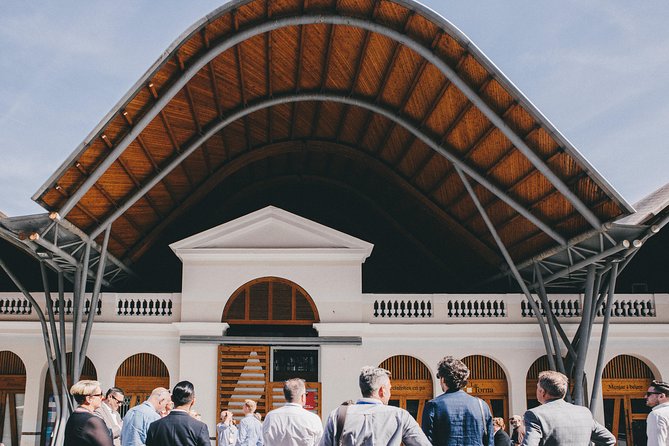
Santa Caterina Market is one of the most important stops because it brings the discussion into everyday city life. Markets are not only places to buy food. They are working public buildings, neighborhood meeting points, and signs of how a city chooses to renew itself.
Here, the tour examines Miralles’s connection to the market and uses the building for hands-on observation. The final part of the walk includes fieldwork in the market, applying some of the methods associated with Miralles’s work. You are asked to look closely at processes, structure, movement, and the way the building relates to its surroundings.
That practical approach is a major strength. You are not simply told that a design is important. You get a way to inspect it. The experience may be especially useful if you normally walk through a city looking at facades without knowing what details matter.
Santa Caterina also helps explain the tour’s larger idea: old Barcelona is not frozen in the past. Historic quarters keep changing, sometimes carefully and sometimes through conflict. A market can carry traces of older urban life while also representing a newer vision of the neighborhood.
Santa Maria del Mar and the La Ribera quarter
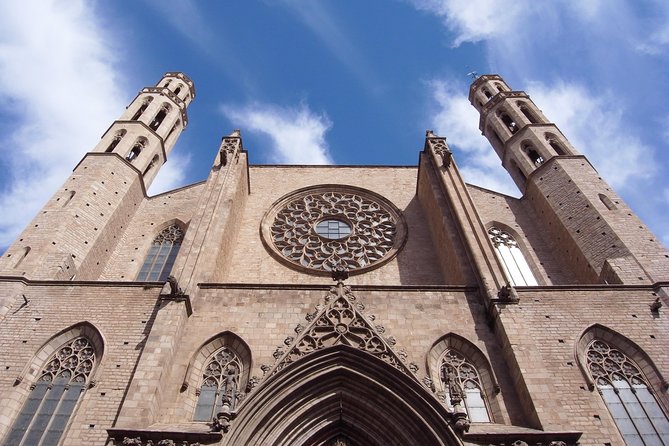
The Basilica of Santa Maria del Mar brings the walk into La Ribera, one of Barcelona’s most evocative old quarters. The church is a major Gothic landmark, but the tour is less interested in presenting it as an isolated masterpiece than in placing it within the city around it.
You will consider how religious buildings express the priorities of their time. The discussion includes the political and cultural forces that altered Barcelona’s architecture, giving the church a wider role in the story of the quarter.
This is where the walk can reward repeat visitors. You may already know Santa Maria del Mar from a guidebook or a previous visit. The difference here is the attention to relationships: the building, the streets around it, the institutions that supported it, and the urban changes that followed.
The pace is a walking pace through the old center, with stops for explanation. Wear comfortable shoes, since the value of the tour comes from moving through the city rather than viewing it from one fixed point. The supplied information does not specify interior access or admission to the basilica, so treat this as an architectural stop rather than a guaranteed church visit.
A different sort of day out in Barcelona:
- Barcelona: Park Güell Admission Ticket
★ 4.4 · 76,534 reviews - Barcelona: Casa Batlló Entry with Self-Audioguide Tour
★ 4.7 · 25,359 reviews - Barcelona: 24 or 48-Hour Hop-On Hop-Off Bus Tour
★ 4.4 · 20,872 reviews - Barcelona: Park Guell Guided Tour with Skip The Line Entry
★ 4.7 · 17,563 reviews
Barcelona Cathedral and the layers of the Gothic center
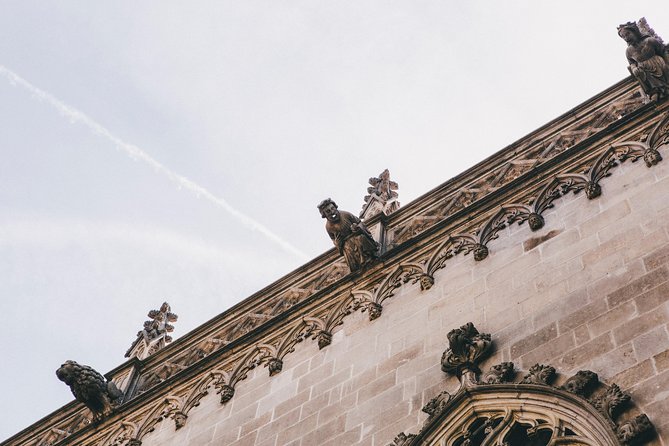
Barcelona Cathedral provides another major point for reading the city’s Gothic core. From here, the tour returns to the long view of Barcelona, moving between periods rather than treating the Gothic quarter as one single chapter.
The cathedral helps make the city’s religious and political history visible. Its scale and position show how institutions shaped the center, while the surrounding streets reveal how later generations built around, through, and beside earlier structures.
Pia’s teaching style is particularly useful for this kind of place. She has been praised for using charts and detailed explanations to show how Barcelona changed across centuries. That may sound academic, but it can clarify a city that otherwise feels like a jumble of Roman stones, medieval walls, grand churches, and modern interventions.
The drawback is the same as the tour’s main limitation: the explanations can be information-filled. If your group includes children or adults who prefer stories with a quick punch line, the pace may feel slow. The guide’s role here is closer to a walking lecture than a theatrical performance.
The Temple of Augustus and Roman Barcelona
The MUHBA Temple of Augustus is the clearest early anchor on the route. Its surviving Roman columns offer a direct link to Barcino, the Roman city beneath modern Barcelona.
This stop is valuable because it resets your sense of time. In the Gothic quarter, it is easy to think only in medieval terms. The temple reminds you that the city had an urban plan, civic institutions, and religious centers long before the Gothic buildings appeared.
The walk begins with Roman Barcelona and later travels through the Carolingian era, so the Temple of Augustus helps establish the first layer in that sequence. You are not just collecting old monuments. You are learning to see how one city can hold several urban systems at once.
The temple stop is also a good example of the tour’s wider method. Look at what survives, what has disappeared, and what modern Barcelona has built around the remains. The physical fragments are important, but so is the decision to preserve and present them inside a living neighborhood.
From the Carolingian era to Olympic Barcelona
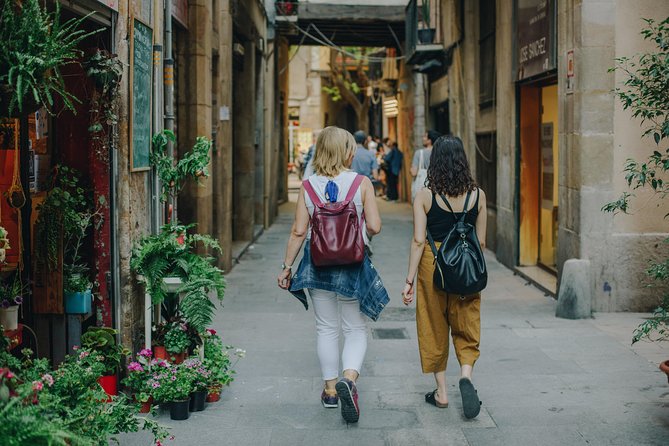
The tour does not stop with medieval architecture. It follows Barcelona through major political and cultural shifts, including the period after Franco and the Olympic era.
That broader timeline matters. Barcelona’s modern image is often tied to the Olympics and the city’s large-scale transformation, but urban change did not begin there. The tour places the Olympic period beside older decisions and later consequences, helping you see renewal as a process rather than a single success story.
The post-Franco section adds another layer. Architecture is connected to political change, public life, and the way a city imagines its future. That makes this experience more useful than a standard monument walk if you want to understand Barcelona as a civic project.
You should expect discussion rather than a parade of modern buildings. The route is designed around history, politics, cultural imagination, and architecture. If your main goal is to see as many famous modernist facades as possible, this may not be the right choice. If you want to understand the forces that produced modern Barcelona, it offers a stronger payoff.
The forat de la vergonya and difficult urban decisions
The reference to el forat de la vergonya, or the hole of shame, signals that the walk does not avoid uncomfortable parts of Barcelona’s urban story. The phrase refers to a disputed urban space in the old city, associated with conflict over redevelopment and local needs.
This section gives the tour moral and civic weight. You are encouraged to think about who benefits from a new project, who loses familiar spaces, and how public design can become a political argument. That is a useful counterbalance to the usual Barcelona story, which often focuses only on attractive buildings and successful renewal.
The subject may not suit someone looking for an easygoing morning of landmarks. But it is exactly the kind of detail that can make a city visit more honest. Architecture is not just about shape and materials. It affects housing, movement, memory, and control of public space.
The guide’s style and the right level of interest
Pia receives especially strong praise for her command of Barcelona’s architectural history, her clear English, and her ability to tailor explanations to a group’s level. She has even translated a few terms into Italian for a participant, which suggests a flexible and attentive teaching style.
At the same time, the experience is not equally easy for every audience. One family found the subject too advanced for some members, describing it as closer to a second-level class than a basic introduction. That is fair warning.
You do not need formal architecture training. The tour is intended for people who want to learn how to look at buildings and city spaces. But you should have some patience for long explanations and abstract ideas. I would choose it for an adult who enjoys museums, urban design, local politics, or historical interpretation.
For a mixed family group, set expectations in advance. One teen or parent may be fascinated while another person waits for the walk to end. A private outing can be adapted more closely to your interests, but the regular tour is the better value if you are comfortable sharing the discussion with others.
Timing, group size, and practical value
The tour lasts about three hours and starts at 10:30 am. That is a useful morning length: long enough to build a connected story, but short enough to leave the afternoon open for more sightseeing.
The group limit is 20 people. A smaller departure will make it easier to ask questions and follow the guide’s visual explanations. A larger group may require you to stay close and listen carefully in busy old-city streets.
No price is provided here, so I cannot name a precise value comparison. I can say what you are paying for: an English-speaking architecture specialist, a structured route through several historic quarters, context across many periods, and an architecture microguide to keep or use after the walk. If you would otherwise spend hours visiting these areas without understanding their connections, the tour can add real value.
The experience requires good weather and a minimum number of participants. If poor weather or low enrollment cancels the walk, you are offered another date or experience, or a full refund. You can cancel for a full refund up to 24 hours before the start time. Service animals are allowed, public transportation is nearby, and most people can participate, though the format remains a walking tour through the old center.
Who should book this architecture walk?
Book it if you want to see Barcelona through ideas as well as sights. It is especially good for architecture students, design fans, urban history readers, and repeat visitors who want a more serious look at the Gothic and La Ribera quarters.
I would also recommend it to first-time visitors who enjoy guided learning. You do not need to recognize architectural names in advance. You only need curiosity and a willingness to pay attention to how buildings connect with power, religion, memory, and public life.
Skip it if you want a quick overview, comic storytelling, or a tour built around entering famous interiors. The guide may be excellent, but the subject is demanding and the explanations can be dense.
For the right audience, this is a rewarding way to spend a Barcelona morning. You leave with more than a collection of old churches and Roman columns. You gain a working method for looking at the city, and that method can continue helping you long after the walk ends.
FAQ
How long does the Barcelona Gothic to Modern tour last?
The tour lasts approximately three hours.
What time does the tour begin?
The scheduled start time is 10:30 am.
Where does the tour begin?
It begins at the Barcino Sculpture on Plaça Nova, 40, in Barcelona’s Ciutat Vella.
Where does the tour end?
The activity ends back at the meeting point.
Which language is the tour offered in?
The tour is offered in English.
What places are included on the route?
The route includes Santa Caterina Market, the Basilica of Santa Maria del Mar, Barcelona Cathedral, and the MUHBA Temple of Augustus.
How many people can join the regular tour?
The activity has a maximum group size of 20 people.
Can I cancel for a full refund?
Yes. You can cancel at least 24 hours before the start time for a full refund. Cancellations or changes made less than 24 hours before the start time are not refunded or accepted.
Recently added around Barcelona
- Montserrat very early : Hiking, Abbey, very small group★ 5.0 · 127 reviews
- Guided Private Yacht Tour in Barcelona Spain★ 5.0 · 6 reviews
- Private Tour from Barcelona to Montserrat (with guide)★ 4.5 · 6 reviews
- Private Tour from Barcelona to Costa Brava (with guide)★ 5.0 · 5 reviews
- Andorra Tour★ 4.0 · 7 reviews
- Barcelona Gaudi Tour: Sagrada Familia, Casa Batllo & Casa Mila★ 5.0 · 4 reviews
- Street Art, Sculptures & Crime Stories Walking Tour – Barcelona★ 5.0 · 11 reviews
- Wine Tasting in Barcelona (Catalan Varieties) Small Groups★ 5.0 · 10 reviews
Barcelona Gothic Quarter Tours, compared.
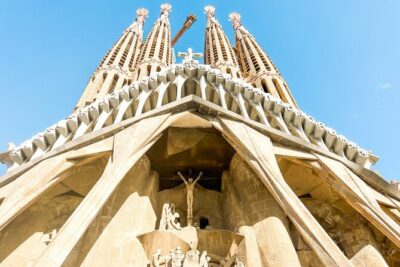
Barcelona all included: Sagrada, Park Güell, Montjuic & Gothic
Read our review →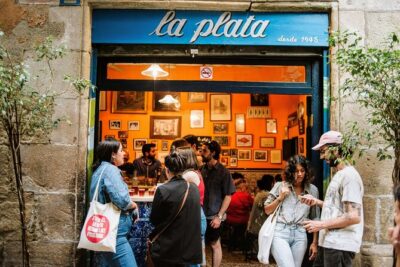
Barcelona Gothic Quarter Tapas & Taverns Food & Wine Tour
Read our review →
Gothic Quarter Ghosts and Legends Walking Tour
Read our review →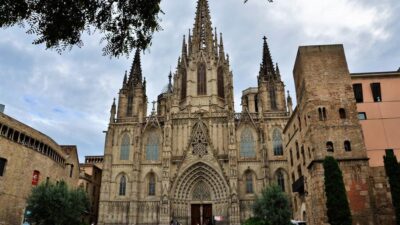
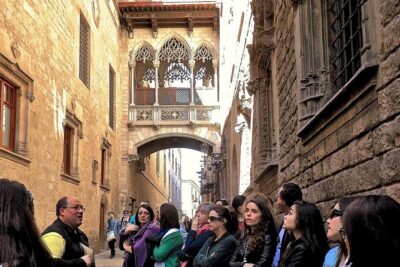
Barcelona Old Town & Gothic Quarter Small Group Tour
Read our review →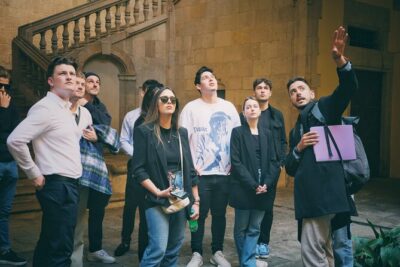
Ramblas, Old Town, Gothic and Gaudi Architecture Walking Tour
Read our review →
El Born and Gothic Quarter Wine & Tapas Bar Tour
Read our review →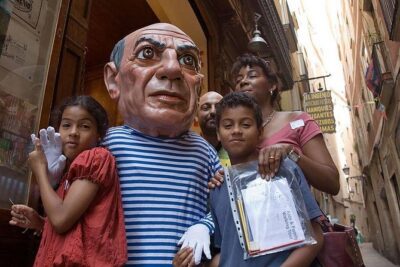
Kids and Family Gothic Quarter Walking Tour in Barcelona
Read our review →Browse the lists this tour appears in