
Reviewed · BARCELONA BIKE TOURS
Barcelona | StreetArt Bike Tour Moco Museum
Barcelona’s best street art is not gathered in one museum. It is scattered across walls, side streets, former industrial spaces, and busy public squares. This 2.5-hour electric bike tour links those places into one lively route, from Keith Haring’s AIDS mural near MACBA to El Beso, the giant photo mosaic near the Cathedral.
I like two things here: you get the useful context behind the images, and the bike lets you cover a wide slice of central Barcelona without wearing out your feet. The main consideration is that this is a moving city tour, not a long art lecture. You will stop for photos and explanations, but some works are quick pass-bys.
Key points at a glance
- Keith Haring’s AIDS mural: A major stop near the Museu d’Art Contemporani de Barcelona, with time to hear why the work matters.
- A route that keeps changing: Barcelona’s street art is temporary, so the exact walls and order can shift as new work appears.
- A useful central Barcelona route: You pass MACBA, Rambla del Raval, the Three Chimneys gardens, Port Vell, the Cathedral, Passeig de Gracia, and Casa Batlló.
- Stories from an English-speaking guide: Guides explain the artists, symbols, and local setting rather than simply pointing at painted walls.
- Electric bikes and short stops: The bike makes the distance manageable, though you still need to ride confidently in city streets.
- Good value at $34: One bike, water, a handlebar bag, photo stops, and a guided route make this a reasonable introduction to Barcelona’s urban art.
Why this tour is different from a museum visit
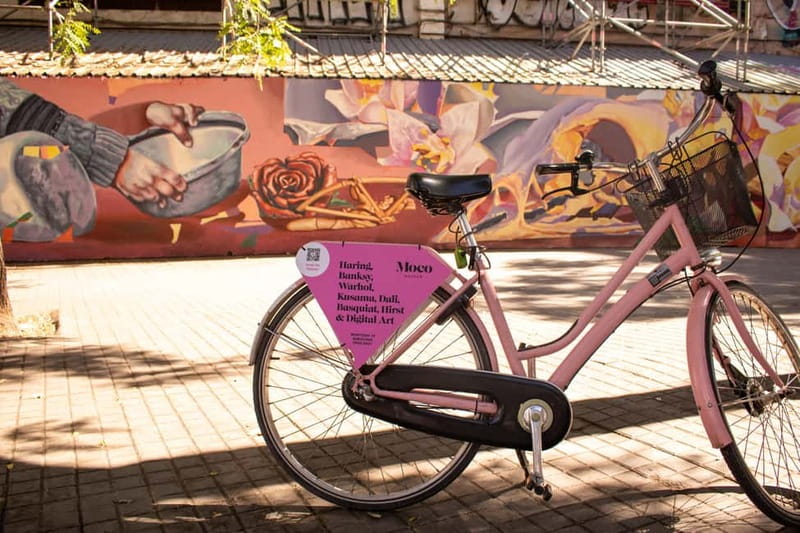
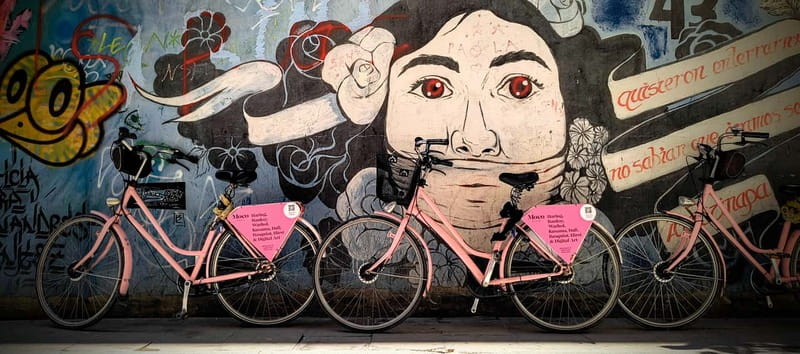
The Moco name may catch your eye, but this experience takes place outdoors. You are not touring the Moco Museum’s galleries. Instead, you ride through the city to see public art in the places where it was made or displayed.
That difference matters. A museum gives you controlled lighting, labels, and a fixed collection. This route gives you context: painted shutters, old factory structures, neighborhood streets, public sculptures, and walls that may look different on your next visit. Street art can be covered, removed, or replaced, and the guides adjust the route to suit those changes.
I like this approach because it treats Barcelona itself as the gallery. You see how modern art sits beside older buildings, landmarks, and everyday city life. The route also mixes famous names with local and lesser-known artists, so you are not simply following a greatest-hits list.
The tour is in English, and one guide named in the feedback is Eirini. The guide’s role is important here. Without explanation, a wall can be just a colorful backdrop. With the story behind it, you can start reading the symbols, slogans, and characters.
More Barcelona Bike Tours:
- Barcelona 3-hour Bike or E-Bike Tour: Highlights and Hidden Gems
★ 5.0 · 1,429 reviews - Barcelona: 2.5-Hour Bike or E-Bike Historical Tour
★ 4.5 · 1,262 reviews - Barcelona E-Bike Photography Tour
★ 5.0 · 843 reviews
Starting at Carrer dels Tallers 45
Meet at Carrer dels Tallers 45, by the palm tree. Enter the passage where the Barcelona Ciclo Tour team is waiting, and arrive about 10 minutes early. The start is in a central part of Barcelona, making it practical to reach before a day of sightseeing.
The tour begins with a short safety briefing, listed at about five minutes, and bike preparation. You receive one bike per person, a free bottle of water, and a small handlebar bag for belongings. That bag is useful for a phone, wallet, and sunscreen, but you should still keep your packing light.
The tour description refers to electric bikes, so this is not the same effort as a traditional cycling excursion. You still need to ride and pay attention, especially around city traffic and pedestrians. The experience is not suitable for anyone who cannot ride a bike or for wheelchair users.
Children up to age 16 must wear helmets, provided free of charge. Adults can request a helmet ahead of time for an extra cost. Headphones are not allowed, which makes sense because you need to hear the guide and remain aware of the road.
From El Gat de Botero to CCCB and MACBA
One early stop is El Gat de Botero, the large cat sculpture by Fernando Botero. It offers an easy first photo stop and a playful introduction to Barcelona’s public art. From there, the group reaches the Centre de Cultura Contemporània de Barcelona, usually known as CCCB.
At CCCB, the route includes the Sant Jordi Sculpture and skyline views. This is one of the tour’s useful transitions: you move from a recognizable public sculpture to a broader look at how contemporary art fits into the city. You are not only seeing murals. You are also seeing how Barcelona places art in open urban spaces.
The ride continues to the Museu d’Art Contemporani de Barcelona, or MACBA. The museum is a major reference point for modern art in the city, but the outdoor walls around it are just as important for this tour. Expect a brief stop, rather than a museum entry.
This part of the route can be busy and visually crowded. That is both its strength and its limitation. You get a strong sense of Barcelona’s creative street life, but you should not expect a quiet setting for every explanation or photograph.
Keith Haring’s mural and the power of public art
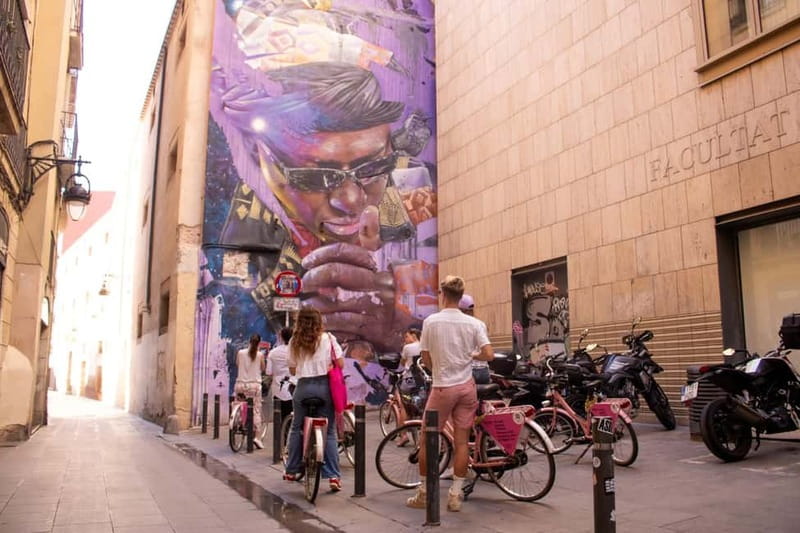
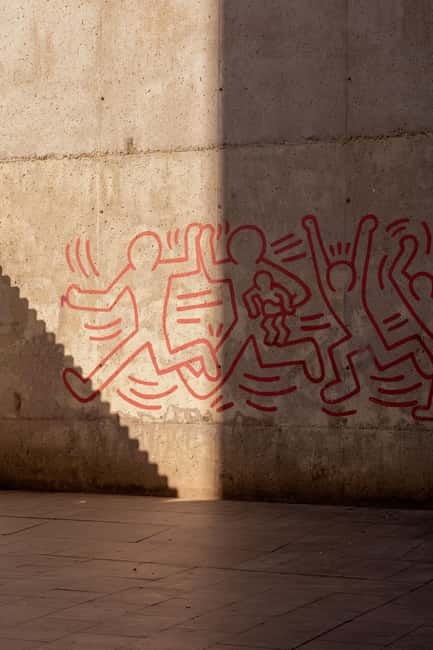
The Mural del Sida, Keith Haring’s AIDS mural, is one of the most important stops. Haring’s work is known for its bold figures and direct symbols, and this mural carries a serious public-health message. The guide provides the needed background, helping you see the work as more than a familiar graphic style.
The stop is brief, listed at about five minutes, so listen closely and take your photos efficiently. If this mural is your main reason for booking, you should understand that the tour gives you an outdoor viewing and explanation, not a long seminar on Haring’s career.
Still, the stop earns its place. It shows how street art can speak plainly about fear, loss, activism, and community. That directness is part of what makes public art different from a painting behind glass.
Nearby, the tour also includes Colp One Dog, another work associated with the MACBA area. The pairing gives you a useful contrast between a globally recognized artist and a piece connected to Barcelona’s own street-art culture.
More Barcelona Street Art Tours:
- Barcelona Street Art and Graffitti Bicycle Tour
★ 5.0 · 361 reviews - Barcelona Street Art Tour with Exclusive Artist Studios Visit
★ 5.0 · 152 reviews - Raval Street Art and Graffiti Guided Tour in Barcelona
★ 5.0 · 81 reviews - Barcelona: Raval Street Art and Graffiti Walking Tour
★ 4.9 · 60 reviews
Joaquin Costa, Ferlandina, and Xupet Negre
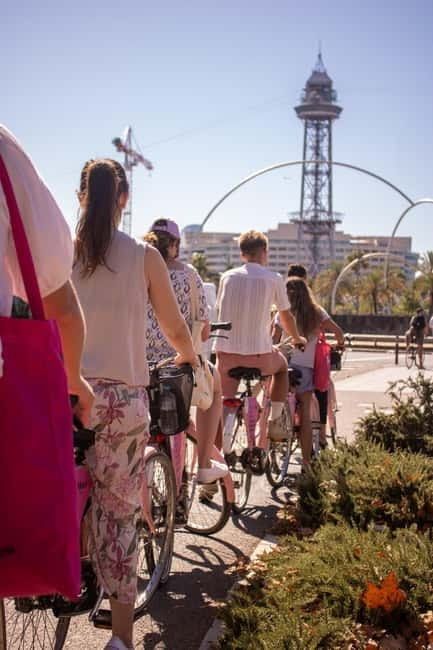
The ride then threads through streets including Carrer de Joaquin Costa and Carrer de Ferlandina. These streets connect the major art institutions with smaller urban scenes, where the scale feels more personal and the walls can be easier to examine.
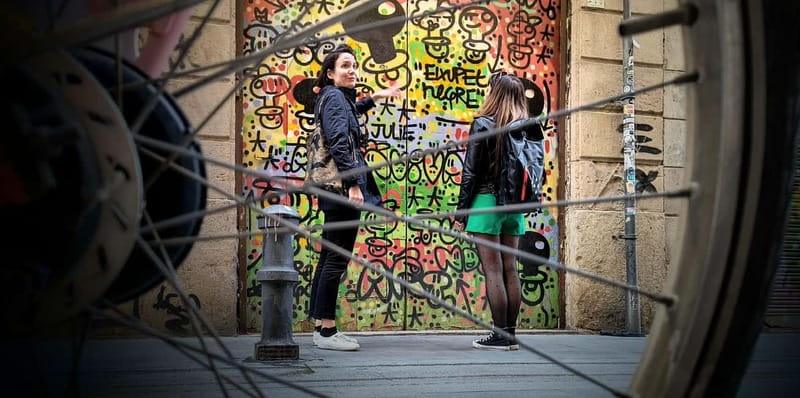
You may see Birdie Al Awan and work by Xupet Negre. Xupet Negre is described as one of the earliest graffiti artists in the city, making this a valuable stop for understanding Barcelona’s local graffiti roots. The guide can explain how artists work within the city, how symbols become signatures, and why certain walls matter.
This is where the bike format pays off. On foot, you could certainly explore the same area, but the organized route saves you from piecing together locations yourself. You also get a guide who can connect the artworks rather than leaving you to guess what you are seeing.
The tradeoff is pace. You may want to stop longer at one wall, but the group needs to keep moving. Use your phone for quick photographs, and save your favorite locations for a later walk if you want more time.
Rambla del Raval and the Feminist wall
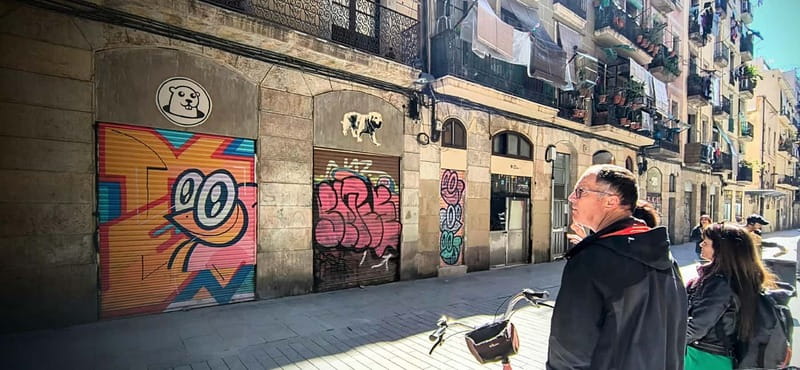
Rambla del Raval brings a different mood. The route includes the Feminist wall, Space Invader, and work associated with Ana Eliza. These pieces add themes of strength, diversity, and public identity to the tour.
Space Invader’s work is especially suited to a city ride because it rewards attention. Small tiled figures can be easy to miss when you are walking quickly, and a guide helps point out where to look. The Feminist wall gives the route a stronger social voice, showing that street art can be public commentary as well as decoration.
Rambla del Raval is also a place where the surroundings matter. You are seeing art in a functioning neighborhood, not on a purpose-built art campus. That makes the experience feel more connected to daily Barcelona, though it also means street noise, traffic, and other people may interrupt parts of the talk.
Àgora Benítez and the Three Chimneys
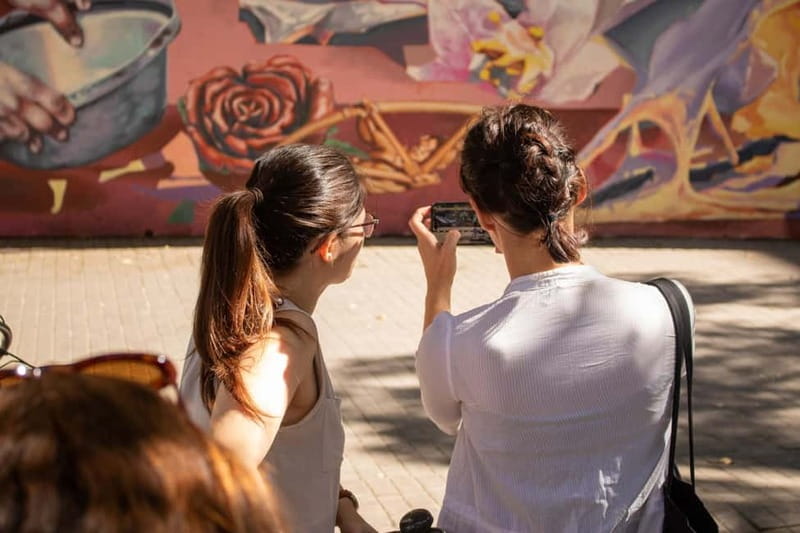
On Carrer de Aurora, the tour includes work by Àgora Benítez. The route then heads toward Avenida del Paralelo and the Galería Arnau. These stops continue the mix of painted work, theater-related surroundings, and changing public spaces.
The Jardins de les Tres Xemeneies is one of the more distinctive settings. The garden occupies a former industrial area, with three tall chimneys as its defining feature. The site shows how Barcelona has reused industrial structures and turned them into public space.
This is an excellent place for the tour’s theme because the setting itself tells part of the story. You see old industrial remains beside newer art and city activity. The guide can help you connect the physical setting with the work on the walls.
The stop is listed at about 10 minutes, which gives you a little more time for photos and explanation. Bring sunglasses and a hat, especially in strong sun. The experience takes place rain or shine, but a free poncho is provided if the weather turns wet.
Port Vell, La Gamba, and El Cap de Barcelona
The route continues toward the waterfront and the Columbus Monument. At Passeig de Colom, you see La Gamba, the famous lobster sculpture by Mariscal, and El Cap de Barcelona, also known as Barcelona’s Head, by Leinceshtain.
These works widen the definition of street art. They are large public sculptures, not wall paintings, but they belong to the same conversation about how art changes the way you move through a city. La Gamba is playful and easy to recognize. El Cap de Barcelona has a bolder, more graphic presence.
The waterfront portion also gives you scenic riding between stops. It is not only about looking at walls. You pass through some of Barcelona’s major public spaces and get a sense of how the central districts connect.
Keep in mind that the route has many stops. Some are photo opportunities with only a few minutes of explanation. If you prefer a slow tour with one or two major artworks, this may feel hurried. If you want a broad introduction to the city’s public art, the variety is a benefit.
El Beso, the Cathedral, and the final sights
Near Barcelona Cathedral, the tour reaches El Mural del Petó, usually called El Beso. This large photo mosaic is made from individual images and creates a kiss when viewed from a distance. It is one of the route’s most memorable visual ideas because the artwork changes depending on where you stand.
The Cathedral itself is passed rather than toured. That is an important distinction. You do not enter the Cathedral, and the tour does not replace a dedicated visit to the Gothic Quarter. You simply see how a modern public artwork sits within one of the city’s older settings.
The final section includes the Palau de la Música Catalana, Passeig de Gracia, and Casa Batlló. These stops bring the tour into Barcelona’s grand architectural center. Casa Batlló gives you a quick look at Gaudí’s distinctive exterior, while Passeig de Gracia connects it with the city’s major shopping and architectural boulevard.
The ride ends back at Carrer dels Tallers 45. Because the route returns to its starting point, you do not need to plan a separate pickup or figure out where to leave the bike.
What the $34 price gets you
At $34 per person, the tour offers solid value if you want a guided overview rather than a self-guided art hunt. The price includes the bike, an English-speaking guide, bottled water, a handlebar bag, and photo stops.
The strongest value is the route planning. You cover MACBA, Rambla del Raval, the Three Chimneys, the waterfront, the Cathedral area, Passeig de Gracia, and Casa Batlló in one outing. Doing all that alone would take time, map work, and a willingness to navigate Barcelona’s streets without local guidance.
The price is less compelling if you are mainly interested in one mural or already know the city well. You could visit several central works on foot for little or no cost, though you would lose the guide’s explanations and the convenience of the planned circuit.
The free cancellation period is up to 24 hours before departure, and you can reserve now and pay later. That helps if your Barcelona schedule is still shifting. Check the available start time when booking, since the advertised meeting time is 11 a.m. but availability should determine the current departure.
Who will enjoy this ride most
I would recommend this tour to first-time Barcelona visitors who want to combine art, landmarks, and light sightseeing. It also suits families with older children who can ride confidently. The feedback specifically describes children enjoying the outing, and the mixture of sculptures, murals, and short stops keeps the subject from feeling like a classroom lesson.
It is a good match for you if:
- You want a guide to explain street art instead of just finding it.
- You like seeing several parts of central Barcelona in one morning.
- You prefer an electric bike to a long walking tour.
- You enjoy public art, photography, and modern city culture.
- You want practical local suggestions after the ride. One guide provided food recommendations after the tour, which can be useful at lunchtime.
I would think twice if you cannot ride comfortably, need step-free access, dislike city cycling, or want extended time at each artwork. Adults who want a helmet should request one in advance, since complimentary helmets are specified for children up to age 16.
Wear comfortable clothes and shoes, bring sunscreen, sunglasses, a hat, weather-appropriate layers, and a charged smartphone. Carry identification or a copy, as requested in the tour information. Do not bring headphones.
Should you book the Moco Street Art Bike Tour?
Book it if you want Barcelona’s street art explained within a wider city ride. The Keith Haring mural, Xupet Negre, El Beso, La Gamba, and the Three Chimneys give the tour plenty of character, while MACBA, the Cathedral, Passeig de Gracia, and Casa Batlló add familiar Barcelona landmarks.
The best reason to choose it is the combination of coverage and interpretation. The route changes as the walls change, so you get a current look at a living art scene rather than a fixed museum collection. At $34, that is a fair deal for a 2.5-hour guided ride with equipment included.
Skip it if your priority is a slow, detailed study of individual works. For everyone else, especially first-time visitors and families who can ride, this is an efficient and engaging way to see how Barcelona’s old streets and new art share the same space.
FAQ
Where does the Barcelona Street Art Bike Tour start?
It starts at Carrer dels Tallers 45 in Barcelona. Meet by the palm tree and enter the passage where the Barcelona Ciclo Tour team will be waiting.
How long does the tour last?
The tour lasts 2.5 hours. Check availability for the current starting times.
What language is the tour in?
The live guided tour is in English.
Is a bike provided?
Yes. One bike per person is included, and the experience uses electric bikes.
Is water included?
Yes. Each participant receives a free bottle of water.
Are helmets provided?
Helmets are provided free of charge for children up to age 16, and helmets are mandatory for them. Adults can request a helmet in advance for an additional cost.
What happens if it rains?
The tour operates rain or shine. A poncho raincoat is provided free of charge if needed.
Can I cancel the booking?
You can cancel up to 24 hours in advance for a full refund. You can also reserve now and pay later.
More Barcelona Museums and Galleries
- Barcelona: FC Barcelona Museum “Barça Immersive Tour” Ticket
★ 4.4 · 10,944 reviews - Barcelona: Park Güell and Gaudí House Museum Entry Ticket
★ 4.5 · 6,326 reviews - Barcelona: Picasso Museum Skip-the-Line Guided Tour
★ 4.5 · 3,355 reviews - Girona & Dali Museum Small Group Tour with Pick-up from Barcelona
★ 5.0 · 2,965 reviews
Recently added around Barcelona
- Montserrat very early : Hiking, Abbey, very small group★ 5.0 · 127 reviews
- Guided Private Yacht Tour in Barcelona Spain★ 5.0 · 6 reviews
- Private Tour from Barcelona to Montserrat (with guide)★ 4.5 · 6 reviews
- Private Tour from Barcelona to Costa Brava (with guide)★ 5.0 · 5 reviews
- Andorra Tour★ 4.0 · 7 reviews
- Barcelona Gaudi Tour: Sagrada Familia, Casa Batllo & Casa Mila★ 5.0 · 4 reviews
- Street Art, Sculptures & Crime Stories Walking Tour – Barcelona★ 5.0 · 11 reviews
- Wine Tasting in Barcelona (Catalan Varieties) Small Groups★ 5.0 · 10 reviews
Barcelona Bike Tours, compared.
Barcelona 3-hour Bike or E-Bike Tour: Highlights and Hidden Gems
Read our review →
E-Bike Tour with Montjuic Cable Car & Boat Ride
Read our review →
Barcelona E-Bike Small Group Tour with Tapas & Wine Tasting
Read our review →
Browse the lists this tour appears in