Reviewed · TOURS
Esoteric & Spiritual Tour of Barcelona
Barcelona’s Gothic Quarter has a second story beneath its usual sightseeing script. On this three-hour walking tour, you follow clues tied to Templars, Masonic symbols, alchemy, Tarot, mysticism, and the birth of Kabbalah while moving through streets shaped by Roman and medieval Barcelona.
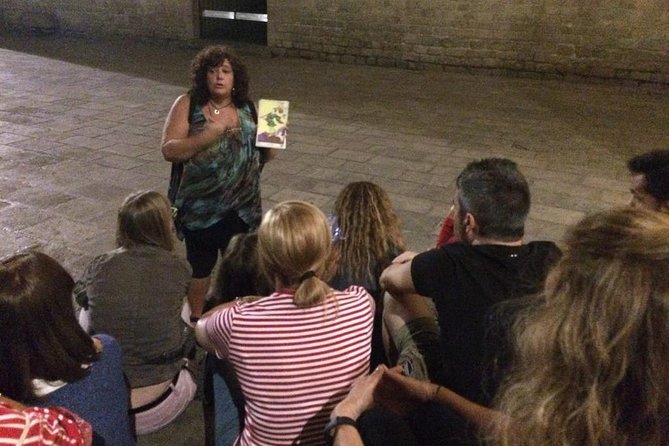
I like the small maximum of eight people, which gives guide Sandra room to answer questions and adjust the discussion. I also like the slow pace and the route from Plaça Catalunya to Plaça del Rei, since you get both an easy introduction to the city and a focused look at places many standard tours pass without much thought.
The main caution is the amount of material. Sandra covers a lot in three hours, and the subject can leave your head spinning. If you prefer dates, buildings, and conventional political history, this may feel too abstract or speculative at times.
Key points to know before you book
- A different Gothic Quarter walk: The route links El Call, Barcelona Cathedral, an old church, Roman remains, and medieval landmarks through the lens of spirituality and symbolism.
- Sandra leads the experience: Her teaching covers Western esotericism, Templars, Masonry, Rosicrucianism, alchemy, Kabbalah, mysticism, and Tarot.
- Small and personal: The tour is limited to eight people and is presented as a private experience, so you should have room to ask questions and shape the conversation.
- Slow walking, not a hard hike: Expect about three hours of strolling and standing on pedestrian streets, with no transport needed.
- Strong value for the right interest: At $90.02 per person, the price is higher than a basic neighborhood walk, but it includes a specialist guide and a tightly focused subject.
- Flexible start times: Morning and afternoon departures let you fit the tour around meals, museum visits, or other Barcelona plans.
Why this Gothic Quarter tour feels different
Most first visits to Barcelona’s Barri Gotic focus on grand churches, Roman walls, narrow lanes, and the pleasant pleasure of getting a little lost. This tour uses those same streets, but it asks different questions. What symbols survive in the stonework? How did Jewish, Christian, classical, and occult traditions cross paths? What stories sit behind familiar medieval places?
That approach gives you a new way to look at a neighborhood you might otherwise see as a collection of photogenic lanes. The tour is not simply a sightseeing walk with a few mystical facts added at the end. Western esotericism is the main subject, and the city provides the setting.
I would choose this experience after seeing Barcelona’s main architectural sights, or at least after getting your basic bearings. The more familiar you are with the Cathedral area and the shape of the Gothic Quarter, the easier it is to notice how Sandra connects separate places and traditions.
The tour begins near the top of Las Ramblas at Plaça Catalunya. From there, you walk into the older city, gradually leaving the open square and wide avenue behind for pedestrian streets and historic quarters.
Other Barcelona days people weigh up beside this one:
- Barcelona: Park Güell Admission Ticket
★ 4.4 · 76,534 reviews - Barcelona: Casa Batlló Entry with Self-Audioguide Tour
★ 4.7 · 25,359 reviews - Barcelona: 24 or 48-Hour Hop-On Hop-Off Bus Tour
★ 4.4 · 20,872 reviews
Plaça Catalunya to El Call
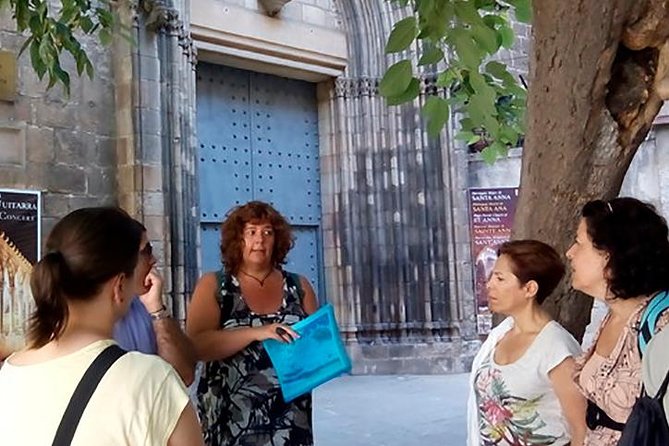
Plaça Catalunya is a practical meeting point. It sits at the upper end of Las Ramblas and is easy to reach by public transportation. The exact starting point is at Centre Comercial El Triangle, at Plaça de Catalunya, 1, 4.
The first part of the route helps set the tone. You are not being taken to a single museum or a private room filled with objects. The city itself is the classroom. As you walk, Sandra introduces the basic ideas behind Western esotericism and shows how spiritual traditions can be read through places, stories, symbols, and old urban spaces.
The move into El Call is especially useful. This was Barcelona’s historic Jewish district, and it gives the tour a setting for discussing the birth of Kabbalah and the relationship between Jewish mystical thought and other traditions covered during the walk.
Expect the conversation to move across several subjects rather than stay with one narrow theme. Templars, Masonry, alchemy, Rosicrucianism, mysticism, and Tarot all enter the discussion. That range is one of the tour’s pleasures, though it also explains why you may want to take notes or leave time afterward to sort through what you heard.
Roman remains beneath the medieval streets
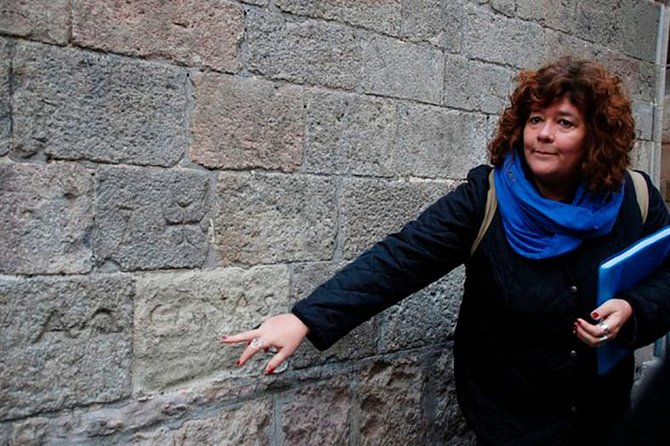
Barcelona is often presented through its medieval center, but the route also reaches back roughly 2,000 years to Roman remains. This matters because the tour is not limited to one era or one religious tradition. Roman foundations add an older layer to the later Jewish and Christian history of the quarter.
You can expect the Roman material to be tied to the larger story of how cities collect meanings over time. Ancient remains, medieval institutions, religious buildings, and later symbolic interpretations all share the same compact streets. That makes the walk feel more connected than a simple list of historic stops.
The Roman element also gives the route some variety. You are not standing in front of one church for three hours while a guide talks. The experience keeps moving through a large pedestrian area, with pauses for explanation and discussion.
Still, keep your expectations practical. This is a walking and interpretation tour, not a full archaeological visit. The supplied information promises Roman remains and medieval landmarks, but it does not present the tour as an archaeological excavation or a formal museum tour.
Around Barcelona Cathedral and an old church
The Cathedral area gives Sandra another strong setting for the subject. Here, the tour considers Christian symbols and medieval religious culture alongside the other traditions discussed on the route.
The appeal is in the connections. A standard Cathedral visit might focus on architecture, chapels, dates, and artistic details. This experience asks you to pay attention to symbolism and the ways spiritual ideas can appear in religious and civic spaces.
You will also visit an old church. The information provided does not name the church, so I would not book this expecting a specific famous building as the main event. Its value is the setting for the discussion, not a promise of a major interior visit or a particular art collection.
That distinction is important. The tour’s strongest feature is Sandra’s presentation and the way she links the sites. If you want a traditional church tour with a detailed architectural survey, another experience may suit you better. If you enjoy medieval history mixed with symbolism and mysticism, this stop should fit well.
A different sort of day out in Barcelona:
- Barcelona: Park Guell Guided Tour with Skip The Line Entry
★ 4.7 · 17,563 reviews - Barcelona in 1 Day: Sagrada Familia, Park Guell,Old Town & Pickup
★ 5.0 · 13,541 reviews - Barcelona Aquarium: Entry Ticket
★ 4.3 · 13,335 reviews - Barcelona: Sagrada Familia Skip-the-Line Entry Ticket & Tour
★ 4.8 · 12,789 reviews
The many threads of Western esotericism
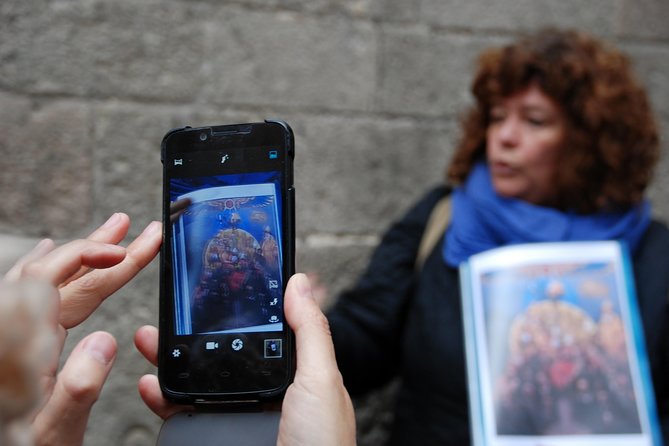
Sandra’s subject range is unusually broad. You may hear about the Templars, Freemasonry, Rosicrucianism, alchemy, Kabbalah, mysticism, Tarot, Ancient Greek sources, Hebrew traditions, and Christian thought.
That breadth is a major reason to book the tour, but it also shapes the kind of experience you get. This is not a narrow lecture about one order or one manuscript. It is a connected conversation about how different spiritual and symbolic traditions have been understood across time.
The best way to approach it is with curiosity rather than a demand for one tidy answer. Sandra’s work appears designed to open up questions and links between traditions. You may leave with several subjects you want to study further, rather than with a single final explanation of Barcelona’s secret past.
I would also keep a little intellectual distance. Esoteric subjects can involve interpretation, symbolism, and competing readings of history. The tour is most rewarding if you enjoy hearing possible connections and thinking about them, not if you expect every claim to be presented like a standard textbook fact.
The guide’s energy is part of the experience. Sandra is described as enthusiastic and generous with her expertise, and the structure allows conversation instead of a purely scripted monologue. One especially useful detail is that she may begin the tour just for your party, even when the experience allows up to eight people. That can make the opening feel more personal.
Why the small group matters
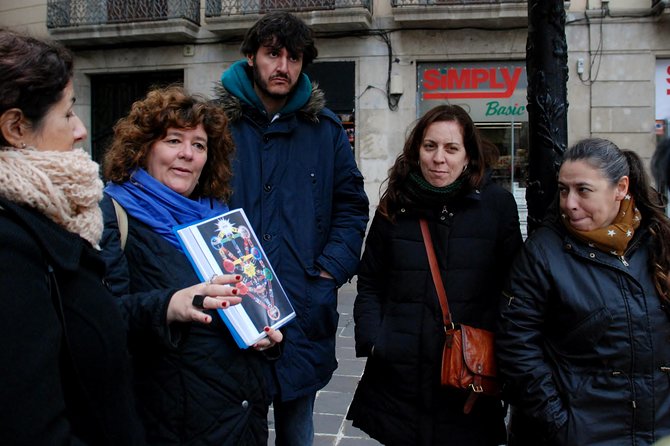
A maximum of eight people is a real advantage on narrow Gothic Quarter streets. You can hear the guide more easily, stay close together, and ask questions without waiting behind a large crowd.
The tour is also described as private, which points to flexibility. If your group becomes absorbed in a question about Kabbalah, Masonry, or symbolism, there should be more room to follow that thread than on a rigid, large-group city walk.
This does not mean every departure will feel like a completely custom research session. The route and main subjects are set. But the small format gives Sandra a better chance to respond to your interests and explain difficult ideas at a useful pace.
For couples, friends, or families with older children who already enjoy history and symbolism, this format can work particularly well. It is less suited to a group that wants quick stops, constant photo opportunities, or a light overview of Barcelona.
Three hours of slow walking and standing
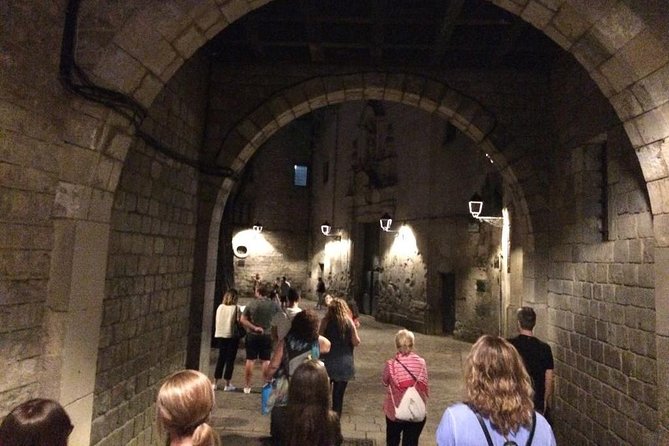
The physical demand is modest, but it is not zero. You will walk slowly through pedestrian streets and stand during explanations for about three hours.
There is no transport to arrange, and no additional expense is required for the route itself. Wear comfortable shoes, since the Gothic Quarter is best experienced on foot and the tour does not operate like a seated talk.
The slow pace is a strength. You have time to look up at buildings, notice details, and follow the conversation without racing from one point to another. It also lets the tour work for most people who can manage ordinary city walking.
If standing for long periods is difficult, think carefully before booking. The information says most people can participate and that service animals are allowed, but it does not promise seats at every stop or a fully step-free route.
Morning and afternoon departures give you some control over the day. A morning tour leaves the rest of your afternoon open. An afternoon departure can fit after another Barcelona activity, though you may want to avoid packing too many demanding tours around it.
Is $90.02 a fair price?
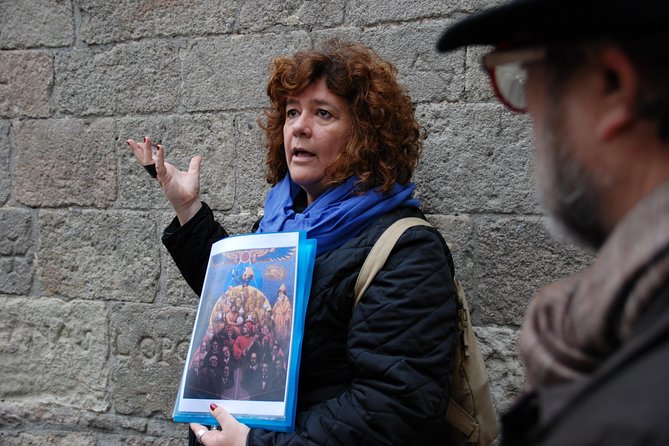
At $90.02 per person, this is not the cheapest way to see the Gothic Quarter. You are paying for a specialist guide, a small group, and a subject that goes far beyond a basic city orientation.
The price makes the most sense if you already have a genuine interest in Western esotericism, medieval symbolism, or spiritual history. Sandra’s range is the main value. You are not paying only to walk from Plaça Catalunya to Plaça del Rei. You are paying for interpretation that changes how you read the streets.
It is less compelling if you simply want to see the Cathedral, Roman remains, and El Call with a standard historical explanation. Barcelona has many conventional walks, and this one is intentionally more unusual.
Group discounts may improve the value for several people booking together. Since the tour is capped at eight, ask about the discount when arranging a larger party within that limit.
Ending at Plaça del Rei
The route finishes at Plaça del Rei, beside the Barcelona Cathedral in the Gothic Quarter. This is a useful ending because you finish in the same historic center you have been exploring, rather than being dropped far outside the old city.
Plaça del Rei also suits the tone of the experience. By the end, you have moved through Roman remains, El Call, medieval landmarks, an old church, and the Cathedral area. The final square leaves you in a place where you can keep exploring on foot or continue with a meal nearby.
The route is not designed to return you to Plaça Catalunya. Plan your next step from Plaça del Rei, which is already in the Gothic Quarter. No return transport is included because none is needed for the tour itself.
Who should book this experience?
I would recommend it most strongly to you if you enjoy:
- Medieval history mixed with spiritual traditions
- Symbolism, Tarot, alchemy, or mystical subjects
- Templar, Masonic, Rosicrucian, or Kabbalistic themes
- Slow walking with plenty of explanation
- Small groups and direct conversation with a guide
- Seeing familiar city streets from an unusual angle
You may want a different tour if your priority is Gaudi architecture, food, art museums, or a fast introduction to Barcelona’s main sights. This walk gives you some useful historical context, but its focus is firmly esoteric.
The tour also rewards an open mind. Sandra’s enthusiasm can make a complicated subject lively, yet the amount of information may be intense. If you already feel at home with these subjects, you will likely get more from the connections. If you are new to them, consider treating the walk as an introduction and not expecting to remember every name and theory.
Free cancellation is available if you cancel at least 24 hours before the start time. Changes or cancellations inside that window are not refunded, and poor weather can lead to a different date or a full refund. Since the experience takes place outdoors, check the forecast before setting your plans.
My verdict on the esoteric Barcelona walk
Book this tour if you want Barcelona’s Gothic Quarter presented through mystery, symbolism, and spiritual history rather than only kings, churches, and architecture. Sandra’s broad command of the subject, the small group size, and the slow route make it a strong choice for curious people who enjoy an energetic conversation.
Skip it if you want a simple introduction to the city or a conventional sightseeing walk. At $90.02, the experience needs to match your interests. For the right audience, though, it offers a rare way to see El Call, Roman remains, the Cathedral area, and Plaça del Rei as parts of a larger story.
FAQ
Where does the tour begin?
It begins at Centre Comercial El Triangle, Plaça de Catalunya, 1, 4, in Barcelona.
Where does the tour finish?
It finishes at Plaça del Rei in the Gothic Quarter, next to the Barcelona Cathedral.
How long does the tour last?
The tour lasts approximately three hours.
How much does the tour cost?
The listed price is $90.02 per person.
Is transportation included?
No transportation is needed or included because the experience is a walking tour through pedestrian streets.
How many people can join?
The tour has a maximum of eight participants.
Is the tour offered in English?
Yes. The experience is offered in English.
Are morning and afternoon departures available?
Yes. You can choose between morning and afternoon departure times.
Is cancellation allowed?
You can cancel for a full refund at least 24 hours before the start time. Cancellations or changes made less than 24 hours before the start are not refunded. If poor weather causes the tour to be canceled, you will be offered another date or a full refund.
Recently added around Barcelona
- Montserrat very early : Hiking, Abbey, very small group★ 5.0 · 127 reviews
- Guided Private Yacht Tour in Barcelona Spain★ 5.0 · 6 reviews
- Private Tour from Barcelona to Montserrat (with guide)★ 4.5 · 6 reviews
- Private Tour from Barcelona to Costa Brava (with guide)★ 5.0 · 5 reviews
- Street Art, Sculptures & Crime Stories Walking Tour – Barcelona★ 5.0 · 11 reviews
- Andorra Tour★ 4.0 · 7 reviews
- Barcelona Gaudi Tour: Sagrada Familia, Casa Batllo & Casa Mila★ 5.0 · 4 reviews
- Wine Tasting in Barcelona (Catalan Varieties) Small Groups★ 5.0 · 10 reviews
Tours, compared.
Park Guell Guided Tour with Skip The Line Entry
Read our review →
Sagrada Familia Skip-the-Line Entry Ticket & Tour
Read our review →
FC Barcelona Museum “Barça Immersive Tour” Ticket
Read our review →