
Reviewed · GAUDí TOURS IN BARCELONA
Barcelona: 2,5h Gaudí Segway Tour
Barcelona’s Gaudí sights are spread across the city, and this tour gives you a quick, lively way to connect them. You roll from the old center to the Eixample and Sagrada Familia, with stops at Casa Batlló, Casa Milà, and the Sagrada Familia rather than spending the whole day on foot.
I like the mix of famous architecture and less obvious stops, including Roman remains, Santa Maria del Mar, Ciutadella Park, and Gaudí’s early work at the Castell dels Tres Dragons. I also like that the guides, including Freddy and Danny, receive praise for being kind, helpful, and accommodating.
The catch is pace. Most stops last only five minutes, and admission to every major sight costs extra, so this is best for seeing the outside of Barcelona’s landmarks, not for touring their interiors.
Key points to know before you book
- Three major Gaudí exteriors in one route: See Casa Batlló, Casa Milà, and Sagrada Familia without arranging separate transport.
- A useful first Segway outing: Training and a safety briefing are included, and one recent participant found the machine easy to control on a first attempt.
- More than Gaudí: The route includes the Gothic Quarter, Born, Roman ruins, Ciutadella Park, Arc de Triomf, and Barcelona’s old bullring.
- Small groups within larger bookings: Up to 30 people can book, but larger groups are split into groups of six or fewer with a guide.
- Strict riding rules: Segway riders must be at least 14 years old, 150 centimeters tall, and between 45 and 130 kilograms.
- A good value for a city overview: At $45 per person, you get 2.5 hours of transport, commentary, and a broad route, but not entry to the buildings.
Why a Segway works for Barcelona’s spread-out Gaudí sights
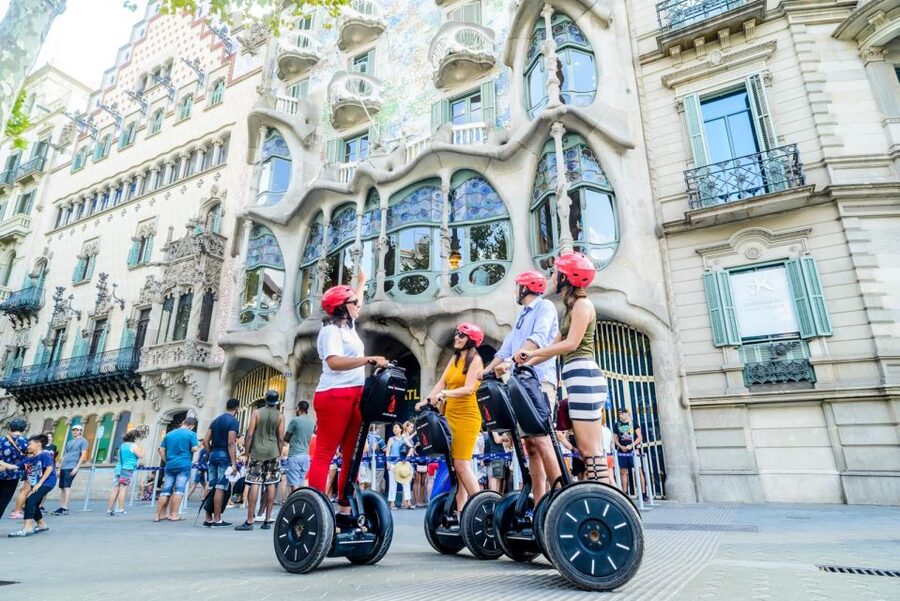
Gaudí’s best-known buildings are not all in one neighborhood. Casa Batlló and Casa Milà sit along Passeig de Gracia, while Sagrada Familia is farther northeast. The tour links these sites with the Gothic Quarter, Born, the waterfront, Ciutadella Park, and the Eixample.
That saves your feet and your planning time. You can cover ground between major areas without relying on the Metro for every change of scene. I find that especially useful on a first day in Barcelona, when you want to understand how the old city connects to the planned Eixample district.
You should not think of this as a series of long architectural lectures. The stops are short, generally five minutes, so the guide has time to point out a façade, explain a detail, and let you take a photo before moving on. This keeps the tour moving, but it also means you will need a separate visit if you want to see the interiors of Casa Batlló, La Pedrera, or Sagrada Familia.
The Segway itself is part of the appeal. A ten-minute safety briefing takes place at Jardins de les Tres Xemeneies, followed by instruction in safe operation. If you have never used one, you are not expected to arrive as an expert. One participant described a first attempt as easy to control and fun, which matches the simple appeal of learning a new way to move around the city.
More Gaudí Tours in Barcelona
- Barcelona: Park Güell and Gaudí House Museum Entry Ticket
★ 4.5 · 6,326 reviews - Sagrada Familia & Gaudi Tour Private or Small Group with Tickets
★ 4.5 · 1,188 reviews - Complete Gaudi Tour: Casa Batllo, Park Guell & Sagrada Familia
★ 5.0 · 1,152 reviews
Starting at Jardins de les Tres Xemeneies
The meeting point is Passatge de la Canadenca, 6, inside Jardins de les Tres Xemeneies. You meet the guide and Segways in the training square among the street art and skate park, not at a shop. Your guide and equipment are scheduled to be there five minutes before your booked time.
The nearest Metro access is Paral-lel, served by the purple L2 and green L3 lines. Use the Nou de La Rambla exit. Give yourself enough time to find the training square, since the instructions specifically tell you not to look for a storefront.
The briefing covers safe Segway operation before the group sets off. Comfortable shoes matter, and sunglasses are useful in bright weather. In winter, warm, water-resistant clothing and gloves are recommended. You should also bring a passport or ID card and dress for the forecast.
From the port to the old city

The first sightseeing points are around the waterfront and historic center. At Mirador de Colom, the guide makes a short photo and commentary stop by the Christopher Columbus monument. You then continue to El Cap de Barcelona, a colorful sculpture near the port designed by Roy Lichtenstein.
Next comes the Pla de Palau lampposts associated with Antoni Gaudí. This is a small detail that many people would miss when walking quickly through the city. It helps show that Gaudí’s work is not limited to the giant landmarks that appear on every postcard.
The tour then moves through the old neighborhoods, including the Gothic Quarter and Born. You see Roman ruins and pass the Basilica of Santa Maria del Mar, one of the most recognizable churches in the Born district. The route also includes El Born Centre Cultural, where the remains of an earlier city are part of the setting.
This part gives the tour a useful sense of contrast. Barcelona’s oldest districts have tight streets and layers of Roman and medieval history, while the later Eixample was laid out on a much broader plan. A Segway lets you move between these areas faster than walking, though the short stops mean you should listen closely when the guide explains what you are seeing.
The route also lists the Basilica of Our Lady of Mercy and a return through Parc del Mirador del Poble-sec. These stops help fill out the city beyond Gaudí, but they are not long visits. Expect exterior sightseeing and photographs rather than time inside churches or cultural buildings.
Ciutadella Park and Gaudí’s early work
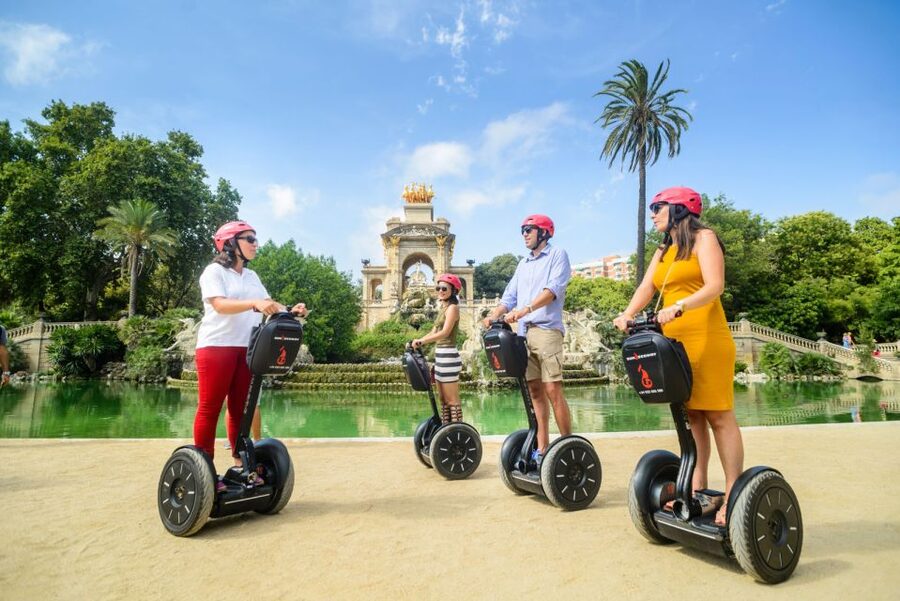
Ciutadella Park is one of the most pleasant stretches of the route. You glide through Barcelona’s largest park and see the Parliament of Catalonia and the Castell dels Tres Dragons.
The castle matters to Gaudí fans because it connects with his early career. He worked on the building with architect Lluís Domènech i Montaner, before Gaudí became the household name associated with Barcelona’s most famous modernist buildings. The stop gives you a glimpse of a younger, less established Gaudí.
The park also provides a change of pace from city streets. You are not simply ticking off façades along a commercial avenue. You get trees, open space, and a look at how Barcelona uses one of its major public parks.
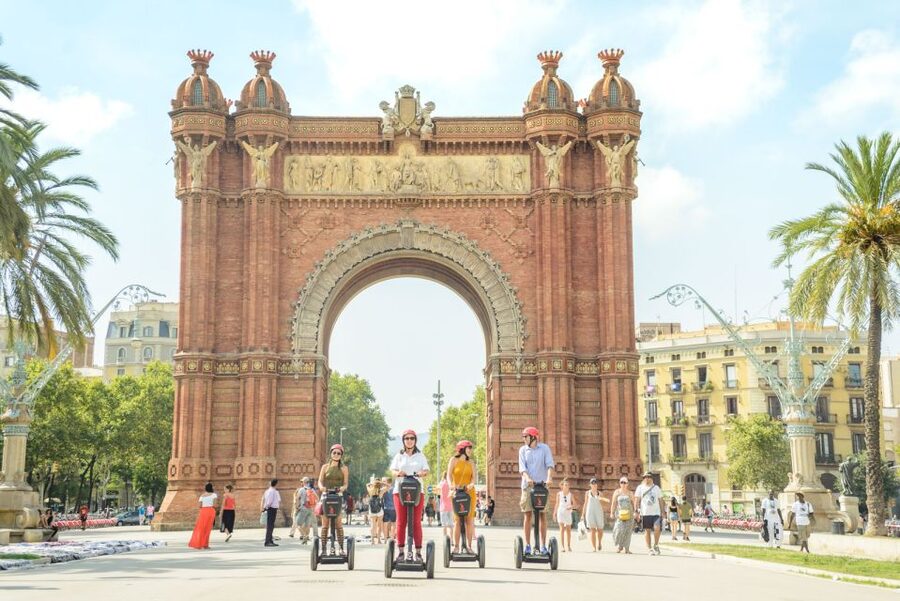
From there, you pass Arc de Triomf. It served as the main entrance to the 1888 Universal Exhibition held in Barcelona. Unlike many triumphal arches, it was designed as a civic gateway rather than a military victory monument. The broad avenue also makes for a strong photo stop and a clear transition into the Eixample.
More Barcelona Segway Tours:
- Barcelona Segway Tour
★ 5.0 · 680 reviews - Barcelona Segway Tour
★ 4.7 · 630 reviews - Barcelona: City Highlights Guided Segway Tour
★ 4.9 · 624 reviews - Barcelona: 2-Hour City Sights Guided Segway Tour
★ 4.9 · 453 reviews
Passeig de Gracia and the modernist façades
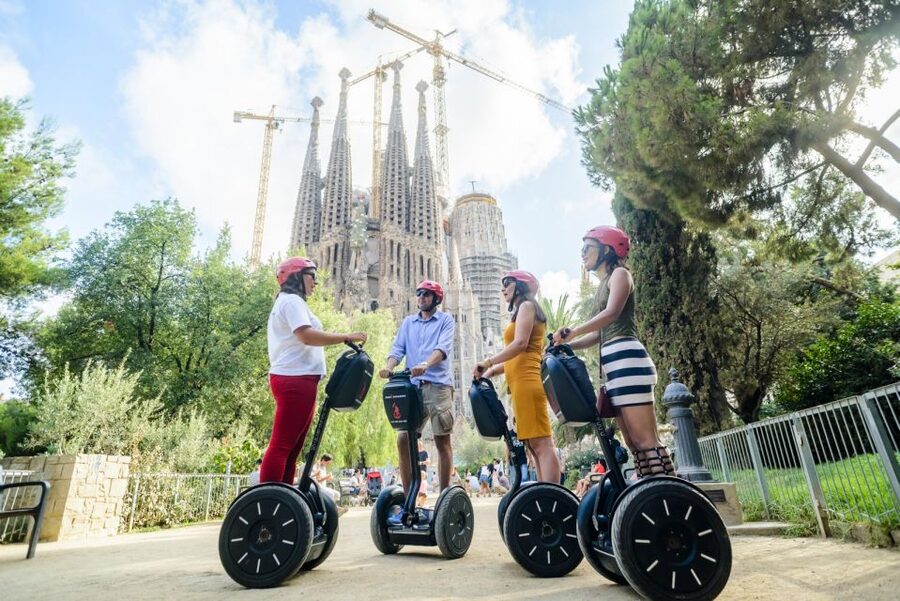
Passeig de Gracia is the architectural centerpiece of the tour. It is also one of Barcelona’s main luxury shopping streets, so you see expensive boutiques alongside some of the city’s most important Modernisme buildings.
The guide points out lesser-known modernist works such as Casa Calvet, Casa Amatller, and Casa de les Punxes. These buildings are worth noticing because Gaudí’s style did not develop in isolation. Barcelona’s early twentieth-century architecture was shaped by several designers, each using curved forms, ornament, tile, ironwork, and unusual rooflines in different ways.
Casa Batlló is the headline stop. Its façade is famous for its color, flowing shapes, and almost storybook quality. The exterior is often read as a dragon’s back, though the building rewards you simply for looking at its balconies, windows, roofline, and shifting ceramic surfaces.
You get about five minutes here for a guided explanation and photographs. That is enough to appreciate the outside, especially if you want a quick introduction to Gaudí’s visual language. It is not enough to tour the rooms, climb through the building, or study the interior light wells. If Casa Batlló is high on your list, plan a separate timed admission.
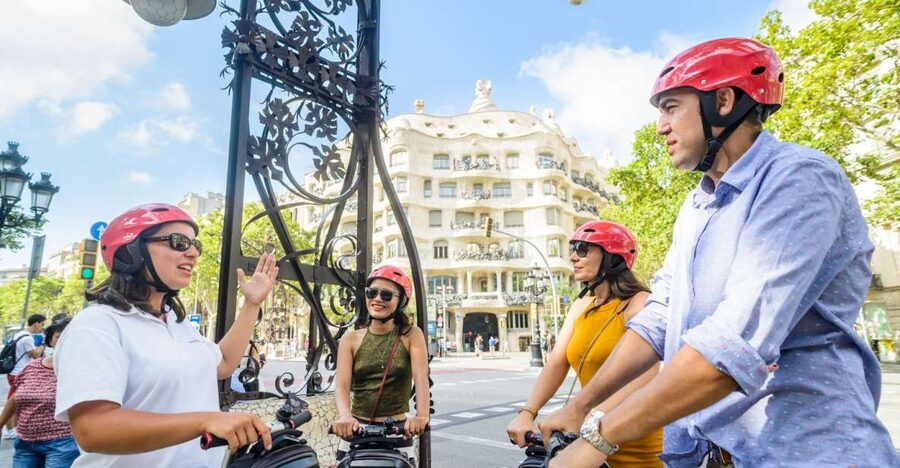
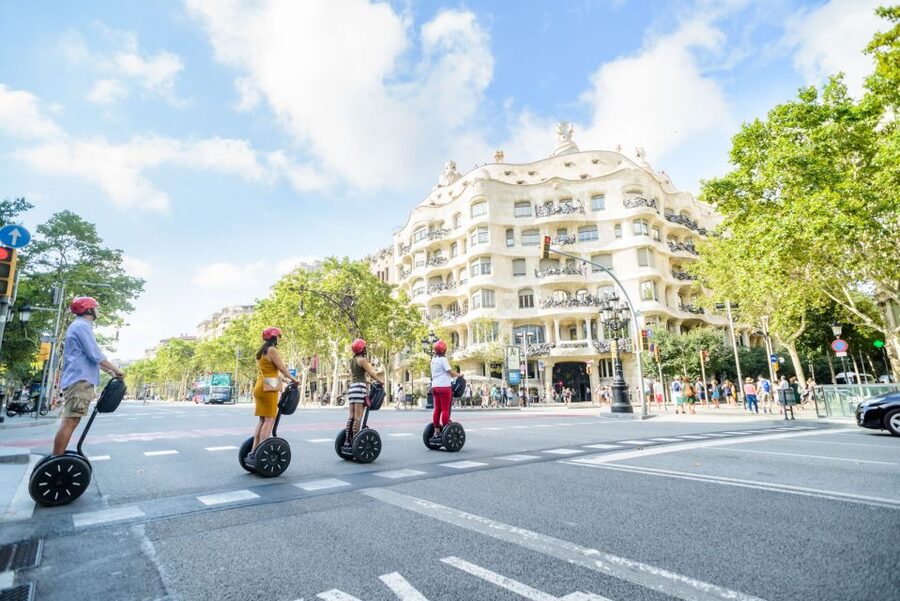
Casa Milà comes next. Built in 1906, it was one of Gaudí’s final major works and is commonly called La Pedrera because of its rough, stone-like exterior. The undulating façade looks unlike a conventional apartment block, with iron balconies and a surface that seems to move along the street.
The guide also explains the building’s place in Barcelona’s growth. When La Pedrera was built, it marked the edge between Barcelona and the former village of Vila de Gracia, before that settlement was absorbed into the expanding city. That detail makes the building more than a strange façade. It shows how the city was changing around it.
Again, you see the exterior rather than the famous rooftop chimneys or interior courtyards. You can return later if those features matter to you.
Sagrada Familia, the tour’s big finish
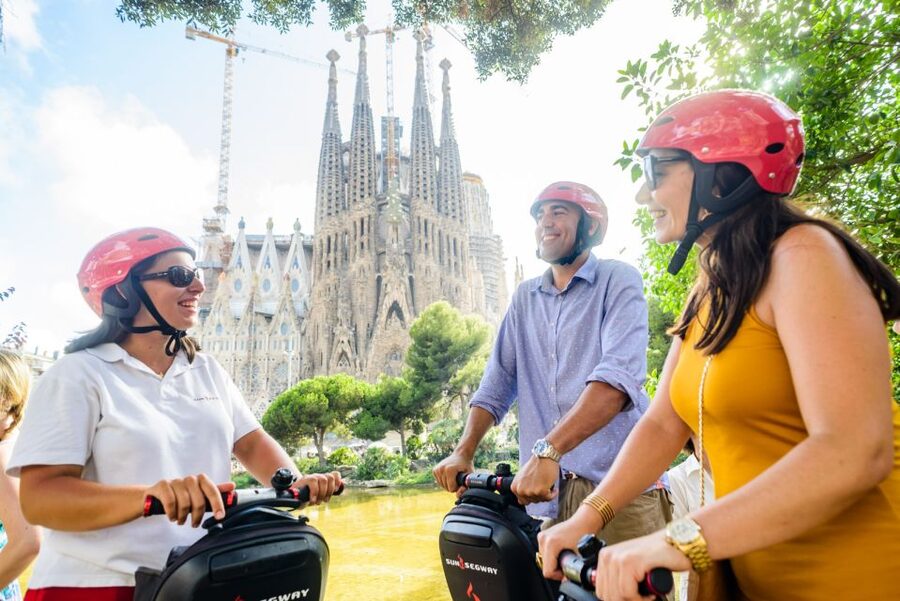
Sagrada Familia is likely the most anticipated stop. Construction began in 1882, and the basilica remains closely tied to Gaudí’s vision and Barcelona’s identity.
The tour gives you time to photograph the exterior and hear a short explanation of the building’s place in Catalan Modernisme. You can study the different façades, towers, and dense stonework from outside, but entry is not included. If you want the full interior, tower access, and a longer look at the design, book an official admission separately.
For many people, seeing Sagrada Familia from the street is still worthwhile. The scale is hard to grasp in a photograph, and a guide can help you notice details that would otherwise blur together. But you should be clear about what you are buying: this is a city ride with an exterior stop, not a basilica visit.
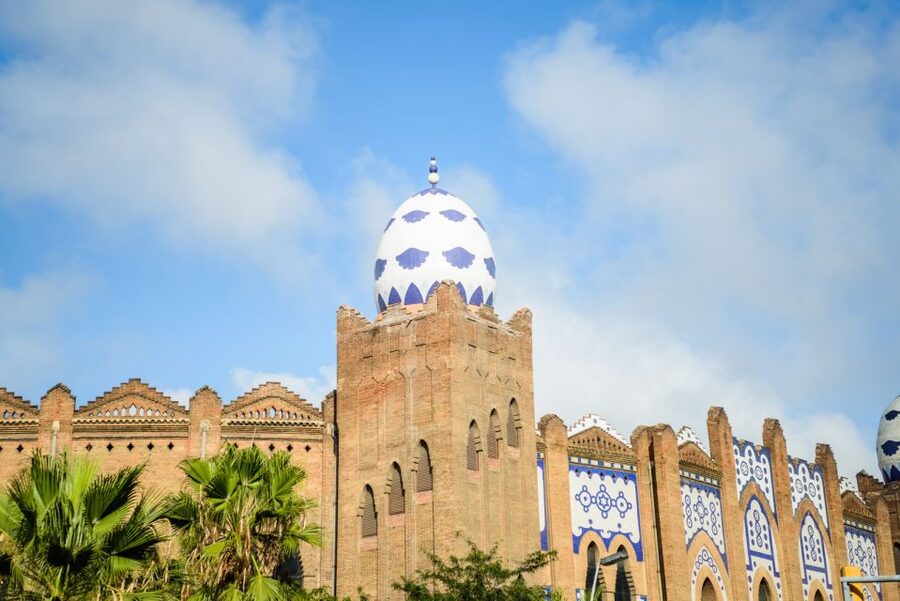
The last listed sight is La Monumental, a former bullring. Bullfighting has been prohibited in Catalonia since 2012, and the building now serves as a reminder of a part of Barcelona’s past that has changed. It is a useful final stop because the tour is not only about Gaudí. It also touches on public spaces, local customs, city planning, and changing attitudes.
What the $45 price really gets you
At $45 per person, the price is reasonable if you want a guided overview and an efficient way to move among distant sights. The fee includes the Segway, helmet, training session, and live guide. You are paying for transport, route planning, and commentary as much as for the machine itself.
The value drops if you expect entry to Sagrada Familia, Casa Batlló, or Casa Milà. None of those admissions is included, and adding all three could make the day considerably more expensive. The tour works best as an orientation, followed by one or two carefully chosen interior visits.
The guide language choice is generous. Tours are available in Spanish, English, French, Italian, Portuguese, and Arabic. Private groups are also available if you want a more personal pace or have a specific group arrangement.
Groups can reach 30 people, but larger bookings are split into smaller units of six or fewer, each with a professional guide. That setup matters because Segway riding is easier when the group is not spread across several blocks. Recent praise for Freddy and Danny focuses on kindness, help, and accommodating service, which are useful qualities when someone is learning to ride.
Tips are not included, so carry a little extra if you feel the guide earned one. Food, drinks, and hotel pickup are also not included. The tour begins and ends at the same Passatge de la Canadenca meeting point.
Who should choose this tour?
I would choose this for a first or second visit to Barcelona when I wanted a broad city view without spending a full day on foot. It suits adults and older teenagers who meet the riding rules and enjoy outdoor sightseeing, short explanations, and frequent photo stops.
It is also a good fit if you want to compare several Modernisme façades before deciding which interiors deserve your time. Seeing Casa Batlló, Casa Milà, Sagrada Familia, Casa Amatller, and Casa de les Punxes in one route gives you useful context.
I would not choose it if your main goal is detailed architecture study. The schedule is too quick, and the stops are too short for that. It is also not suitable for children under 14 on Segways, pregnant women, or people with back problems. Anyone who does not meet the 45 to 130 kilogram and 150 centimeter requirements will need to check the alternative arrangement for younger participants, since those under 14 join on e-bikes.
You should also be comfortable outdoors for 2.5 hours. Alcohol and drugs are not allowed, and the operator recommends clothing suited to the weather.
Should you book the Barcelona Gaudí Segway Tour?
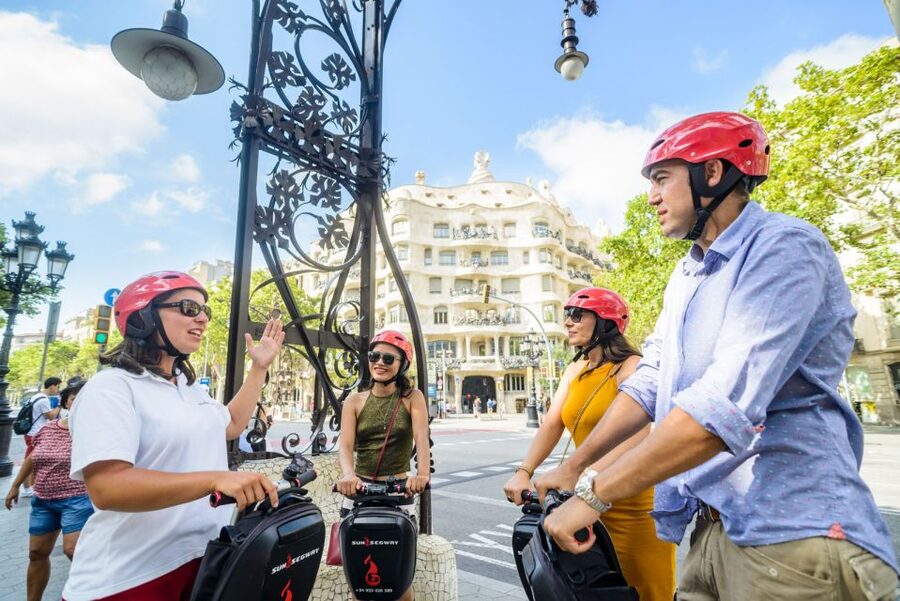
Book it if you want an energetic overview of Barcelona, prefer riding to long walks, and are satisfied with exterior visits. The route covers an impressive amount of ground, from Roman remains and Born to Passeig de Gracia and Sagrada Familia, while the $45 price includes equipment, instruction, and a live guide.
Skip it if you want to enter every major building or spend twenty minutes studying each façade. In that case, use the tour as a possible introduction, then reserve separate admission for the one or two Gaudí sites you care about most.
The strongest reason to book is the combination of famous works and local context. You get Gaudí’s icons, but also parks, old neighborhoods, civic buildings, modernist neighbors, and a former bullring. Just arrive ready to ride, wear comfortable shoes, and treat the short stops as a preview rather than the full visit.
FAQ
How long does the Barcelona Gaudí Segway Tour last?
The tour lasts 2.5 hours. Starting times vary, so you need to check availability for the date you want.
Where does the tour begin?
It begins at Passatge de la Canadenca, 6, inside Jardins de les Tres Xemeneies. Meet in the training square among the street art and skate park.
How do I reach the meeting point by Metro?
Take the purple L2 or green L3 to Paral-lel station, then use the Nou de La Rambla exit.
Is Segway training included?
Yes. The tour includes a training session and a ten-minute safety briefing before departure.
What languages are available?
Live guides are available in Spanish, English, French, Italian, Portuguese, and Arabic.
Is admission to Sagrada Familia included?
No. Entry to Sagrada Familia is not included. The tour makes a guided exterior and photo stop.
Are Casa Batlló and Casa Milà admissions included?
No. The tour visits the buildings from outside, and entry to attractions is not included.
What is the minimum age for the Segway?
The minimum age for riding a Segway on this tour is 14. Participants under 14 join the tour on e-bikes.
Are there weight and height requirements?
Yes. Segway riders must weigh between 45 and 130 kilograms and be at least 150 centimeters tall.
Can pregnant women join the tour?
No. Pregnant women cannot join for safety reasons. The tour is also not suitable for people with back problems.
What should I bring?
Bring a passport or ID card, comfortable shoes, sunglasses, and clothing suited to the weather. Warm, water-resistant clothing and gloves are recommended in winter.
Does the tour return to the starting point?
Yes. The activity ends back at Passatge de la Canadenca, 6.
Recently added around Barcelona
- Montserrat very early : Hiking, Abbey, very small group★ 5.0 · 127 reviews
- Guided Private Yacht Tour in Barcelona Spain★ 5.0 · 6 reviews
- Private Tour from Barcelona to Montserrat (with guide)★ 4.5 · 6 reviews
- Private Tour from Barcelona to Costa Brava (with guide)★ 5.0 · 5 reviews
- Barcelona Gaudi Tour: Sagrada Familia, Casa Batllo & Casa Mila★ 5.0 · 4 reviews
- Street Art, Sculptures & Crime Stories Walking Tour – Barcelona★ 5.0 · 11 reviews
- Andorra Tour★ 4.0 · 7 reviews
- Wine Tasting in Barcelona (Catalan Varieties) Small Groups★ 5.0 · 10 reviews
Gaudí Tours in Barcelona, compared.
Park Güell and Gaudí House Museum Entry Ticket
Read our review →
Sagrada Familia & Gaudi Tour Private or Small Group with Tickets
Read our review →
Complete Gaudi Tour: Casa Batllo, Park Guell & Sagrada Familia
Read our review →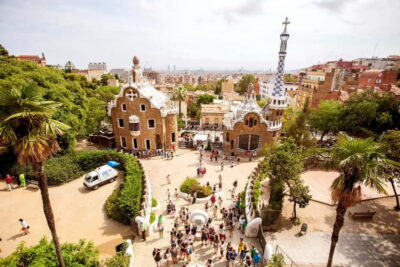
Park Güell: Guided Tour with Optional Gaudí Experience Entry
Read our review →
Ramblas, Old Town, Gothic and Gaudi Architecture Walking Tour
Read our review →
Gaudi´s Casa Vicens Skip the Line Ticket with Audioguide
Read our review →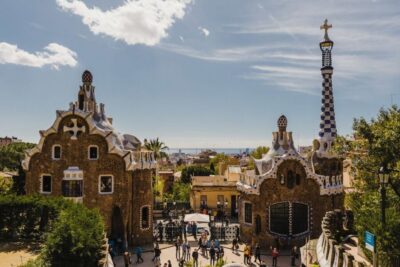
Discover Gaudí, Sagrada Familia, and Park Güell
Read our review →
Browse the lists this tour appears in