
Reviewed · BARCELONA TAPAS TOURS
Gothic Quarter Insights & Tapas Experience
Barcelona’s Gothic Quarter is easiest to understand when you move through it in layers: Roman Barcino beneath your feet, medieval churches and palaces above it, and modern Barcelona woven through the old streets. This 2.5-hour walking tour links the main sights with stories, legends, architecture, and a final pintxo and drink.
I like the clear route from Plaça Nova to Santa Maria del Mar, and I like that the tour ends around a table rather than simply dropping you at the last monument. Guides such as Ariana, Leah, Núria, and Maria have been praised for warmth and lively storytelling. The main caution is that this is an overview, not a full historical seminar, and one past participant wanted more legends and fewer building facts.
Key points to know before booking
- Roman Barcelona appears early: See the old city wall, the Barcino letters, and the four surviving columns of the Temple of Augustus.
- The route covers nine major stops: You visit medieval squares, churches, civic buildings, and Carrer de Montcada.
- A pintxo and drink are included: This gives you a small taste of Barcelona’s bar culture at the end.
- The group can reach 20 people: A smaller group may feel more personal, while a full group can make narrow streets harder to manage.
- The 3:30 pm start is useful: It fits well after lunch or as a first-afternoon orientation to the old city.
- Comfortable shoes matter: This is a walking tour through narrow lanes and historic streets, with no hotel pickup.
Starting at Plaça Nova beside the Roman wall
Meet at Lamaro Hotel Barcelona, Av. de la Catedral, 7, at 3:30 pm. The address is beside Barcelona Cathedral and close to Plaça Nova, so you begin in one of the best places to see how the old city has been built up over time.
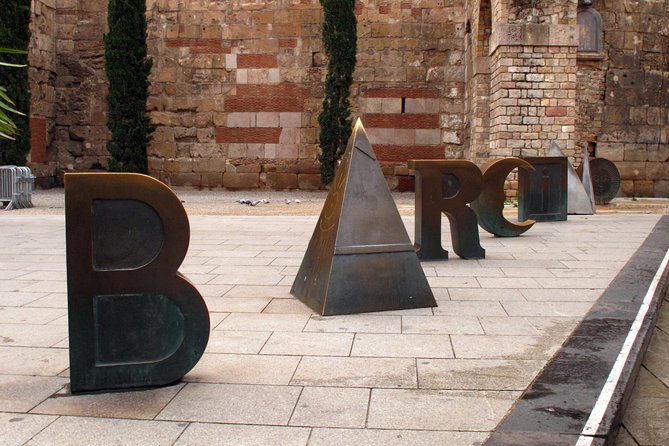
Plaça Nova was created in the 14th century in front of the Roman city gate. The square now mixes medieval remains, later buildings, and Joan Brossa’s large Barcino letters. The seven metal letters spell the Roman name linked to Barcelona’s beginnings, making a playful contrast with the stone wall behind them.
I like this opening because it gives you a useful frame before the walk gets more detailed. You are not simply looking at old stones. You are seeing the boundary of Roman Barcino and the later city that grew around it.
The meeting area can become crowded. One group had trouble spotting the guide during a street fair, then found the guide by looking for an umbrella. The exact umbrella color is not guaranteed, so arrive a little early, keep your phone handy, and look around the hotel and cathedral area before the 3:30 start.
More Barcelona Gothic Quarter Tours:
- Barcelona all included: Sagrada, Park Güell, Montjuic & Gothic
★ 5.0 · 2,169 reviews - Barcelona Gothic Quarter Tapas & Taverns Food & Wine Tour
★ 5.0 · 1,470 reviews - Barcelona: Gothic Quarter Ghosts and Legends Walking Tour
★ 4.7 · 1,443 reviews
Cathedral, Casa de l’Ardiaca, and the small lanes
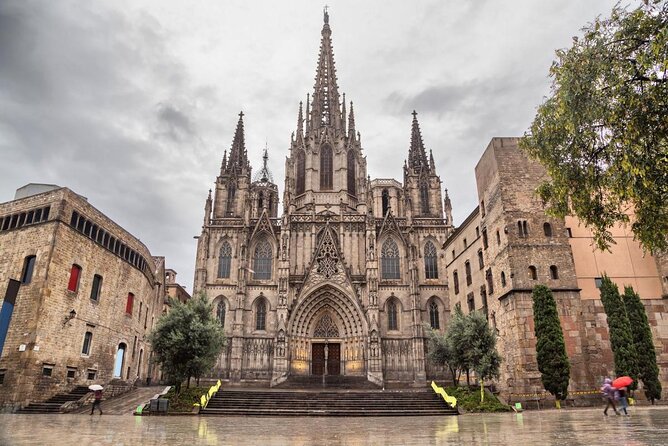
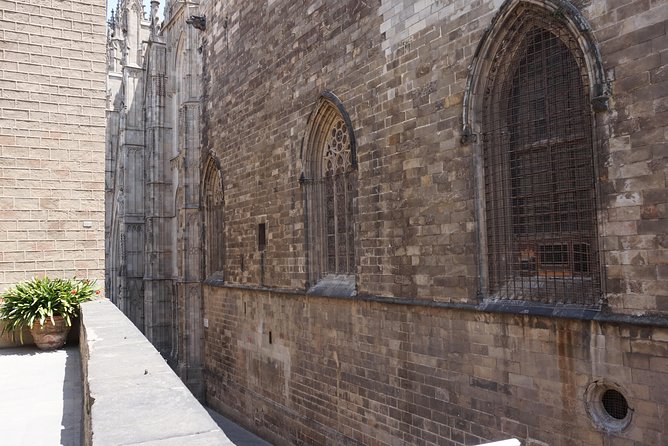
The next stops bring you into the religious and civic heart of the Gothic Quarter. At Barcelona Cathedral, the guide explains how the city’s episcopal center developed within and around the Roman walls. The supplied timing gives this stop only about five minutes, so expect an outdoor explanation rather than a full interior visit.
That distinction matters. This experience is built around streets, squares, façades, and context. It is not a cathedral entry tour, and the itinerary does not promise admission inside the monuments.
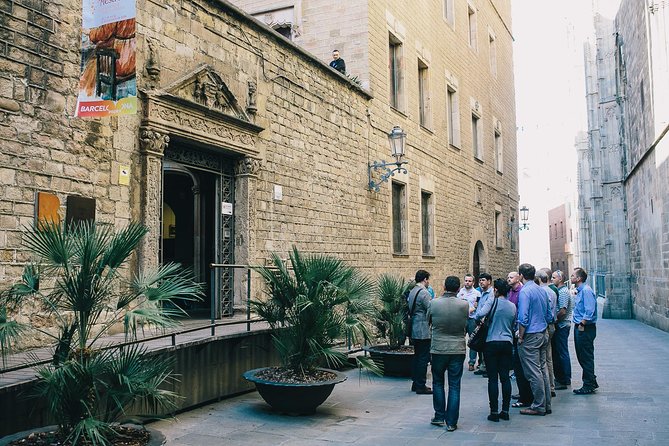
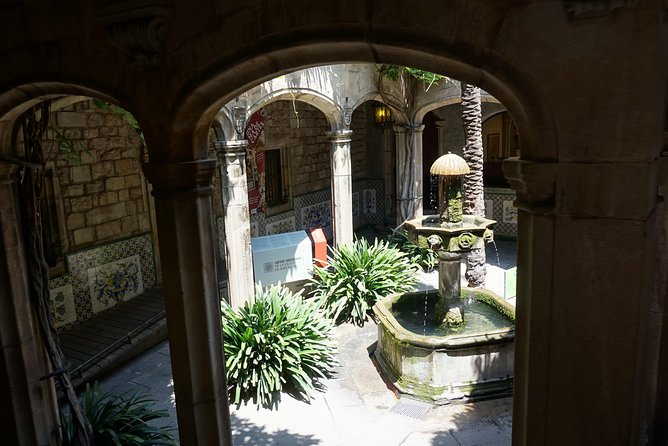
At Casa de l’Ardiaca, you see a former residence of church officials that changed over many centuries. Its courtyard, portico, Renaissance details, and Gothic foundation show how Barcelona’s buildings were altered rather than replaced each time the city changed.
The building’s staircase and upper terrace have a particularly picturesque character. Your guide can use the site to explain how religious power, architecture, and urban life overlapped in the medieval city.
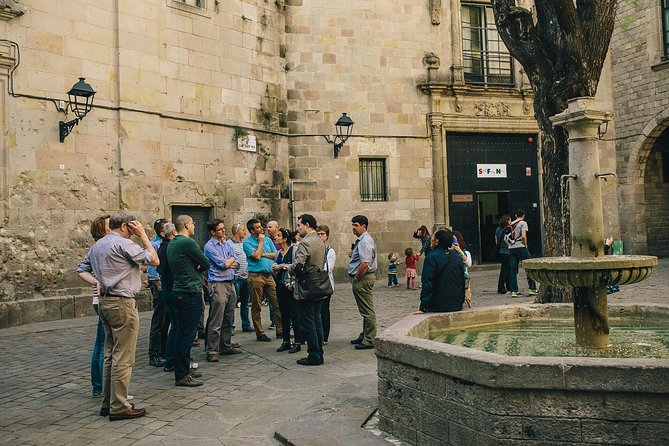
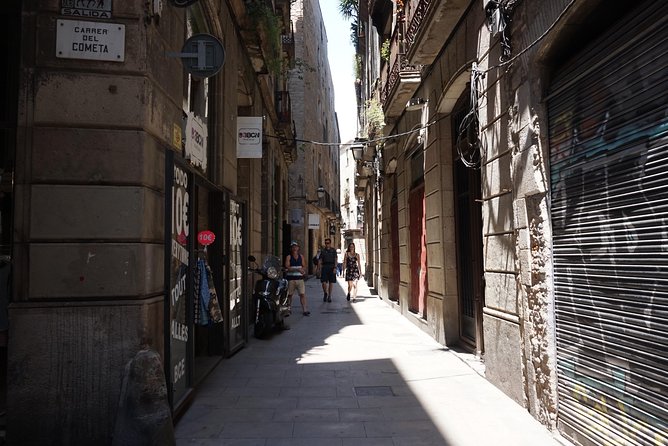
The walk then continues through narrow streets to Plaça Sant Felip Neri. This is one of the most atmospheric pauses on the route, with a small fountain, a Baroque church, and former guild buildings connected with shoemakers and coppersmiths.
Give yourself time to look up here. The square is easy to pass if you are moving quickly, but the charm comes from its scale and quiet shape. The tour’s ten-minute stop is enough for photographs and explanation, though not for a long visit inside the church.
Placeta del Pi and Barcelona’s church squares
Placeta del Pi offers a different view of the Gothic Quarter. The basilica and its surrounding squares occupy the site of old cemeteries, which were gradually transformed into public spaces. Painters and artisans have traditionally used these areas to display their work.
This stop helps you see the Gothic Quarter as a lived-in neighborhood rather than a row of monuments. Churches, markets, workshops, guilds, and burial grounds were all part of the same compact urban world.
The guide’s role is especially useful here. A building façade can be impressive but hard to read on your own. A good explanation connects the church to the square, the square to the former cemetery, and the whole setting to the way medieval residents used the city.
This is also a good point to decide how much detail you want from the tour. Most of the strongest praise has gone to guides who explain architecture while adding small facts about daily life and local customs. If your main goal is a long series of legends, ask questions as you go. The experience leans toward history and buildings, with stories added along the way.
Plaça del Rei and the medieval royal center
Plaça del Rei is one of the route’s major historical stops. The square is enclosed by the Palau Reial Major and other buildings that formed the royal center of medieval Barcelona.
The setting is formal and enclosed, a sharp contrast to the winding lanes around it. It gives you a clear sense of how the city’s rulers presented power through architecture. The ten-minute visit is well used for orientation and photographs, but you should not expect a full museum visit or an extended examination of every building.
The Conjunt Monumental around the square represents one of Barcelona’s clearest medieval architectural groups. That makes it valuable early in your visit, especially if you are still trying to understand the city’s old center.
I would pay close attention to the guide’s explanation here, then return later if you want more time. A guided introduction helps you recognize the square’s parts, while an independent revisit lets you enjoy the space without keeping up with the group.
More Barcelona Tapas Tours:
- Montserrat Half-Day Tour with Tapas and Gourmet Wines
★ 5.0 · 7,359 reviews - Montserrat & Cogwheel Train, Gourmet Wine Tasting & Tapas/Lunch
★ 5.0 · 6,290 reviews - Barcelona Tapas and Wine Experience Small-Group Walking Tour
★ 5.0 · 5,804 reviews - Montserrat with Black Madonna & Medieval Winery with Tapas/Lunch
★ 5.0 · 5,209 reviews
The Temple of Augustus, a Roman surprise
The MUHBA Temple d’August is one of the most rewarding stops because it is easy to miss. Behind a small medieval courtyard on Carrer Paradís, four columns from the Temple of Augustus have survived for more than 2,000 years.
You do not need a huge site to feel the age of Barcelona. These columns make the city’s Roman past suddenly concrete. After walking through medieval streets, you are reminded that Barcelona’s oldest layers sit directly beneath its later ones.
The short stop works well because the site is compact. The guide can explain what you are seeing, why the columns survived, and how Roman remains became part of a later neighborhood.
This is one of the places where the tour offers more than a basic postcard route. You may pass the Gothic Quarter’s famous churches on your own, but a tucked-away Roman remnant is much easier to overlook without local direction.
Santa Maria del Mar and Carrer de Montcada
The route continues to the Basilica of Santa Maria del Mar, often called the real cathedral of the old town because local people built it in the medieval period. It is a leading example of Catalan Gothic architecture and one of the area’s essential landmarks.
The ten-minute timing means the tour focuses on the exterior and the story of the basilica. The supplied information does not include interior admission, so plan on a guided look rather than a full church visit.
Santa Maria del Mar also helps balance the route. Earlier stops focus on Roman remains, church administration, royal authority, and small squares. Here, the emphasis shifts toward the people of the neighborhood and the scale of medieval religious building.
The final listed stop is Carrer de Montcada, the city’s most important zone for medieval civic architecture. The street runs from the Romanesque Marcus Chapel toward Plaça del Born and takes its name from the powerful Montcada family.
Carrer de Montcada is a strong place to end the sightseeing portion because the buildings show how wealthy civic families shaped the city. The street was later divided by the opening of Carrer Princesa in the 19th century, another reminder that Barcelona’s old center has never been frozen in one period.
One pintxo, one drink, and a useful finish
The included food is simple: one pintxo and one drink. That is not a full meal, but it is enough to give you a taste of the local bar tradition and a chance to sit down after the walk.
A pintxo is generally a small bite associated with northern Spanish bar culture, while tapas is the broader term used for small shared dishes. One past group especially appreciated learning the difference during the stop, and that kind of small cultural detail is exactly where the food portion earns its place.
The drink and snack also help the group relax. The tour is capped at 20 people, although some sessions may be smaller. Past groups included seven and eight people, which allowed easy conversation with the guide and other members of the group.
Do not book this expecting a food crawl. You receive one pintxo and one drink, not a series of tastings. If you want dinner afterward, treat the stop as an introduction and continue eating elsewhere.
How the guide affects the experience
The strongest part of this tour depends on the guide. Ariana has been described as warm and well informed, while Leah was praised for making Barcelona’s past feel lively and easy to follow. Núria led a family group that included teenagers and kept the tour engaging for different ages. Maria also received strong praise for her approach.
Those names come from individual sessions, so you cannot choose a particular guide when booking. Still, they show the style you should expect: clear explanations, local stories, a friendly manner, and plenty of chances to ask questions.
Languages listed for the experience include English, Spanish, French, and Italian. The inclusion details specifically identify English, Spanish, and French, so check the available language at booking if this is important to you.
The tour is described as suitable for most people, and service animals are allowed. You should still wear comfortable shoes. The route covers a lot of ground on foot, and the old streets are not designed for a fast, straight walk.
Is $54.06 a fair price?
At $54.06 per person, the price is reasonable if you want an organized introduction to Barcelona’s oldest center and value a guide who can connect scattered sights into one story.
You are paying for roughly two and a half hours, the guide, a planned route through nine stops, one pintxo, and one drink. The attractions themselves are listed as free, so the value rests mainly in the explanation, the route, and the convenience of seeing several important places without planning every turn yourself.
I would compare this with the cost of a self-guided walk. You can see many of these streets without paying, but you may miss the Temple of Augustus, misunderstand the purpose of Plaça del Rei, or walk past Casa de l’Ardiaca without knowing what it is. If you enjoy researching sites in advance, the tour may feel less necessary.
The best value comes when you take it early in your Barcelona visit. One past participant used it just after arriving from a cruise, and the 3:30 pm start worked well as a quick orientation to the area. I agree with that timing. After the walk, you know where the cathedral, royal square, Santa Maria del Mar, and Carrer de Montcada sit in relation to one another.
Who should book this Gothic Quarter walk?
I would suggest it to first-time visitors, history fans, architecture lovers, families with older children, and anyone who wants a friendly introduction before exploring alone.
It also suits solo visitors who like meeting a small group, since the shared pintxo and drink create an easy social finish. The group limit of 20 keeps it from becoming a huge walking procession, though a full group may feel less personal in narrow streets.
You may want a different experience if you dislike walking, want extensive church interiors, or expect a full meal. It may also disappoint you if legends and dramatic stories are your main goal. The tour does include anecdotes, but it gives more attention to buildings, urban development, and documented history.
Free cancellation is available up to 24 hours before the start time. The activity requires a minimum number of participants, so a cancellation by the operator can result in another date or a full refund.
Should you book it?
Book this tour if you want the Gothic Quarter explained rather than simply photographed. The route covers Roman columns, medieval churches, royal buildings, guild streets, and small squares, then adds a pintxo and drink without pretending to be a full food tour.
I would book it for the first or second day of a Barcelona visit, especially at the 3:30 pm start. You will leave with a working map of the old city and several places worth revisiting at your own pace. Skip it if you prefer complete independence or plan to spend hours inside each monument. For a compact, social introduction with strong guides and a practical route, it offers solid value.
FAQ
How long does the Gothic Quarter tour last?
The experience lasts approximately 2 hours and 30 minutes.
What time does the tour start?
The tour begins at 3:30 pm.
Where does the tour meet?
It meets at Lamaro Hotel Barcelona, Av. de la Catedral, 7, in Barcelona’s Ciutat Vella.
Where does the tour finish?
The activity ends back at the meeting point.
What food and drink are included?
The tour includes one pintxo and one drink.
What languages are available?
The experience is listed as being offered in English, Spanish, French, and Italian. The inclusion details specifically mention English, Spanish, and French, so confirm the language option when booking.
How large is the group?
The maximum group size is 20 people.
Can I cancel for a refund?
Yes. You can cancel at least 24 hours before the start time for a full refund. Changes or cancellations made less than 24 hours before the start time are not accepted for a refund.
Recently added around Barcelona
- Montserrat very early : Hiking, Abbey, very small group★ 5.0 · 127 reviews
- Guided Private Yacht Tour in Barcelona Spain★ 5.0 · 6 reviews
- Private Tour from Barcelona to Montserrat (with guide)★ 4.5 · 6 reviews
- Private Tour from Barcelona to Costa Brava (with guide)★ 5.0 · 5 reviews
- Andorra Tour★ 4.0 · 7 reviews
- Barcelona Gaudi Tour: Sagrada Familia, Casa Batllo & Casa Mila★ 5.0 · 4 reviews
- Street Art, Sculptures & Crime Stories Walking Tour – Barcelona★ 5.0 · 11 reviews
- Wine Tasting in Barcelona (Catalan Varieties) Small Groups★ 5.0 · 10 reviews
Barcelona Tapas Tours, compared.

Montserrat & Cogwheel Train, Gourmet Wine Tasting & Tapas/Lunch
Read our review →
Barcelona Tapas and Wine Experience Small-Group Walking Tour
Read our review →
Montserrat with Black Madonna & Medieval Winery with Tapas/Lunch
Read our review →
Montserrat and Winery Tour with Tapas or Lunch
Read our review →
Tapas Walking Tour with Food, Wine, and History
Read our review →
Barcelona Paella Cooking Class with Market Visit, Tapas & Sangria
Read our review →
Barcelona Tapas Walking Tour: Food, Wine & History
Read our review →
Browse the lists this tour appears in