Reviewed · TICKETS
Sant Pau Recinte Modernista Entrance Ticket in Barcelona
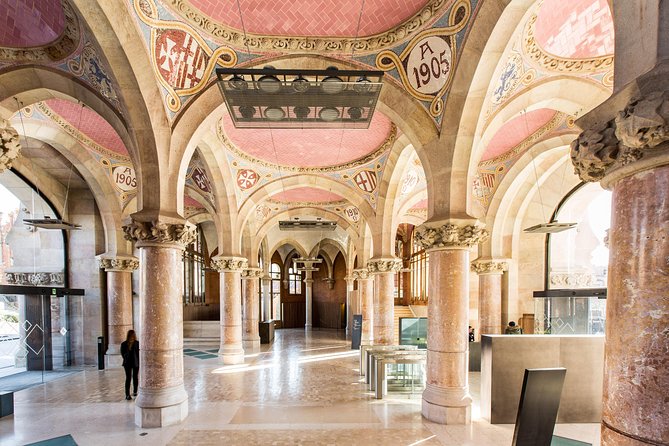
Sant Pau Recinte Modernista is a former hospital that looks more like a small city of palaces. Designed by Lluís Domènech i Montaner, it pairs colorful tiles, stained glass, sculptures, domes, and gardens with a practical plan for moving patients and staff. You explore it at your own pace, without being tied to a group.
I especially like the quiet gardens and the underground tunnels, which give you a feel for how this unusual hospital worked. I also like the chance to see restored rooms, including the old surgery area, rather than only admiring the exteriors. The main caution is that the self-guided route can feel unclear, and some areas may be closed during special events.
Key points before you book
- Former hospital with palace-like pavilions: See a working medical complex transformed into a major Art Nouveau monument.
- Underground patient tunnels: Walk through tiled passageways linking the pavilions and gardens.
- Sant Salvador Pavilion: Follow the hospital’s story from its 1401 foundation through the modern era.
- Audio guide costs extra: The admission ticket does not include narration, but an audio device can be rented for €4.
- Close to Sagrada Família: Sant Pau is a short distance from Barcelona’s other great Modernisme landmark.
- Plan on 1 to 2 hours: Allow extra time if you read every display or stop often for photographs.
Why Sant Pau feels different from Barcelona’s usual sights
Barcelona has no shortage of grand Modernisme buildings, but Sant Pau gives you more than a decorative façade. It was built as a functioning hospital, with a series of separate pavilions connected by underground routes. The design aimed to give patients fresh air, sunlight, gardens, and calmer surroundings.
That medical purpose makes the decoration more interesting. The mosaics and sculptures were not simply added to impress wealthy owners. They were part of a larger plan to make a hospital feel more humane. As you walk from building to building, you can see how art, public health, and Catalan architecture meet in one place.
The complex is large enough to feel like a small district. You will not spend the whole visit inside one grand hall. Instead, you move among restored pavilions, outdoor paths, exhibition rooms, and tunnels. That variety helps keep the visit fresh, though it also explains why the route can be a little confusing.
More Tickets in Barcelona:
- Barcelona: Park Güell Admission Ticket
★ 4.4 · 76,534 reviews - Barcelona Aquarium: Entry Ticket
★ 4.3 · 13,335 reviews - Barcelona: Sagrada Familia Skip-the-Line Entry Ticket & Tour
★ 4.8 · 12,789 reviews
Starting at the Administration Pavilion
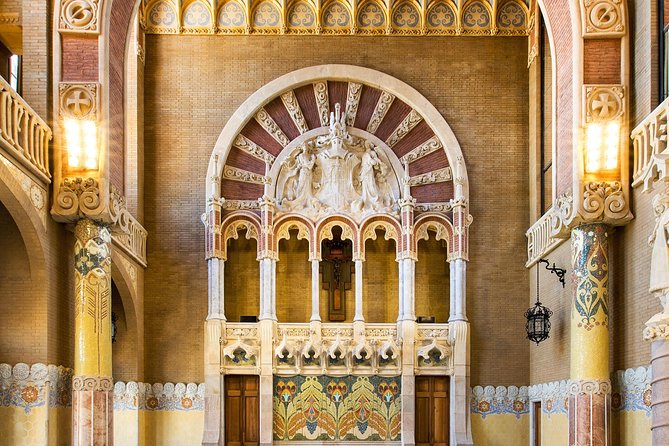
Your visit begins at the Administration Pavilion, where you show the mobile ticket and receive directions for the self-guided route. The prepaid ticket gives you a firm entry reservation, which is useful during busy periods. One practical detail is worth noting: the ticket is for admission only. Food, drinks, and a guide are not included.
The first exhibition area introduces Sant Pau’s medical and architectural story. An interactive touch table and video presentation help explain how the hospital developed and why Domènech i Montaner designed it in this way. If you know little about the site before arriving, this introduction gives the rest of the visit more meaning.
The presentation is useful, but do not expect a live guide to frame the experience for you. You need to read the displays and follow the printed material or map. English information is available, and the paper guide can help you get your bearings faster than simply wandering from building to building.
Sant Salvador Pavilion and the hospital’s long story
The Sant Salvador Pavilion is one of the key stops. Its exhibition traces the Hospital de la Santa Creu i Sant Pau from its founding in 1401 into the 21st century. That long timeline matters because the Modernisme buildings are only one chapter in the institution’s story.
You learn how an older hospital tradition developed into the complex you see today. The site was still used as a hospital in the 1990s, a detail that gives the restored rooms a stronger connection to recent history. This was not an abandoned fantasy building that never served its purpose. It was a working place of care for generations.
On the upper floor, a contemporary installation takes the form of a dragon. It honors Domènech i Montaner and his role in Catalan Modernisme. The piece adds a modern note to the historical exhibition and reminds you that Sant Pau is not frozen in one period.
If you enjoy architecture, this pavilion provides useful context before you examine the decorative details outside. If you are mainly interested in medical history, it helps explain how treatment and hospital design changed over time.
The pavilions, gardens, and decorative details
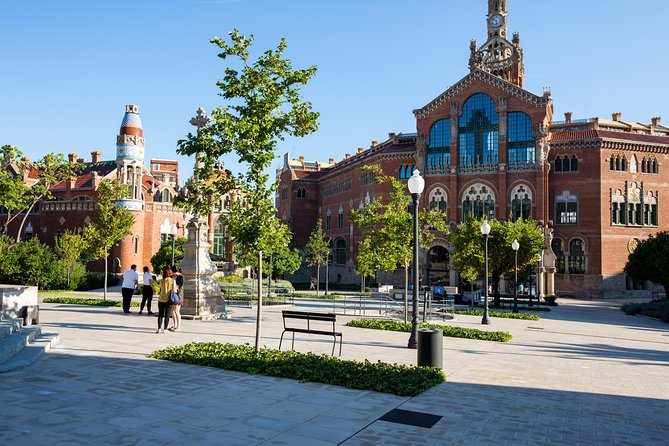
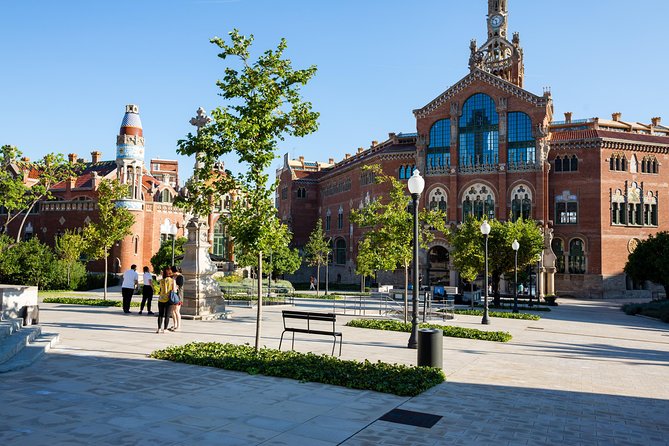
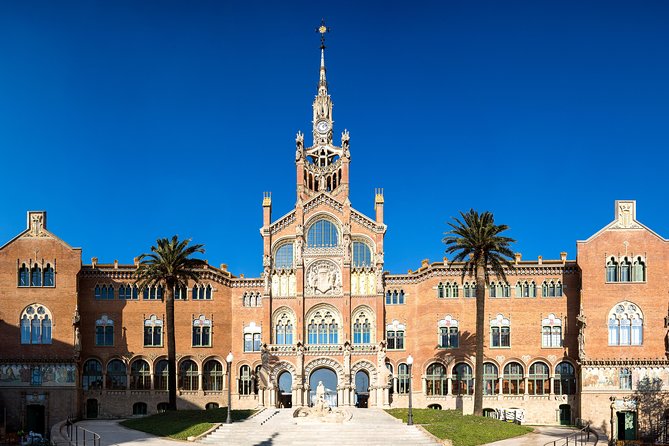
The real pleasure of Sant Pau comes from walking outdoors between the buildings. Look up as you go. Stained glass, ceramic tiles, sculptures, carved details, and colorful domes appear on nearly every pavilion. The tile work remains one of the site’s strongest features, especially when you see how carefully the restored surfaces have been maintained.
The gardens give the complex breathing room. Paths connect the pavilions, and the open setting makes the visit feel calmer than many central Barcelona attractions. You can stop to study the façades without being pushed along by a large tour group.
The gardens also help you understand the original hospital plan. The pavilions were separated rather than packed into one block, giving patients and staff a more pleasant setting. You can appreciate the beauty first, then recognize that the layout had a practical purpose.
Take your time with the exterior details. A quick walk can make Sant Pau seem like a collection of pretty buildings. A slower visit reveals repeated symbols, carefully planned color, and a strong connection between the buildings and their setting.
A different sort of day out in Barcelona:
- Barcelona: Casa Batlló Entry with Self-Audioguide Tour
★ 4.7 · 25,359 reviews - Barcelona: 24 or 48-Hour Hop-On Hop-Off Bus Tour
★ 4.4 · 20,872 reviews - Barcelona: Park Guell Guided Tour with Skip The Line Entry
★ 4.7 · 17,563 reviews - Barcelona in 1 Day: Sagrada Familia, Park Guell,Old Town & Pickup
★ 5.0 · 13,541 reviews
Underground tunnels and the old Surgery Room
The underground tunnels are among the most memorable parts of the visit. They link the pavilions and were used to move patients between buildings. The tiled passageways show how the hospital’s grand appearance was supported by a practical network below ground.
The tunnels also change the scale of the complex. From the gardens, the pavilions may seem separate. Below them, you see the connections that made the hospital function as one institution. This is one reason I would not rush through Sant Pau in less than an hour.
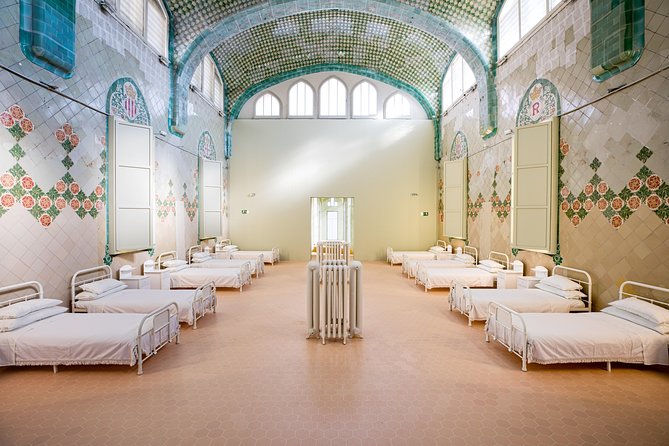
The restored Sant Rafael Pavilion adds another perspective. Along with the old Surgery Room, it brings the medical side of the site into focus. You are not only looking at mosaics and stained glass. You are also seeing spaces linked to treatment, surgery, and daily hospital work.
The old Surgery Room may be especially interesting if you like social history or the development of medicine. It is a reminder that Sant Pau’s beauty was always tied to a serious purpose. The contrast between ornate decoration and clinical function gives the visit its character.
The grand interior rooms
The Lluís Domènech i Montaner Room, Pau Gil Room, and Main Hall provide some of the most formal interior spaces on the route. These rooms help show how the complex balanced public function with ceremony and display.
The Main Hall is a good place to slow down and examine the architectural details. The Pau Gil Room adds another named space to the route, while the Domènech i Montaner Room connects the buildings directly to the architect responsible for the design.
The restored interiors can be easier to appreciate with narration. An audio guide is not included with the admission ticket, but it can be rented at the entrance for €4. Several parts of the visit are self-explanatory, yet an audio tour can help connect the rooms, symbols, and hospital plan.
If you prefer to read at your own speed, the printed guide and translated displays may be enough. If you want a stronger explanation of what you are seeing, budget for the extra audio fee. That small cost may be worthwhile, especially if this is your main Modernisme visit of the day.
Ending at the Sant Jordi Pavilion
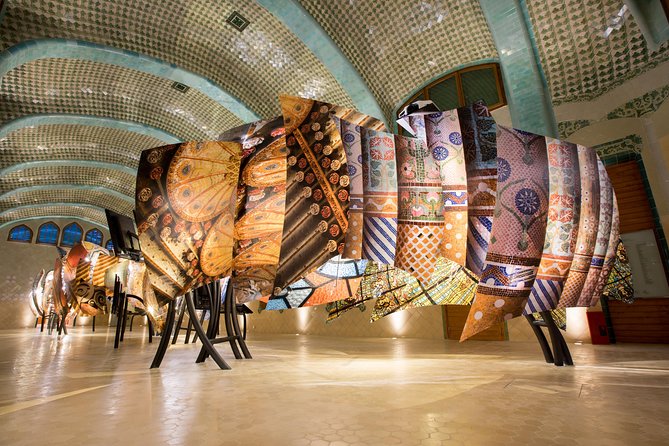
The Sant Jordi Pavilion hosts rotating temporary exhibitions. Its contents can change, so the appeal here depends partly on what is showing during your visit. It works as a final stop because it adds a changing cultural element to a site otherwise focused on the hospital and its architecture.
Do not treat the temporary exhibition as the sole reason to buy the ticket. The main value is the complex itself, including the pavilions, gardens, tunnels, and restored rooms. Think of Sant Jordi as an added stop rather than the centerpiece.
How much time you need
The stated visit length is about 1 to 2 hours. I would allow at least 90 minutes if you want to see the main buildings, read the displays, and walk the tunnels without hurrying.
A fast visit can cover the principal route in about an hour. That pace gives you the broad picture but leaves less time for mosaics, gardens, and interior details. Two hours gives you room to pause, use the audio guide, and return to any pavilion that catches your eye.
The site is large, but it does not require a full day. That makes it easy to pair with other central Barcelona sights. Its location near Sagrada Família is particularly convenient. You can visit both Modernisme landmarks in the same part of the city, though you should give each enough time to avoid turning both into rushed photo stops.
Is the $21.78 ticket good value?
At $21.78 per person, this is not a bargain-basement attraction, but it offers more than a single room or façade. Your ticket covers access to a substantial complex with exhibitions, gardens, tunnels, restored pavilions, and historic rooms.
The value is strongest if you care about architecture, Barcelona’s Modernisme movement, medical history, or unusual adaptive reuse. You also get the freedom to set your own pace. There is no fixed group schedule, and you can linger over the tile work or move quickly through material that interests you less.
The price is harder to justify if you only want a quick look at the exterior. The grounds and buildings are the reason to go inside, so make sure you have enough time to explore beyond the entrance. A special event can also affect the visit. One visitor arrived during an influencer event and found several areas blocked off, so temporary closures are a consideration.
The prepaid ticket has another advantage: it protects your entry during busy periods. Some people may find an on-the-day ticket at the door, but prebooking removes that uncertainty. The ticket can be canceled for a full refund up to 24 hours before the start time, while later cancellations and changes are not accepted.
Getting around and practical comfort
Sant Pau is on Sant Antoni Maria Claret in central Barcelona and is close to public transportation. A hop-on hop-off bus stop is directly outside, which makes the site easy to add to a sightseeing day.
The mobile ticket keeps arrival simple. You show the ticket at the front desk, where staff process your admission. The site is generally suitable for most people, and service animals are allowed.
The route includes stairs, and access to lifts may not always be straightforward. If you have bad knees or find stairs difficult, ask about lift access when you arrive rather than assuming every part of the route will be effortless.
Weather can affect comfort. Much of the experience is outdoors in the gardens and between pavilions, while the indoor areas provide relief during heat or rain. Seats are available in some interior areas, and air conditioning can make a difference on a hot day.
Who will enjoy Sant Pau most
I would choose Sant Pau for you if you want a quieter architectural visit that goes beyond Barcelona’s best-known façades. It suits people who enjoy mosaics, tile work, stained glass, gardens, historic interiors, and the practical story behind a building.
It is also a good choice if you have already seen Sagrada Família and want another major work by a Catalan Modernisme architect. The two sites feel different. Sagrada Família is a single monumental church, while Sant Pau is a working hospital complex spread across pavilions and gardens.
Families with older children may appreciate the tunnels and the unusual idea of a hospital designed as a small garden community. Medical history fans will find the old surgery area and treatment displays worthwhile. Architecture fans should plan to linger outside, where much of the finest detail appears.
You may want to skip it if you dislike self-guided museums, need constant direction, or have only a few minutes between other appointments. The route is not perfectly signposted, and a self-guided visit requires some attention. An audio guide improves the experience, but it adds €4.
Should you book the Sant Pau entrance ticket?
Book it if you want a substantial, calm, and visually striking Barcelona sight with a clear connection to medicine and city history. The restored buildings, gardens, tunnels, and tile work give you plenty to see for the price, and the prepaid entry is useful during busy periods.
Before you go, set aside 90 minutes, download your mobile ticket, and decide if you want the €4 audio guide. Start with the Sant Salvador exhibition, follow the route through the tunnels and pavilions, and save time for the gardens and exterior details.
I would not choose this ticket simply to collect another famous building. Choose it because you want to understand how a hospital could be both highly practical and remarkably beautiful. For that kind of visit, Sant Pau is one of Barcelona’s most rewarding stops.
FAQ
How long does the Sant Pau visit take?
The visit takes approximately 1 to 2 hours. Allow closer to two hours if you plan to read the exhibitions, use the audio guide, and spend time in the gardens.
Is a guide included with the ticket?
No. The admission ticket includes entry to Sant Pau Recinte Modernista, but it does not include a guide. An audio device can be rented at the entrance for €4.
Is an audio guide available?
Yes. An audio guide is available for an additional €4. It is not included with the prepaid admission ticket.
Can I use a mobile ticket?
Yes. The experience provides a mobile ticket, which you show when you arrive at the front desk.
Is the attraction close to public transportation?
Yes. Sant Pau is near public transportation, and a hop-on hop-off bus stop is directly outside the complex.
Are service animals allowed?
Yes. Service animals are allowed.
Can I cancel for a refund?
Yes. You can cancel at least 24 hours before the experience start time for a full refund. Cancellations or changes made less than 24 hours before the start time are not accepted for a refund.
Recently added around Barcelona
- Montserrat very early : Hiking, Abbey, very small group★ 5.0 · 127 reviews
- Guided Private Yacht Tour in Barcelona Spain★ 5.0 · 6 reviews
- Private Tour from Barcelona to Montserrat (with guide)★ 4.5 · 6 reviews
- Private Tour from Barcelona to Costa Brava (with guide)★ 5.0 · 5 reviews
- Andorra Tour★ 4.0 · 7 reviews
- Barcelona Gaudi Tour: Sagrada Familia, Casa Batllo & Casa Mila★ 5.0 · 4 reviews
- Street Art, Sculptures & Crime Stories Walking Tour – Barcelona★ 5.0 · 11 reviews
- Wine Tasting in Barcelona (Catalan Varieties) Small Groups★ 5.0 · 10 reviews
Tickets, compared.


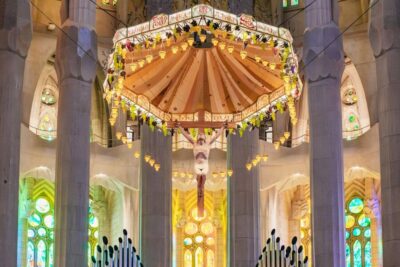
Sagrada Familia Skip-the-Line Entry Ticket & Tour
Read our review →
FC Barcelona Museum “Barça Immersive Tour” Ticket
Read our review →
Park Guell Guided Tour with Skip the Line Ticket
Read our review →
Park Guell and Sagrada Familia Tour with Skip the Line Tickets
Read our review →
Park Güell and Gaudí House Museum Entry Ticket
Read our review →